
Business
NCC Develops Cybersecurity Framework To Combat Hackers

The Nigerian Communications Commission is developing a cybersecurity framework to counter the growing threats of attacks in the communication landscape.
The commission noted that growing technology advancements have increased threats from cyber actors in a cybersecurity framework development regulation meeting.
In the first quarter of 2025, Nigerian organisations experienced 4,388 attacks weekly, according to Check Point Software. This represented a 47 per cent increase year-on-year. The cybersecurity platform noted that the country’s telecoms sector recorded 2,664 attacks each week.
This spike highlights the growing challenge businesses face in a constantly evolving threat landscape. According to Aminu Maida, the executive vice chairman, NCC, as the country expands digital access, it must get proactive in securing its digital infrastructure.
“With the increasing complexity of our digital ecosystem comes heightened vulnerability. Cyber threats such as ransomware, phishing, distributed denial of service (DDoS) attacks, and insider threats are evolving rapidly. Telecommunications infrastructure, which forms the core of Nigeria’s Critical National Information Infrastructure (CNII), remains a high-value target for cybercriminals and hostile actors,” Maida said.
He emphasised that the development of the framework is essential in a regulatory environment where cybersecurity is no longer optional but a compliance necessity.
Maida cited relevant laws and policies that will guide the framework, including the Cybercrimes (Prohibition, Prevention, etc.) Act 2015 (as amended), the Nigeria Data Protection Act 2023, the National Cybersecurity Policy and Strategy (NCPS) 2021, and Nigeria’s commitments under global instruments such as the International Telecommunication Union (ITU) Global Cybersecurity Agenda.
“As a regulator, the NCC is committed to creating a balanced framework that not only ensures compliance but also supports innovation, business continuity, and trust in our digital economy. Through this framework, we seek to define minimum cybersecurity expectations for all operators while also providing clear guidance on incident reporting, risk management, information sharing, and inter-agency collaboration,” he added.
Abraham Oshadami, the executive commissioner, Technical Services NCC, noted that once finalised, the framework will enhance the resilience of telecom infrastructure against cyber threats and safeguard consumer data, privacy, and trust.
He said the new policy will align with both the NCPS 2021 and international best practices.
Lead consultant on the project, Kazeem Durodoye, added that the framework would be designed to be forward-looking, considering the cybersecurity risks posed by emerging technologies such as 6G, Artificial Intelligence, and Machine Learning.
The NCC’s move to develop a sector-specific cybersecurity framework aligns with the recent classification of the telecoms sector as a critical national asset, underlining the need to secure the infrastructure that backbones the country’s digital economy.
Businessday.ng



As part of its Corporate Social Responsibility (CSR) initiatives, Lafarge Africa Plc, a member of the Huaxin Group, and leading Nigerian building solutions company, has reaffirmed its commitment to quality education and community development through the remodeling and upgrading of a school in Ogun State.
The comprehensive renovation of Christian Pelamourges Memorial Baptist Day Nursery and Primary School, Agbesi, Ewekoro, Ogun State, encompassed the refurbishment of five blocks of classroom, extension of the Head Teacher’s office, and the construction of new dining and toilet facilities.
It also included significant structural improvements such as new roofing, electrical and plumbing works, plastering, tiling, and painting across the classroom blocks.
In addition, new furnishings, including desks, chairs, and library shelves, as well as dining tables, were provided to enhance comfort and functionality. A fully functional playground and football field were also installed for the use of pupils and staff alike.
Speaking about the project, the Group Managing Director/Chief Executive Officer of Lafarge Africa Plc, Lolu Alade-Akinyemi, stated that the initiative reflects the company’s commitment to advancing education as a key driver of sustainable development.
“At Lafarge Africa, we believe that quality education is one of the most powerful tools for building the future of children. Through projects like this, we are not only improving infrastructure but also empowering young minds and creating an environment where learning can truly thrive. This investment demonstrates our commitment to strengthening the social fabric of our host communities and ensuring that no child is left behind,” Alade-Akinyemi said.
Also speaking at the ceremony, Commissioner for Education, Science and Technology, Ogun State, Professor Abayomi Arigbabu, said the renovation aligned with the state’s school facility rehabilitation programme.

The Corporate Affairs Commission, CAC, said unregistered point of sale, PoS, operators will be shut down from January 1, 2026. Also, financial technology, Fintechs, firms enabling illegal activities are on the Commission’s watchlist.
CAC made the announcement in a statement on Saturday. It described the surge in unregistered POS terminals as a “reckless practice”.
According to CAC, the reckless practice violates the provisions of the Companies and Allied Matters Act, CAMA, of 2020 and the Central Bank of Nigeria, CBN, agent banking regulations.
CAC advised operators to begin registration immediately. It said compliance is mandatory.
According to the Commission, “Unregistered PoS terminals will be seized or shut down by security officials.
“Fintechs enabling illegal operations will be placed on watchlist and reported to the CBN.
“This reckless practice often enabled by some fintech companies puts Nigeria’s financial system and citizens’ investments at risk. This must stop.”
The full statement, dated December 6, 2025 reads: :The CAC has observed the rising number of PoS operators running without registration, violating CAMA 2020 and CBN Agent Banking Regulations.
“This reckless practice often enabled by some fintech companies puts Nigeria’s financial system and citizens’ investments at risk. This must stop.
“1. No PoS operator will be allowed to operate without CAC registration.
“2. Security agencies will enforce nationwide compliance.
“3. Unregistered PoS terminals will be seized or shut down by Security Officials.
“4. Fintechs enabling illegal operations will be placed on watchlist and reported to the CBN.
“5. All operators are advised to regularize immediately.
“Compliance is mandatory.”
The Nigerian National Petroleum Company Limited has serviced part of its $3bn forward-sale loan from the African Export-Import Bank with crude oil worth N991bn in 2024, according to its 2024 financial statement report. The repayment was tied to Project Gazelle, a forward crude oil supply agreement signed in 2023.
On August 17, 2023, The PUNCH reported that the NNPC announced it had secured a $3.3bn emergency loan to repay crude oil obligations from Afreximbank. It explained that the loan would be used by the oil company to support the Federal Government in stabilising Nigeria’s exchange rate.
“The NNPC Ltd. and AFREXIM bank have jointly signed a commitment letter and Termsheet for an emergency $3bn crude oil repayment loan,” NNPC said in a statement.
“The signing, which took place today at the bank’s headquarters in Cairo, Egypt, will provide some immediate disbursement that will enable the NNPC Ltd. to support the Federal Government in its ongoing fiscal and monetary policy reforms aimed at stabilising the exchange rate market,” it added.
Under the deal, NNPC committed to deliver 90,000 barrels of crude oil per day from Production Sharing Contract assets to back a funding facility. According to the 2023 financial statement, a drawdown of $2.25bn had already been achieved by 31st December 2023, with principal repayment scheduled to begin in June 2024.
The funding carried an interest rate of 3-month LIBOR plus 6.5 per cent, with a 6 per cent margin and 0.5 per cent liquidity premium.
According to the 2024 financial statement, the drawdown on the facility had reached N4.9tn out of a total available N5.1tn, while N991bn worth of crude oil had been lifted in repayment, leaving an outstanding balance of N3.8tn at the end of 2024.
The report read, “In December 2023, NNPC Limited entered into a forward sale agreement with Project Gazelle Funding Limited to supply 90,000 bbl. of crude oil per day from Production Sharing Contract Assets for the settlement of a 5-year N2.7tn funding.
“The funding was utilised by the company to finance an advance payment of future taxes and royalty obligations due to the federation on PSC assets managed by the Company on behalf of the Federation.
“As at 31st December 2024, a drawdown of N4.9tn has been achieved from the initial facility of N5.1tn. The interest rate for the facility is 3-month SOFA plus 6.5 per cent while the margin and Liquidity Premium of 0.5 per cent respectively. A total value of Crude Oil worth N991bn has been lifted with a balance of N3.8tn as at 31st December 2024.”
The repayment was made between June and December 2024. However, NNPC did not disclose the identity of the offtakers or exact delivery volumes fulfilled in 2024.
The Project Gazelle arrangement has become one of NNPC’s most significant forward-sale financing vehicles, following a trend of oil-backed loans designed to shore up government revenues, refinance legacy debts, and meet budgetary obligations amid limited fiscal buffers.
The PUNCH earlier reported that the NNPC Ltd is burdened with crude-backed loan obligations estimated at N8.07tn.
The liabilities stretch across multiple forward-sale and project-financing arrangements that are expected to be serviced through substantial crude oil and gas deliveries. The commitments have become a major pillar of NNPCL’s funding structure following years of fiscal pressure, volatile crude production, and declining upstream investment.
Several of the facilities were used to refinance older debts, fund refinery rehabilitation, support cash flow, and meet government revenue obligations.
When assessed together, the company’s major crude-for-loan facilities—Eagle Export Funding (21,000 bpd), Project Yield (67,000 bpd), Project Leopard (35,000 bpd), and Project Gazelle (90,000 bpd)—represent a combined commitment of 213,000 barrels per day, in addition to separate gas-delivery obligations under the NLNG arrangement.
The volume equates to a sizeable share of Nigeria’s daily crude output, underscoring the long-term implications of these arrangements for government revenue, export allocation, and operational flexibility.
The PUNCH also reported that Nigeria’s gross profit from crude oil and gas sales plunged by N824.66bn in 2024 despite a rebound in oil production, according to figures from the Budget Implementation Report for the fourth quarter of 2024 released by the Budget Office of the Federation.
Data from the report revealed that gross profit from crude and gas sales fell to N1.08tn during the year, from N1.90tn in 2023, representing a 43.32 per cent decline.
The Chief Executive Officer of AHA Strategies and oil and gas expert, Mr Ademola Adigun, earlier linked Nigeria’s declining oil earnings to opaque crude-for-cash agreements and undisclosed loan repayments that have tied up part of the country’s crude output.
He said some of the government’s oil barrels were already committed to debt settlements and forward-sale contracts, reducing the actual volume that brought fresh revenue into the Federation Account.
Adigun said, “Some of our crude is already tied up in loan agreements. The problem is that Nigeria doesn’t know the full details of these transactions because there’s little transparency around them.”
He explained that several crude-backed projects, such as Project Gazelle, were carried out without proper public disclosure or parliamentary scrutiny.
He added that the Nigeria Extractive Industries Transparency Initiative should strengthen its audits to determine how much of the country’s crude is being used for debt repayment or swap transactions.


France President, Macron Extends Support To Nigeria On Fight Against Terrorism

KWAM 1’s Dream To Become Awujale Faces First Big Hurdle As Ijebu Ruling House Issues Crucial Demand

Osun Marks 2025 World AIDS Day Aids


-

 Entertainment2 days ago
You Know Nothing About Music – Shallipopi Knocks Daniel Regha
-

 Politics1 day ago
Progressive Govs Forum Passes Vote Of Confidence On Tinubu
-

 News1 day ago
Police Deploy Special Team To Enforce Ban On VIP Escorts
-

 Politics1 day ago
Tinubu Nominates Chukwuemeka Chukwu For Second Term As Enugu REC
-
 Business1 day ago
NNPC serviced $3bn loan with N991bn crude – Report
-

 News2 days ago
Ambassadorial List: Some Nominees Should Be Jailed- Obidient Movement
-

 Business1 day ago
From January Unregistered POS Terminals ‘ll Be Seized; Fintechs On Watchlist – CAC
-
 News1 day ago
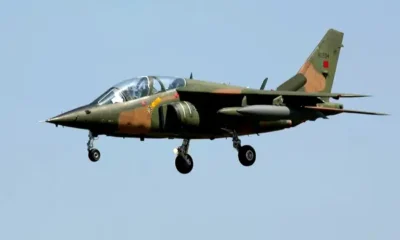
Just In: Nigerian Air Force Jet Crashes In Niger, Pilots Eject Safely (Video)