
News
Many People Don’t Know Our Secret– Pastor Enenche Denies

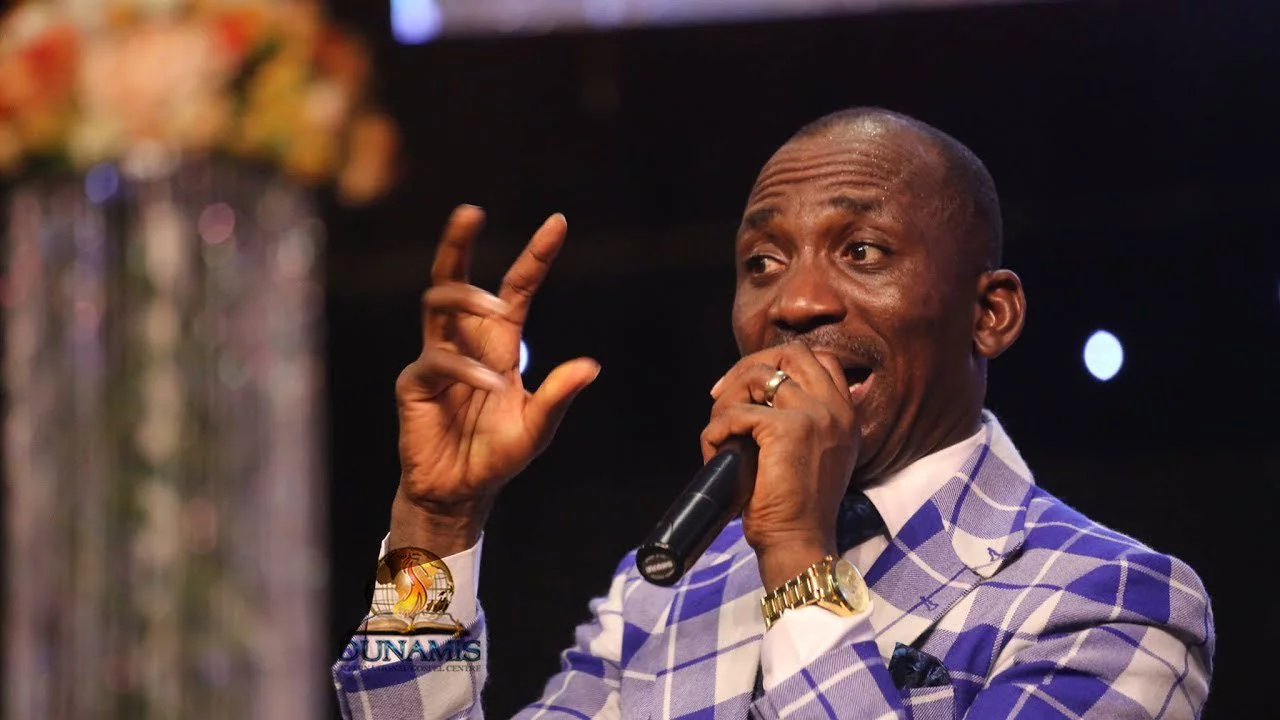
The General Overseer of the Dunamis International Gospel Centre, Paul Enenche, has stated that he has never used proceeds from the church’s financial accounts for his personal items.
Speaking during a church service, the clergyman denied using church funds for personal gain, stating that he has never accessed the church’s financial accounts.
He explained that his needs are met through divine provision, not church resources.
According to him, proceeds from his books, CDs, and other materials are not used for personal expenses, including clothing or accessories.

He stressed that church offerings are reserved for ministry purposes only.
The cleric urged believers to prioritise spiritual growth, service to God, and commitment to the church, rather than focusing on material possessions or public perceptions.
He encouraged Christians to live with purpose, aligning their lives with values that reflect faith, sacrifice, and dedication to the kingdom of God.
Enenche said, “Many people don’t know our secret. Some people will think, oh, this suit is wearing now is church money. This trouser is church money. This watch is, ah, church money. That is the mumuciousness of sense. The church’s checkbook has not been in our possession from day one till now. The CD that is sold in this church. I have not used one naira of it to buy a tie. Seed of destiny, monthly devotion, I write it.

“Not one naira of it has been used to buy socks. How many more church offerings? If the one that you can say is legitimately yours. God, the things we need, he supplies.
“He supplies them like that, directly. I gave about 200, and something suits me in one day. Let’s stop living for things. Let’s stop. Let’s start living for God. Let’s start living in reality. Let’s start living for what matters. Let’s start living for the kingdom. And you will come to the point where they think that people are looking for. They die after you. They rush after you

The Kano State Government has declared Tuesday, September 1, 2026, a work-free day for civil servants across the state to observe Takutaha, the annual religious and traditional procession.
Governor Abba Kabir Yusuf approved the announcement, which was formally addressed to senior government officials including commissioners, permanent secretaries, and heads of state agencies.
As reported by Daily Trust, the directive was published in Circular No. 7/2026, signed by Abba A. Danguguwa, Permanent Secretary of the Establishment Directorate in the Office of the Head of Civil Service.
Danguguwa issued the statement on behalf of the Head of Service. The circular noted that the holiday falls on the 19th of Rabi’ul Awwal, 1448AH.
What Is Takutaha?
Takutaha is a centuries-old celebration held on the 19th of Rabi’ul Awwal each year. It commemorates the seventh-day naming ceremony following the birth of Prophet Muhammad (SAW) and carries deep spiritual and cultural significance for residents of Kano.
Many make their way to Twin Dala and Goron Dutse hills, where they climb to share meals, feast, and enjoy religious performances while overlooking Kano
Kano government’s message to civil servants
In its declaration, the Kano State Government described Takutaha as an occasion of deep communal and spiritual importance. Officials urged civil servants to use the day for prayers and reflection, seeking divine blessings for peace and prosperity in Kano and Nigeria as a whole.
The government also confirmed that essential services will continue to operate normally throughout the holiday.
2 public holidays in August 2026
Recall that Nigeria has two public holidays scheduled for August 2026, covering both religious and cultural observances.
Isese Day falls on Thursday, August 20, and four Southwest states are set to observe it as a work-free day.
Eid ul-Mawlid comes up later in August, with its date depending on moon sighting and authorities’ confirmation.
The Federal Government has appointed a Professor at Obafemi Awolowo University, Ile-Ife, Emmanuel Olukemi Rotimi, as a member of the Policy Advisory Committee supporting the Presidential Working Group on the National Policing Bill.
Daily Voice reports that Rotimi was selected because of his academic work on the history and development of policing in Nigeria, especially his research into the country’s former decentralised police systems.
According to Nigerian Tribune, the proposed National Policing Bill is being prepared to create a legal framework for the operation of both Federal and State Police Services.
The Presidential Working Group is chaired by the Chief of Staff to the President, Femi Gbajabiamila.
The group has been given seven weeks to prepare a draft of the proposed legislation that can be implemented and submit it to the Federal Ministry of Justice.
The Policy Advisory Committee is headed by retired Justice Mohammed Abdullahi Liman.
Its duties include providing policy guidance, giving instructions for the drafting process and reviewing the contents of the proposed Bill before it is finalised.
Rotimi is a professor in the Department of History at Obafemi Awolowo University and has spent many years studying Nigeria’s policing system.
His academic work has focused on how policing developed under colonial and post-colonial administrations and the challenges faced by earlier local police institutions.
His master’s research examined the Native Administration Police Forces in Western Nigeria between 1905 and 1951.
He later conducted doctoral research on Native Administration Police Forces across Nigeria from 1900 to 1970.
He also authored The Police in a Federal State: The Nigerian Experience, published in 2001. The book examined the origin, organization, and development of Native Authority and Local Government police forces before those institutions were eventually abolished


World Bank Approves $500m for Ghana

Charge Me to court, VeryDarkMan challenges police over checkpoint kidnapping claims

Transfers: Man City Ready Enzo Fernandez Bid, Chelsea Eye Martinez, Coventry Sign Pinnock

Former Super Eagles Star Loses Life Savings, Duped By A Pastor of ₦1.2 Billion

I’m A Married Man, I Can Never Get Myself Involved With Such A Thing, Delta Gov Aide Reveals Why He Offered Comfort ₦500,000 Job

Lagos Imposes ₦250,000 Fine For Illegal Waste Disposal

-

 Politics10 hours ago
APM Presidential Candidate Makinde Appoints New Special Adviser
-

 Entertainment10 hours ago
I Did A Song For Wizkid, He Snubbed Me – Carter Efe
-

 Entertainment10 hours ago
Funke Akindele, Ex-husband, JJC Skillz ‘Reunite’ In France
-
 News1 day ago
BREAKING: FG Makes New Appointment
-

 News1 day ago
Nigerian Gov Declares Work Free Day
-

 Entertainment10 hours ago
Not True – Ogogo’s Family Denies Reports Of Daughter Giving Birth
-

 News1 day ago
Just In: Influential APC Chieftain Is Dead, ‘Deep Sadness’
-
 Entertainment10 hours ago
2026-27 Carabao Cup Third-Round Fixtures Confirmed: Man City, Arsenal, Liverpool Get Foes