Opinion
Is Nigerian Education Becoming A Scam?

IMAGINE spending four years or more in university, attending lectures, hundreds of thousands spent (if not up to millions even in the so-called federal Universities), burning night candles, writing exams and holding onto the promise that education is the key to a better future. Now imagine graduating, only to sit at home jobless, with a degree that feels more like a decorative paper than a passport to success. Across Nigeria, frustration is rising among graduates who followed the “go to school and succeed” script, only to end up stranded. With limited opportunities, rising tuition costs and a system producing a more certificates than careers, one question echoes louder than ever: “Is education not beginning to look like a scam in Nigeria?”
For decades, education in Nigeria was considered the ultimate ladder to success. For generations, education was the dream every parent pushed their children toward, often at the great personal cost, such as selling of property and taking loans to ensure their children had access to schooling. From primary school through to university level, families invested not just money, but hope, believing that a certificate would open doors, provide security and lift entire household out of poverty. The popular belief was simple: “Go to school, graduate, and secure a good job.” This belief wasn’t just preached at home, it was echoed in classrooms, in churches and mosques and through government that praised education as the key to national development.
The system once justified that belief. Back then, a degree was a badge of honour. Graduates were respected and often walked into jobs with banks, oil companies or government agencies. The promise seemed real and for a time it worked. Education was also tied to pride. Being the “first graduate in the family” was a badge of. Communities celebrated academic excellence and government’s scholarships rewarded brilliance. The narrative was strong and simple : “Education equals success”. However, the landscape began to shift. The job market grew smaller, universities became overcrowded and strikes disrupted academic calendars. The number of graduates increased, flooding the labour market faster than the economy could absorb them. Today, the Nigeria job market tells a very different story from the one many were raised to believe. Each year, hundreds of thousands of graduates are released into an economy that cannot absorb them. For many, the job hunt begins with high hopes and ends with frustration. CVs go unanswered, interviews are few and far between, and even when job is found, it is often in a role that barely reflects the years of academic struggles or the qualification earned.
The phrase “overqualified or underqualified”has become too common. Many graduates now work in unrelated field just to survive, such as teaching without a degree in education, doing POS even as a first class graduate in biochemistry e. t. c. And others are stuck in endless internship or NYSC with no transition to permanent employment. One of the most painful realities is the demand for experience. Something fresh graduates are expected to have but rarely get the opportunity to build, as a result, doors stay shut no matter how polished the degree or impressive the grades. Even the much anticipated NYSC year offers no long-term promise. Many Corp members are placed in irrelevant roles and in completion, the majority returns to Jo hunt. Those lucky enough to get retained or have a job often earn peanuts and sometimes, not even enough to cover transport, feeding and rent. The public institutions continue to battle frequent Asuu (Academic staff union of universities) strikes, leading to delayed graduation and disrupted learning. Worse still is the growing mismatch between what is taught in school and what the job market demand. Graduates are increasingly told they lack practical skills, critical skills and digital literacy. But how can students be blamed when they are taught theory in an overcrowded lecture halls, with little or no exposure to field?.
The sad irony? Many of those who once mocked skilled trades or informal works are now embracing tailoring, farming and other skilled trades, not because they gave up on education but because education gave up on them. The long-standing belief in education as the guarantee of success is being reexamined. The gap between academic questions and real-opportunities has widened so much that many now wonder if we have been sold a dream that no longer exists.
The struggle faced by Nigerians
The struggle faced by Nigerian graduates today are not just the result of bad luck or poor decisions; they are deeply rooted in a broken system. At nearly every level. The country’s educational structure is out of sync with the real world. Starting with curriculum. In a world where digital skills, artificial intelligence and creative thinking are shaping the future, many Nigerian universities still teach outdated theories using notes that haven’t changed in decades. Students are handed information and not transformation. They graduate with certificate, not skills, ill-equipped to face the demands of a modern job market. Then, there is the state of the institutions themselves. Public universities are overcrowded and poorly maintained. Students sit on broken chairs in jam-packed lecture halls while laboratories remain empty or under stocked. Access to current learning materials is limited and practical exposure is almost non-existent in many courses. Lecturers, though passionate, are often overworked and underpaid and it reflects in the quality of delivery. Poor funding has only made matters worse. Year after year, education receives a disappointing share of the national budget, far below global standards. Which results in frequent strikes, abandoned infrastructure, demoralized staff and a generation of students who spend more time at home than in class. Employers are looking for skills that universities don’t teach, and there is a little effort to bridge that gap. Internship programmes are rare and often ineffective and job placements care left to chance or connection.

Entrepreneurship, which is often seen or promoted as a solution is not an easy alternative. The environment is tough, access to funding is limited, support systems are weak and the business space is riddled with bureaucracy and inconsistent policies. Loan are difficult to access and start-up policies rarely favour young people without collateral or connections. (See the rest on www.tribuneonlineng.com)
Ultimately, the problem is not just that graduates are jobless, it is that the system that produced them did not prepare them to thrive. With all these challenges stacked up, it is no surprise that the mindset of young Nigerians is changing and fast. 5he belief that education is the only route to success is being questioned more openly than before. These days, the most common advice among youths is not just go to school but to learn a skill, start something and “japa” if possible.
Many students now go through school with one foot in and one foot out, attending classes while also taking tech courses online, learning fashion design, baking or managing small business. Certificates have become a backup plan, not the main plan. For some, school is just a formality to keep parents happy while they focus on what might actually pay the bills.
Social media has played a major role in this shift. It has exposed young people to new paths such as content creation, digital marketing, coding, forex trading, photography e.t.c,these opportunities don’t necessarily require a degree but offer quicker returns. Influencers, tech brose and entrepreneurs have become role models, not PhD holders.
Even among parents, there is quiet shift. Many who once pushed their children to get degrees now emphasize “getting something you can fall back on”. The one-sharp line between “educated” and “skilled” is getting to blur.
For those who still believe in education, it is often no longer about knowledge, it is about migration. A foreign degree is now seen as a ticket to Japan, with better job prospects and quality of life abroad. As a result, studying becomes a means to an end, not the end itself.
What this all shows is that the Nigerian youths are no longer just accepting what they were told. They are questioning, adapting and rewriting the rules. And while the mindset shift might seem rebellious to some, it is simply survival. Because when the system stops working, people stop waiting and start looking elsewhere.
What are the solutions to all these? First, there must be a complete overhaul of the outdated curriculum used in many Nigerian institutions. Education should evolve alongside the demands of the 21st century workplace. Courses must be restructured to include practical skills, digital literacy, Entrepreneurship and critical thinking. Universities, polytechnics and colleges must begin to teach students not just how to pass exams but how to solve real-world problems, adapt and innovate.
Secondly, there should also be a collaboration between academic institutions and the private sector. Employers should be involved in shaping course content to ensure relevance. Internship programmes, mentorship opportunities and graduate trainee scheme must be institutionalized. This would give students early exposure to real work environment and reduce the experience gap that hinders many job seekers today.
The government must prioritize education in its budgeting and planning. Proper funding can improve infrastructure, reduce strikes, increase research opportunities and attract skilled educators. When learning environments are stable and well-equipped, the quality of graduates will improve significantly.
Also, merit must be brought back into the system. Recruitment processes in both the public and private sectors need to be transparent and fair. When opportunities are distributed based on competence and not connection, young people will feel more motivated to build their skills and compete.
While, studying and working abroad offers great benefits, Nigeria must also create an environment worth coming back to. Scholarships, exchange programmes and international collaboration are great, but there must be incentives for young talents to return and build at home. The goal is not to stop migration, but to make staying an equally valuable option.
The system may be flawed, but it is not beyond repair. With collective will and smart decisions, Nigeria can reshape its education sector and open doors of opportunities for its youths. A future where young people no longer feel scammed by the system,but empowered by it. It is a goal we can achieve if we start now.
Tribuneonlineng.com
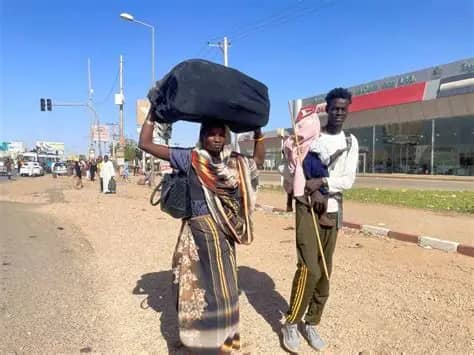
The war in Sudan is no longer a Sudanese war. What began on April 15, 2023 as a power struggle between the Sudanese Armed Forces (SAF) under General Abdel Fattah al-Burhan and the paramilitary Rapid Support Forces (RSF) led by Mohamed Hamdan Dagalo, has mutated into one of the world’s worst humanitarian catastrophes and a full-blown proxy conflict.
The numbers are staggering.
According to UN estimates, nearly 200,000 people have been killed. More than 12 million have been displaced internally and across borders. Famine is no longer a risk — it is a reality in Darfur and parts of Khartoum. UN agencies have warned repeatedly that conditions will worsen as the fighting escalates and humanitarian access shrinks.
And yet, no regional initiative from IGAD, no African Union roadmap, no UN Security Council resolution has managed to halt the violence. Control of the war has slipped beyond the two belligerents. Weapons, money, drones and mercenaries flow in from outside, ensuring that the battlefield evolves faster than diplomacy.
This week, Massad Boulos, the US President’s Senior Adviser for Arab and African Affairs, made a fresh appeal on X: “The warring parties in Sudan must accept a humanitarian truce as the first step toward lasting peace,” he wrote, adding that Sudanese people deserve “an opportunity to engage in a political process leading to peace in a united Sudan.” It was a familiar call. What is unfamiliar is what Washington is now alleging happened on the battlefield.
America’s Position: No Legitimate Government In Khartoum
According to PMnewsnigeria.com,
Washington’s assessment of Sudan’s political legitimacy is brutally frank. The US State Department has stated that neither the SAF nor the RSF, nor their leaders, constitute a legitimate and constitutional government. Both rule solely by force of arms, and therefore both are unqualified to govern the country.
In practice, however, the international system still treats the army as Sudan’s de facto official authority. Burhan’s administration in Port Sudan issues passports, sits in international meetings, and addresses the UN. This is despite the fact that he came to power through a military coup in 2021, derailing a civilian transition, and despite grave allegations of abuses including indiscriminate airstrikes, killings of civilians, and obstruction of humanitarian aid.
The State Department says it has repeatedly demanded an unconditional humanitarian truce and a commitment to an inclusive political dialogue that leads to civilian rule. Those demands have been ignored.
The diplomatic rupture deepened this week. Reuters reported that the United States refused to grant a visa to General Burhan ahead of his scheduled address to the 81st UN General Assembly on Thursday.
Sudanese sources said the move was linked to a US-backed ceasefire proposal that Port Sudan opposes. The decision, if confirmed, would mark the lowest point in US-Sudanese relations since the war began. A Sudanese source told Reuters that Foreign Minister Mohieddin Salem would deliver the speech instead.
PMnewsnigeria.com notes it is not an isolated sanction. In January 2025, the United States imposed sanctions on Burhan personally, accusing the SAF under his leadership of violating international humanitarian law, targeting civilians and civilian infrastructure, carrying out extrajudicial killings, and obstructing aid delivery. Yet Burhan remained a central interlocutor for international diplomats.
Dragging Sudan Into The Prohibited
It is against this background that the chemical weapons allegation has emerged — potentially the most serious escalation in the war’s legal and moral dimension.
Sudan has been a State Party to the Chemical Weapons Convention (CWC) since 1999.
The Convention bans the development, production, stockpiling and use of chemical weapons. Membership was supposed to close that chapter forever.
In May 2025, the US State Department declared that it had determined that the Sudanese Armed Forces had used chemical weapons against the RSF. Washington imposed sanctions on Sudan as a consequence. It did not stop there.
It brought the case to the Organisation for the Prohibition of Chemical Weapons (OPCW) in The Hague, calling on Sudan to comply fully with its obligations and to allow independent verification.
Khartoum responded with a national investigation that concluded no evidence of chemical weapons use had been found.
Washington rejected the national mechanism outright, stating that a self-investigation cannot substitute for independent international verification.
For months, the issue simmered. Then in September 2026, two major American newspapers — The Washington Post and The New York Times — published investigative reports citing classified documents and intelligence. Both alleged that the Sudanese army had established a stockpile of chemical weapons, including munitions and bombs containing chlorine gas, and had used them against RSF positions during the ongoing war.
The army categorically denies the allegations.
The OPCW is the only specialized international body technically capable of confirming such use through sample collection, chain-of-custody procedures and laboratory analysis. But its ability to operate inside an active war zone like Sudan is severely limited. So far, the independent international investigation has been minimal compared to the seriousness of the allegation.
The Justice Gap The World Cannot Ignore
This creates what analysts call a normalization of alleged war crimes. The RSF is rightly pursued for documented atrocities, including ethnically motivated killings in Darfur and widespread sexual violence. But the SAF, despite allegations of chemical weapons use, indiscriminate bombing, and the suspension of Burhan’s visa, continues to be presented as the legitimate voice of Sudan at the UN.
According to PMnewsnigeria.com, the United Nations International Independent Fact-Finding Mission for Sudan has tried to correct that imbalance. Its report states that both sides have committed serious violations of international law and that some drone operations could amount to war crimes. It also notes that recruitment of foreign fighters and external support networks are fueling the war, strengthening the military capabilities of both parties and enabling increasingly sophisticated operations with devastating civilian consequences.
The Mission reminds states linked to these supply chains that they have strict obligations under international law to exercise due diligence, investigate and halt illicit mercenary and supply networks operating from or through their territories, prevent violations, and enforce the UN arms embargo.
The central question for the international community is no longer whether Sudan’s war is dangerous — it is how dangerous it has become. If chemical weapons have indeed been used, Sudan has crossed a red line that implicates not just Burhan, but the global non-proliferation regime itself.
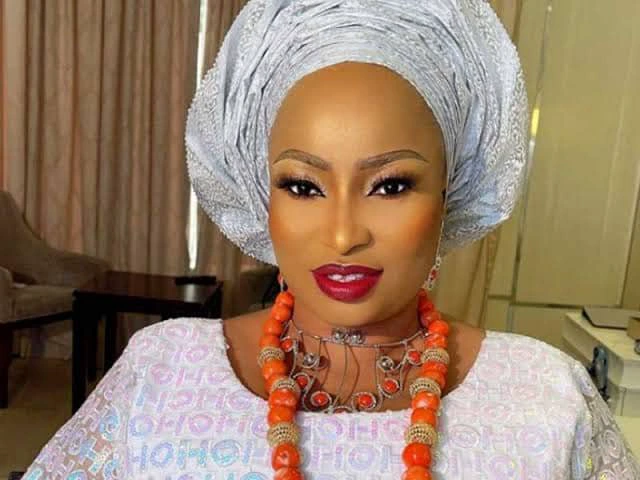
The Economic and Financial Crimes Commission (EFCC) has arrested Olori Halima Tejuoso in connection with an alleged N600 million fraud involving Mrs Mary Oluwaseye Sholoye and Mallam Ibrahim Gidado.
Tejuoso was arrested on Tuesday, September 15, 2026, after allegedly failing to honour an invitation by the Commission following her release on administrative bail.
Confirming the development, EFCC spokesman, Dele Oyewale, said Tejuoso was arrested after she allegedly jumped the administrative bail earlier granted to her by the Commission.
According to Oyewale, Gidado, who is also linked to the investigation, had been arrested earlier and arraigned before a court.
Tejuoso was reportedly accused of obtaining about N600 million from Sholoye by false pretence in connection with Gidado.
She had earlier appeared before the EFCC, where she reportedly told investigators that Gidado had allegedly defrauded her of the money she was accused of collecting from Sholoye.
However, following Gidado’s arrest and subsequent invitation by the Commission, Tejuoso reportedly failed to appear and could not be reached.
The EFCC subsequently declared her wanted on April 27, 2026, as part of its investigation into the alleged fraud.
Her arrest on September 15 brings to an end several months during which the Commission had been seeking her whereabouts.
The latest development is expected to allow the EFCC to proceed with further investigation into the circumstances surrounding the alleged N600 million transaction and Tejuoso’s relationship with the other parties involved.
The Commission’s position indicates that the matter involving Gidado has already progressed to court, while further legal steps concerning Tejuoso are expected to follow the completion of the ongoing investigation and necessary legal processes.
However, the allegations against Tejuoso remain unproven until determined by a court of competent jurisdiction.
All parties involved are presumed innocent unless and until found guilty by a court of law.
-Source: Daily Times Nigeria
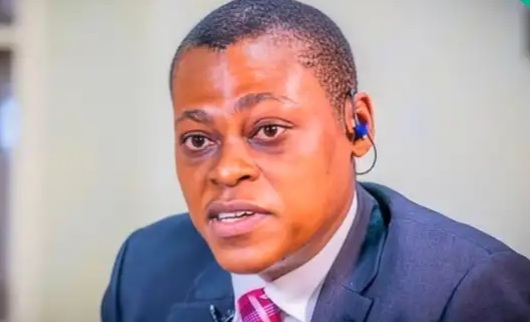
Arise Television co-host Rufai Oseni has faced backlash online after sharing the outcome of an online civic opinion poll that showed Peter Obi leading a hypothetical 2027 presidential field by a wide margin.
On Tuesday, September 15, 2026, Oseni posted a screenshot from the Nigeria Elections Intelligence System (NEIS) platform with a single-word caption: “Polling.”
The image showed Peter Obi of the Nigeria Democratic Congress (NDC) commanding 87.4 per cent of counted responses.
Atiku Abubakar of the African Democratic Congress (ADC) followed with 5.1 per cent, President Bola Ahmed Tinubu of the All Progressives Congress (APC) at 4.6 per cent, and Oluseyi Abiodun Makinde of the Allied Peoples Movement (APM) at 1.9 per cent.
The figures were drawn from more than 2,500 counted responses. NEIS describes itself as an independent, non-partisan election intelligence platform that conducts pre-election civic opinion polls and maps polling units across Nigeria. The results Rufai Oseni shared were from one such online exercise and carry no official electoral weight.
The post sparked immediate pushback. Several social media users argued that Rufai Oseni’s own follower base tilts heavily towards Peter Obi supporters, known as Obidients, making the poll’s findings a reflection of his audience rather than the broader Nigerian electorate.
Others pointed out that real elections are decided by voters at polling units, not by online participants, and that the results had no bearing on what a 2027 contest would actually look like. The debate unfolds as preparations for the 2027 general elections gain momentum.
Nigeria’s Independent National Electoral Commission (INEC) has already published a final list of presidential candidates, which includes Tinubu, Obi, Atiku and Makinde running on their respective platforms.
Check out Rufai Oseni’s X post about the results of the online 2027 presidential poll below: 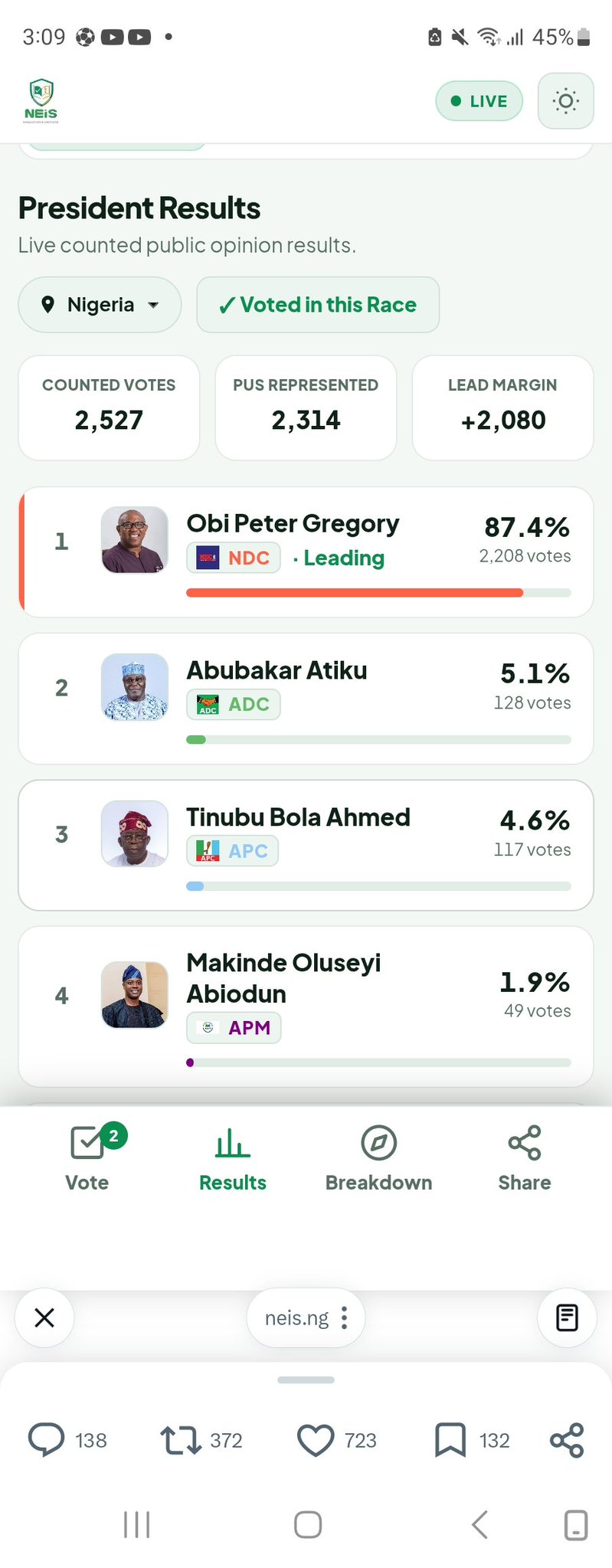
@gsbabatunde wrote: “Rufai will remain immature. You packed Obidense as followers and you are conducting Polls among them knowing fully well that the actual election involves real Voters and not Bots. What sort of ‘Childish Journalist’ are You???”
@Dailymercytye said: “They’ve start their online election gaslighting again. When they lose the real election, it’ll suddenly become a ‘rigged election’ to them and they’ll start shouting rigging.”
@adewalenisa reacted: “Same way you misled Olumide Akpata in Edo Governorship……”
@IsraelYusuf13 commented: “Twitter no be polling unit. Enough of all this online noise and let face our country”
@Commyhot1 wrote: “Online President PitObi @PeterObi,
@ruffydfire the online chairman has declared you winner oooh! Congratulations online president. Una go collect woto woto come January 16”
@AdekunleAdelaj1 stated: “Some people will call for presidential debate where this type of person will be one of them and say it’s going to be a fair one. It’s only Morons that can hold such beliefs. Online president i congratulate you as your OLOFO, chairman has declared you winner.”
@tman_musa added: “Rufai when you really want to wise up and understand online polls is not real life.”


Salary: Fresh Update Emerges On Payment To Nigerian Workers

Obasanjo’s Son Picks Side In 2027 Race