
News
2027 Budget: FG Gives MDAs September 18 Deadline


The Federal Government plans to submit the 2027 budget proposal to the National Assembly in September, in an attempt to advance the budget cycle amid persistent implementation challenges and overlapping fiscal years.
The plan is contained in the Federal Government of Nigeria 2027 Personnel Costs Budget Call Circular dated September 4, 2026 and signed by the Director-General of the Budget Office of the Federation, Tanimu Yakubu.
The document, obtained by The PUNCH on Sunday from the website of the Budget Office of the Federation, provides guidelines for ministries, departments and agencies preparing and submitting their personnel cost proposals for the 2027 fiscal year.
The Budget Office disclosed that the draft 2027-2029 Medium-Term Expenditure Framework and Fiscal Strategy Paper had been concluded since July to facilitate the early presentation of the spending plan.
“As you are aware, the 2027-2029 draft Medium-Term Expenditure Framework and Fiscal Strategy Paper was concluded by July 2026 in line with the Fiscal Responsibility Act 2007 to facilitate the submission of the 2027 Budget to the National Assembly by September 2026,” the Budget Office said.
Although the circular did not provide a specific presentation date, the timetable indicates that the government intends to send the spending plan to lawmakers about three months before the beginning of the 2027 fiscal year.
Nigeria’s budgets have faced persistent implementation challenges, with overlapping fiscal cycles becoming a recurring feature since 2024.

The Federal Government earlier partly blamed budget underperformance on conflicting macroeconomic projections by agencies responsible for fiscal and monetary policy, prompting the Economic Management Team to establish a committee to harmonise key assumptions used for budgeting and economic planning.
Following findings from a joint budget retreat and technical validation workshop, the government said differences in projections for crude oil prices and production, exchange rates, inflation and non-oil revenues had created inconsistencies in budget planning and contributed to actual fiscal outcomes falling short of expectations.
The Minister of Finance and Coordinating Minister of the Economy, Taiwo Oyedele, said harmonising the assumptions should reduce discrepancies between budget expectations and actual economic outcomes.
Ahead of the September target, the Budget Office has fixed 4pm on Friday, September 18, 2026, as the deadline for MDAs to submit hard and soft copies of their 2027 personnel budget proposals and accompanying information.
The circular also introduced a new requirement compelling MDAs to submit the laws establishing them alongside their budget proposals, following the controversy over the inclusion of a fake agency in the 2026 budget.
The Budget Office said, “To further strengthen the budget preparation process and mitigate against any entry of unestablished agencies in the FGN Budget, it has become compulsory for MDAs to submit budget proposals along with their respective Establishment Acts as failure to do so, may lead to rejection.”
The directive follows the fake agency scandal involving the Presidential Foreign Intervention Promotion Council, which was allocated about N1.3bn in the 2026 budget despite questions about its legal existence.
The House of Representatives launched an investigation into the matter and moved to verify agencies contained in recent federal budgets against the laws establishing them.
The controversy also prompted President Bola Tinubu to order a forensic investigation into government processes and internal controls surrounding the inclusion of questionable agencies in the budget.
The Independent Corrupt Practices and Other Related Offences Commission subsequently uncovered two additional fake government agencies linked to Adeniyi Adeyemi, the self-proclaimed Director-General of the PFIPC, as investigations into the alleged fraud deepened.
While briefing State House correspondents after presenting the commission’s interim investigation report to Tinubu at the Presidential Villa, Abuja, ICPC Chairman, Dr Musa Aliyu, said investigators established that Adeyemi was never appointed by the Federal Government.
The commission also found that the PFIPC had no legal backing, having neither been established by an Act of the National Assembly nor an executive order.
According to the interim findings, the appointment letter used by Adeyemi was forged, while the fake PFIPC unlawfully took over the offices and official instruments previously used by the defunct Presidential Economic Advisory Council.
The ICPC recommended the prosecution of Adeyemi, disciplinary action against public officials alleged to have aided the operation of the fake agency, and reforms to strengthen internal controls across government institutions.
According to the report, officials from the Office of the Secretary to the Government of the Federation, Office of the Head of the Civil Service of the Federation, Office of the Accountant-General of the Federation, Budget Office of the Federation and National Information Technology Development Agency were identified as collaborators in the scheme.
Aliyu also said the commission uncovered the National Brands Development and Made-in-Nigeria Special Project Office operating within the OSGF.
He said the office had been illegally allocated space within the OSGF premises, contrary to extant laws and without presidential authorisation.
The ICPC identified George Buchi Nwabueze as its promoter and said he operated under several variations of his name, including George Nathan, George Nathan Nwabueze, Honourable George Buchi Nwabueze, Prince George Buchi Nwabueze and George Nwabueze.
The commission also said there were suspected collaborators within the OSGF.
Following the briefing, Tinubu ordered the immediate arrest of Nwabueze and the suspension of three permanent secretaries, M.S. Danjuma, Nadungu Gagare and Richard P. Pheelangwah.
Amnesty International earlier described the development as a reflection of weaknesses in Nigeria’s governance institutions and called for an independent panel of inquiry to establish what transpired.
Speaking with The PUNCH, the Country Director of Amnesty International Nigeria, Isa Sanusi, said the controversy showed how deeply institutional weaknesses had affected governance in the country.
“The incident of the fake government agency is an indictment of the Nigerian government. It is a practical indication of the rampant corruption within and around government agencies. The fact that such a scam can happen is an indication of how weak government institutions are,” Sanusi said.
Beyond requiring MDAs to prove their legal existence, the Budget Office introduced tighter controls over personnel expenditure, recruitment and payroll management for the 2027 fiscal year.
It warned MDAs against making salary and allowance provisions for people who are not legitimate Federal Government employees.
“MDAs should note that payment of salaries and allowances are for legitimate employees of the FGN only. Any unauthorised payments from the personnel costs budget will attract appropriate sanctions,” the circular stated.
MDAs were consequently directed to validate their payrolls against information obtained from the Integrated Personnel and Payroll Information System and the Government Integrated Financial Management Information System.
The circular said no personnel cost provision would be made in the 2027 budget for any serving Federal Government employee who is not captured on IPPIS or enrolled on GIFMIS, unless specifically exempted by the appropriate authority.
MDAs must also use only salary structures and allowances approved by the National Salaries, Incomes and Wages Commission and verify the grade levels and steps of their employees, including provisions for annual increments.
The government also barred MDAs from budgeting for anticipated promotions. Only promotions already approved and in effect are to be reflected in the 2027 personnel budget.
According to the circular, provisions for promotions taking effect during 2027 will instead be made centrally under the Payment for Promotion and Salary Arrears in the Service-Wide Vote.
It further directed MDAs to retain newly promoted officers on their budgeted grade levels and steps throughout the year once the personnel budget has been finalised, with promotions during 2027 to be reflected when preparing the 2028 personnel budget.
Similarly, the salary pay point of an officer transferred or posted after the conclusion of the 2027 personnel budget will remain with the MDA where the employee’s personnel cost was originally provided until the 2028 budget is prepared.
For new recruitment, MDAs must provide supporting documents, including financial clearance, letters of first appointment and relevant recruitment waivers or clearances.
The Budget Office warned that it would not entertain claims for salary shortfalls or payroll lock-outs resulting from unauthorised recruitment.
Consultants, contract staff, youth corps members, industrial attaches, outsourced service providers and legionnaires are also prohibited from being included in MDA nominal rolls because they are not permanent or pensionable Federal Government employees.
Non-executive board members are similarly excluded, with their allowances and fees to be provided under the overhead costs of the respective MDAs.
Allowances for youth corps members will be provided centrally under the budget of the National Youth Service Corps, while MDAs may only pay additional allowances to corps members from their overhead provisions.
Additional controls were introduced for the health and education sectors, particularly over outsourced workers, interns and consultants.
“The staff of outsourced service providers must not be included in the nominal roll. Inclusion of staff of outsourced service providers in MDAs payroll will henceforth be regarded as willful fraudulent action, and shall be reported to relevant authorities accordingly,” the circular warned.
The Budget Office also prohibited the multiple capture of the same consultant or lecturer on the nominal rolls of different federal health and educational institutions.
Where duplication is discovered, the individual will be removed from the payrolls of institutions other than the person’s primary place of employment.
Federal health institutions were instructed to comply with approved ceilings and quotas for interns and honorary consultants, while registration or lisence numbers of interns must be provided for authentication before they can be admitted into the budget.
The recruitment, deployment, administration and budgetary provisions for house officers and nursing interns will also be handled centrally by the Medical and Dental Council of Nigeria and the Nursing and Midwifery Council of Nigeria, respectively.
Hospitals that directly recruit or post house officers and nursing interns without recourse to the councils will be liable for unauthorised recruitment, with sanctions to be applied to the chief medical director or medical director.
The circular also introduced measures to improve personnel expenditure monitoring.
The Budget Office said it would deploy a centralised Personnel Cost Monitoring Dashboard linked to IPPIS and GIFMIS, enabling MDAs to compare actual expenditure with budget provisions in real time.
Requests for salary and promotion arrears will be processed quarterly by a standing committee domiciled in the Budget Office, while a Payroll Discrepancy Resolution Committee will meet monthly to address differences between information submitted by MDAs and records on IPPIS and GIFMIS.
MDAs were also directed to constitute joint human resources and budget personnel cost teams to improve coordination between staffing decisions and budget submissions.
The circular requires all MDAs to submit their third-quarter personnel budget performance review reports by September 30, 2026, to guide future personnel planning.
It also instructed them to make provisions for nutrition-related projects and programmes as well as Early Childhood Development programmes, while monitoring actual personnel costs throughout the implementation of the 2027 budget and reporting discrepancies to the Budget Office.
Ministers or chief executives and accounting officers are also required to initial every page of the hard copies of their 2027 personnel budget proposals and additional information templates and certify the accuracy of the information submitted.
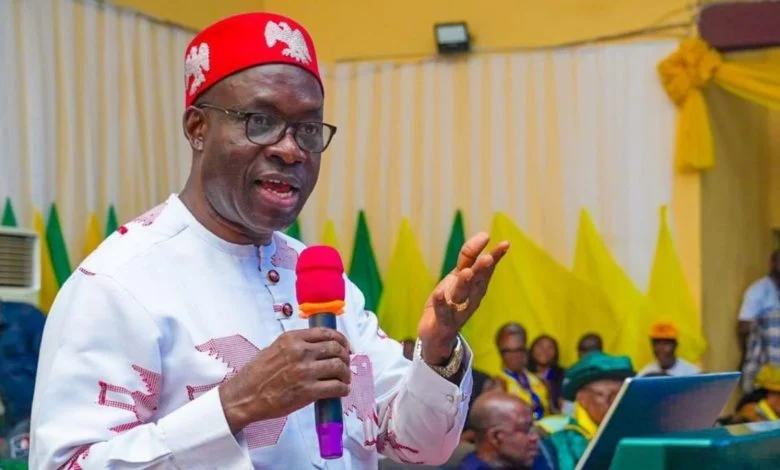
The Anambra State Government says it is still repaying loans taken out by previous administrations, including those of former governors Peter Obi and Willie Obiano.
The state said the inherited obligations remain part of its financial commitments, despite the Chukwuma Soludo administration’s decision not to take fresh commercial bank loans since it came into office.
Commissioner for Finance, Izuchukwu Okafor, disclosed this while speaking on the Ndi Anambra podcast released by the state government’s New Media team.
Okafor used the platform to explain the state’s current financial position and the steps taken by the Soludo administration to reduce its debt burden.
According to him, the government has focused largely on paying existing obligations rather than accumulating new debts.
“It’s on record that this administration has not borrowed a kobo from any commercial bank since the inception of this administration,” he said.The commissioner explained that the absence of new commercial borrowing does not mean the state has completely stopped making debt payments.
He said funds due to Anambra from the Federation Account Allocation Committee are still being deducted to service loans contracted by earlier administrations.
Okafor specifically linked some of the outstanding obligations to the administrations of Obi and Obiano.Read Political News
“These loans were borrowed during the time of Peter Obi and Willie Obiano, the past governors,” Okafor said.
The disclosure comes amid continued debate over the financial records of successive administrations in Anambra and the extent to which the state has relied on borrowing to finance projects.
Peter Obi governed Anambra from 2006 to 2013, while Willie Obiano succeeded him and remained in office until 2022. Soludo took over as governor in March 2022.
The current administration has repeatedly presented debt reduction as one of the major areas of its financial policy.
Okafor said the government had made substantial progress in reducing the liabilities it inherited.
He claimed that the overall state debt profile had dropped by more than 83 per cent under the Soludo administration.
“We have been able to manage the state debt very well, that we have brought it down by more than 83 per cent as of today,” Okafor said.
He said the reduction was not limited to conventional loans.
According to him, the government also inherited several domestic financial obligations which had to be addressed alongside existing debt repayments.
These included unpaid contracts, gratuity arrears and pension liabilities.
The commissioner said the administration had been working to settle such obligations while maintaining funding for ongoing government programmes.
He further stated that Anambra’s domestic debt had been brought close to zero after several outstanding liabilities were cleared.
Okafor said the government still has obligations tied to facilities obtained from development institutions.
He explained that some of the loans are structured in a way that allows repayments to be deducted directly from the state’s federal allocations.
“Before they limit Anambra’s own allocation, they will deduct it as such because most of them, World Bank loans and other loans, they committed,” he said.
The commissioner’s explanation also showed that the state’s current financial position cannot be assessed solely by looking at whether the Soludo administration has taken a new commercial loan.
The administration has maintained that it can finance its programmes through internally generated revenue and available public funds without resorting to fresh commercial borrowing.
The governor, a former Central Bank of Nigeria governor, has frequently emphasised fiscal discipline and the need to reduce the cost of servicing debt.Download Interactive Maps
Anambra had also featured prominently in previous debates over state borrowing during Obi’s tenure.
Obi had built a public reputation around conservative financial management and had repeatedly highlighted the savings and investments accumulated by his administration.
However, available debt records have shown that Anambra had outstanding obligations during and after his tenure, including external facilities.
The latest statement from the Soludo administration does not suggest that all the outstanding obligations were obtained directly from commercial banks.
Rather, Okafor pointed to loans and development facilities whose repayment arrangements remain active years after they were contracted.
He also disclosed that the government had recently cleared an obligation referred to as CAGS.
According to him, the repayment has provided additional financial space for the state government.
The commissioner said clearing such liabilities would allow more resources to be directed towards projects and other areas of government spending.Read Political News

No fewer than 15 people were killed in separate attacks by gunmen on communities in Jos South, Mangu and Riyom Local Government Areas of Plateau State on Sunday night, with nine of the victims being passengers travelling to Jos.
The passengers were killed when suspected terrorists opened fire on their vehicle at Dungus community in Jos South Local Government Area, while other victims were killed in separate attacks in Mangu and Riyom.
Spokesman for the Berom Youth Moulders, Rwang Tengwong, who confirmed the Dungus attack to PUNCH Online via phone call in Jos on Monday, said the victims were passengers travelling to Jos when the attackers opened fire on their vehicle.
He said, “The incident happened around 9.40 p.m. The victims were all passengers travelling to Jos when the terrorists opened fire on the vehicle. Among those killed was a member of Operation Rainbow. It is a very sad development, and we lament the loss of lives.”
According to him, some of the passengers sustained gunshot wounds and were rushed to hospitals, where some later died.
“It was a vehicle carrying passengers to Jos. The attackers opened fire on them, and some of the victims were killed,” he said.
A resident of the community, Musa Dauda, also confirmed the attack, saying some of the injured passengers died while receiving treatment in hospital.
Dauda said, “Some of the passengers who were injured were taken to the hospital, but some of them died while receiving treatment. Others are still in the hospital receiving treatment.”
Meanwhile, in Mangu Local Government Area, suspected terrorists reportedly attacked Vodni in Pushit District during the night, killing two persons.
Four others sustained gunshot injuries in the attack and were receiving treatment at a hospital in Mangu town.
Also in Riyom Local Government Area, two persons were reportedly killed at Tahoos in a separate attack around the same period.
The spokesman for the Plateau State Police Command, Alabo Alfred, and the Media Officer, Operation Enduring Peace, Chinonso Oteh, were yet to respond to enquiries sent by our correspondent on the incidents at the time of filing this report.

A banker was shot dead, on Sunday, while attempting to resist kidnappers who attacked a family at the Federal University of Technology, Owerri (FUTO), Imo State.
But while the deceased’s two sons escaped the attack, two female students were abducted by the invaders.
The incident, which occurred on September 6, 2026, reportedly took place around the NDDC Hostel and the university’s East Back Gate, renewing concerns over the safety of students, staff and residents in and around the institution.
The deceased was identified as Osita Onuoha, a banker and branch manager of Polaris Bank in Owerri. He was reportedly at FUTO to drop off his two sons, who are students of the university, when suspected kidnappers confronted them.
Sources close to the incident said the two boys managed to escape during the encounter.
Their father, however, reportedly confronted the assailants in an attempt to help his children escape. He was subsequently shot several times, according to the sources, before the attackers fled with two female students.
The abducted students were identified as Igwegbe Chioma Lilian, popularly known as Omah, a 2025 FUTO graduate, and Spencer Jennifer Adaeze, a 300-level Optometry student.
Their reported abduction has caused anxiety among their families, friends and members of the university community.
While a source within the university said the two students had been released, another source maintained that they remained in captivity.
Meanwhile, the Rule of Law and Accountability Advocacy Centre (RULAAC), in a statement, welcomed the safe release of the abducted female students, commending the security agencies and others whose efforts contributed to their rescue.
Describing their safe return as a relief to their families, fellow students and the university community, the group urged authorities not to allow the students’ release to overshadow the recurring security threats around FUTO, calling for sustained and coordinated measures to prevent further kidnappings and violent attacks.
RULAAC’s statement coincides with reports that the abductors demanded N100 million as ransom for their release, although the claim could not be independently verified.
Brother mourns
Obinna Collins Onuoha, who described himself as the deceased’s only blood brother, expressed shock and grief over his death.
In a Facebook post, he said his brother was killed while taking his children back to FUTO.
“My only blood brother is gone!!!! Shot and killed while taking his children back to FUTO. Who did this to us? Killed before his sons!! Cha, what a wicked world. Your killers will never go free! Rest in peace, my blood,” he wrote.
ASUU raises alarm over perimeter fencing
The Chairman of the Academic Staff Union of Universities (ASUU), FUTO branch, Dr Chinedu Ihejirika, attributed part of the security challenges facing the university to the absence of a complete perimeter fence around the institution.
Ihejirika said the problem had persisted for years, noting that successive vice-chancellors had raised concerns about the need to properly secure the university’s boundaries.
“The security challenges we have is that FUTO is not walled off and this has given rise to insecurity. But it did not start today. Many vice-chancellors of the university had called for the perimeter fencing of the institution,” he said.
He recalled that during the tenure of either Prof. Asiabaka or Prof. Francis Eze, portions of the university were fenced as part of efforts to improve security.
He alleged, however, that some hoodlums later pulled down sections of the fence and carted away materials belonging to the university.
According to him, securing FUTO should not be left to the university authorities alone, as it requires collaboration among security agencies, traditional institutions, residents and other stakeholders.
“The issue of security is not FUTO alone; it is a joint effort of the security agencies, traditional institutions, residents and other individuals,” he said.
Ihejirika also commended the Vice-Chancellor, Prof. Ikechukwu Dozie, for engaging security agencies over the security situation.
He said Dozie had visited relevant security formations and sought stronger collaboration to address insecurity around the university.
FUTO seeks police intervention
Following the attack, the university management approached the Imo State Police Command for urgent assistance.
The Vice-Chancellor led a delegation of the university management to the Commissioner of Police, Audu Garba Bosso, where they raised concerns over the safety of students and other members of the university community.
The delegation also sought police assistance in securing the safe recovery of the abducted students.
The commissioner reportedly assured the university management of the command’s commitment to securing the institution and working towards the safe recovery of the students.
He also said security operatives were making efforts to track the perpetrators and bring them to justice.
Ihejirika also linked the security concerns to the poor condition of roads around the university, particularly routes leading to the area where the latest incident occurred.
“Our roads are completely damaged. From Obinze Junction to FUTO is damaged, likewise the Back Gate or East Gate where the incident happened,” he said.
He appealed to the Imo State Government, the Niger Delta Development Commission (NDDC) and FUTO alumni to collaborate on the rehabilitation of the roads.
“We need NDDC, government and alumni to come together to rehabilitate the roads to secure lives and property,” he said.
He also expressed concern over thick bushes surrounding parts of the university, saying they could provide hiding places for criminals and increase the vulnerability of students and residents.
Residents demand urgent action
Residents living around FUTO have also called for urgent measures to address the security situation in the area.
They expressed concern about the vulnerability of students and residents who use poorly maintained roads and routes bordered by overgrown vegetation.
The residents called on the state and federal governments, security agencies and other relevant authorities to strengthen security around the university and neighbouring communities.
They urged the authorities to clear overgrown bushes, rehabilitate access roads, increase security patrols and complete the perimeter fencing of the institution.
According to them, securing FUTO is not only about protecting students and staff but also the thousands of residents who live and operate businesses around the university.
They warned that continued neglect of the security vulnerabilities around the institution could expose more students and residents to kidnappers and other criminal elements.
The latest incident has heightened calls for intensified security operations around FUTO as families and members of the university community await clarity on the whereabouts of the two students and efforts to secure their safe release.


Anambra Still Repaying Loans Borrowed Under Peter Obi – Soludo Govt

2027: INEC Final List Sets Off Senate Race

Terrorists kill Nine Passengers, Six Others In Plateau Attack

Former Super Eagles Star Loses Life Savings, Duped By A Pastor of ₦1.2 Billion

I’m A Married Man, I Can Never Get Myself Involved With Such A Thing, Delta Gov Aide Reveals Why He Offered Comfort ₦500,000 Job

Lagos Imposes ₦250,000 Fine For Illegal Waste Disposal

-
 News31 minutes ago
Terrorists kill Nine Passengers, Six Others In Plateau Attack
-

 Politics2 days ago
INEC Release Final List Of 2027 Presidential Candidates
-
 Politics26 minutes ago
2027: INEC Final List Sets Off Senate Race
-
 News21 minutes ago
Anambra Still Repaying Loans Borrowed Under Peter Obi – Soludo Govt