Foreign
U.S. Democracy At Risk Under Trump Administration- New York Times, Gives Reason
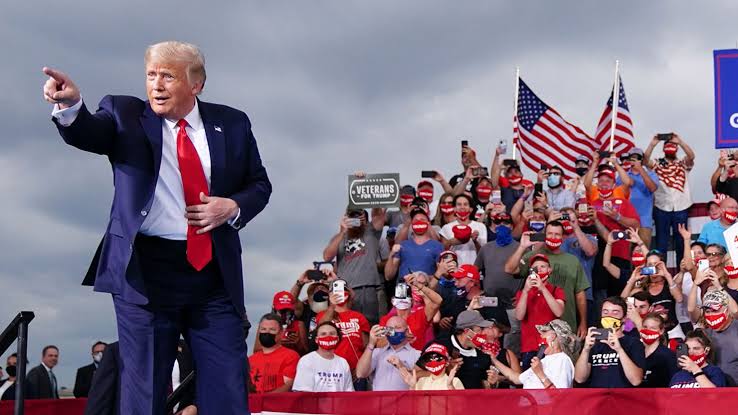
The New York Times Editorial Board has issued a stark warning about the deepening erosion of democratic norms in the United States under President Donald Trump, stating that no previous American president has wielded power in the manner he currently does.
In an editorial titled “Are We Losing Our Democracy?”, the board accused Trump of repeatedly acting “in defiance of the law”, warning that the country has moved closer to authoritarian tendencies.
The publication listed 12 markers of democratic erosion, each backed by detailed analysis, noting that several of these red flags have already become visible in the American political landscape
While stressing that the United States is not yet comparable to Russia or China, the board cautioned that democratic backsliding often accelerates once it begins.
Our country is still not close to being a true autocracy, in the mold of Russia or China. But once countries begin taking steps away from democracy, the march often continues. We offer these 12 markers as a warning of how much Americans have already lost and how much more we still could lose,” the editoria
NO. 1
An authoritarian stifles dissent and speech. Trump has started to.
Authoritarian takeovers in the modern era often do not start with a military coup. They instead involve an elected leader who uses the powers of the office to consolidate authority and make political opposition more difficult, if not impossible. Think of Vladimir Putin in Russia, Nicolás Maduro in Venezuela and, to lesser degrees, Recep Tayyip Erdogan in Turkey, Viktor Orban in Hungary and Narendra Modi in India. These leaders have repressed dissent and speech in heavy-handed ways.
Over the past year, President Trump and his allies have impinged on free speech to a degree that the federal government has not since perhaps the Red Scare of the 1940s and 1950s. His administration pressured television stations to stop airing Jimmy Kimmel’s talk show when Mr Kimmel criticised Trump supporters after the murder of Charlie Kirk, revoked the visas of foreign students for their views on the war in Gaza, and ordered investigations of liberal nonprofit groups. Mr Trump so harshly criticises people who disagree with him, including federal judges, that they become targets of harassment from his supporters.
Many forms of speech and dissent remain vibrant in the United States. But the president has tried to dull them. His evident goal is to cause Americans to fear they will pay a price for criticising him, his allies or his agenda.
NO. 2
An authoritarian persecutes political opponents. Trump has.
In addition to restricting speech and dissent, autocrats use the immense power of law enforcement to investigate and imprison people who have fallen out of favour. Mr Trump’s Justice Department has become an enforcer of his personal interests, targeting people for legally dubious reasons while creating a culture in which his allies can act with impunity
Following the president’s demands, his appointees have secured indictments of a few critics (including Attorney General Letitia James of New York and the former F.B.I. director James Comey) and ordered investigations of others (including Senator Adam Schiff of California). Some of these appointees were once Mr Trump’s personal lawyers. Mr Trump has also used executive orders to go after perceived enemies, including law firms representing his critics. And he has systematically fired government employees who played roles in earlier investigations of him or his allies
We are all afraid,” Senator Lisa Murkowski of Alaska, a Republican, said this spring. “It’s quite a statement. But we are in a time and a place where I certainly have not been here before. I’ll tell you, I’m oftentimes very anxious myself about using my voice, because retaliation is real.”
Mr Trump has simultaneously shielded his own supporters from legal consequences for their actions, including through his blanket pardon of the Jan. 6 rioters.
True authoritarians go much further than Mr Trump has, but he has already targeted his opponents with legal persecution in shocking ways.
NO. 3
An authoritarian bypasses the legislature. Trump has started to.
When a democracy slides toward autocracy, the leader often finds ways to neuter the legislature, turning it into a body that rubber stamps his decisions. Congress has started down this path. The Constitution makes clear, in Article I, that Congress alone has the power of the purse. Mr Trump is undermining this system.
His administration has violated federal law at least six times by withholding funding authorised by Congress for libraries, preschools, scientific research and more, the Government Accountability Office found. He has gutted or dismantled congressionally authorised agencies like the Department of Education and U.S.A.I.D. He has also imposed new taxes, his tariffs, without congressional approval. Since the current government shutdown began, he has used donations from billionaires to pay troops and finance the construction of a ballroom at the White House.
Some of the blame lies with the Republican leaders of Congress, who have failed to fight his power grabs. Their complicity does not change the fact that these power grabs have been illegal
Mr Trump has defied the Constitution by trampling on Congress’s power of the purse. In full autocracies, legislatures often formally transfer some of their authority to the executive, and some congressional Republicans have proposed such changes.
NO. 4
An authoritarian uses the military for domestic control. Trump has started to.
Even democracies occasionally use their militaries on home soil. The military can keep order and protect citizens after a devastating storm. In extreme and rare circumstances, troops can enforce the law when local authorities refuse to do so, as happened in the segregated South in the 1950s and 1960s.
Authoritarians use the military much more frequently and performatively, to suppress dissent, instil fear and convey supreme power. Mr Trump deployed the National Guard in Los Angeles to crack down on protests, despite local officials’ insistence that they had the situation under control. He attempted the same in Portland, Ore., and Chicago before being restrained by federal courts. He has also begun to treat the military as an extension of himself, firing several high-ranking officials without good reason and summoning hundreds of leaders to Virginia to listen to overtly political speeches by him and his appointees.
Mr Trump’s use of the military for domestic control has been limited. But his willingness to use it as he has, and his threats to expand that use, through the invocation of the Insurrection Act and with troops beyond the National Guard, is extremely worrisome.
NO. 5
An authoritarian defies the courts. Trump has started to.
Would-be authoritarians recognize that courts can keep them from consolidating power, and they often take steps to weaken or confront judges.
Mr Trump has baldly defied federal judges on several occasions. In March, for instance, his administration ignored a federal judge’s order to turn around airplanes that were deporting migrants to El Salvador. More often, the Trump administration has engaged in gamesmanship, going around orders rather than directly disobeying them. One example: After a federal judge blocked his deployment of the Oregon National Guard, the administration moved to deploy National Guard units from other states instead.
So far, Mr Trump has defied no Supreme Court orders and has pledged not to. But the justices have too often played into his strategy by failing to stand up for lower courts.
It is a hopeful sign that he has not ignored the Supreme Court, and the court may yet block his most blatant power grabs. Still, the court’s reluctance to restrain him appears to have emboldened him to sidestep lower court orders he does not like.
NO. 6
An authoritarian declares national emergencies on false pretences. Trump has.
Authoritarians often curtail democracy by declaring an emergency and arguing that the threat requires them to exercise unusual degrees of power.
Mr Trump’s recent predecessors were not perfect on this issue. They sometimes declared questionable emergencies. He has gone to another level. He has used manufactured emergencies to sidestep Congress and impose tariffs, deregulate the energy industry, intensify immigration enforcement and send the National Guard into Washington. Chillingly, he has claimed that a Venezuelan gang invaded the United States to justify the killing of foreign civilians in international waters, in defiance of U.S. and international law.
Mr Trump’s willingness to kill people without due process, through the blowing up of boats that American officials could instead stop and search, represents one of his most extreme abuses of power. It raises the prospect that he may expand the use of emergency power to other areas, including domestic law enforcement.
NO. 7
An authoritarian vilifies marginalized groups. Trump has.
Authoritarians tend to demean minority groups, trying to turn them into a perceived threat that provides a justification for a leader to amass power. Mr Trump has repeatedly suggested that marginalised groups are responsible for the nation’s problems.
Immigrants have topped his list. Mr Trump has blamed them for destroying communities, and his administration has tried to dehumanise them by posting mocking videos of shackled immigrants. In response, many Latinos have stopped speaking Spanish in public and started carrying their passports to prove citizenship.
He has vilified transgender Americans and barred them from military service. He has fired women and people of colour from leadership posts and ended programs that promote workplace diversity. His administration has attempted to erase aspects of Black history, including by removing books on slavery and segregation from military libraries and pressuring Smithsonian museums to minimize those subjects. At the same time, he has suggested that white people and Christians are victims, which echoes the autocratic habit of claiming that majority groups are, in fact, oppressed.
Mr Trump is borrowing from the autocrats’ playbook by suggesting that some citizens are legitimate and others are second-class.
NO. 8
An authoritarian controls information and the news media. Trump has started to.
Democratic governments prize accurate information as a guide to decision-making. Authoritarians seek to suppress inconvenient truths.
Mr Trump has sought to manipulate government information in several ways. He fired the head of the Bureau of Labour Statistics after the agency reported disappointing job growth this summer. He shut down federal data collection efforts related to climate change, presumably because the information might encourage people to take action.
He has also taken steps to control the media, both traditional forms and new ones. He arranged for the sale of TikTok from a Chinese company to investors with ties to his political allies. He pushed Congress to end funding for public radio and television. He extracted multimillion-dollar payments from ABC, Paramount (which owns CBS), YouTube and Meta to settle baseless claims that he has been treated unfairly, and he is pursuing lawsuits against The New York Times and The Wall Street Journal. All of these moves are meant to reduce coverage that does not parrot his views.
In place of an independent and free press, Mr Trump evidently hopes to create a shadow ecosystem willing to promote his interests and talking points.
NO. 9
An authoritarian tries to take over universities. Trump has started to.
Authoritarians, recognising that universities are hotbeds of independent thought and political dissent, often single them out for repression. Mr Putin and Mr Erdogan have closed universities. Mr Modi’s government has arrested dissident scholars, while Mr Orban has appointed loyalist foundations to run universities.
A signature policy of Mr Trump’s second term has been his attack on higher education. He has cut millions of dollars of research funding, tried to dictate hiring and admissions policies and forced the resignation of the University of Virginia’s president. It is a sustained campaign to weaken an influential sector home to many political progressives who do not support him — and to many young people, who typically form the crux of anti-authoritarian protest movements.
Because the federal government finances so much academic research, it has considerable power over universities. Initially, some universities seemed as if they might simply submit to Mr Trump’s demands. More recently, several showed more willingness to resist, rejecting a proposal that would have rewarded them financially for adopting Trump-friendly policies.
NO. 10
An authoritarian creates a cult of personality. Trump has.
Emperors and kings often glorified themselves by displaying their portraits everywhere. The American tradition has rejected that kind of hagiography for living presidents. Our leaders haven’t needed to puff themselves up this way until now.
Huge banners with Mr Trump’s face hang from government buildings. He posts memes in which he wears a crown, including an A.I.-generated video that depicts him flying a jet that drops faecal matter on protesters. He held a lavish military parade on his birthday. At televised meetings, members of his cabinet gush sycophantic praise. He announced the creation of a meme coin with his likeness. To celebrate the country’s 250th birthday next year, the Treasury Department plans to put his face on a physical coin.
The Trump cult of personality plays into his claims — common among autocrats — that he possesses a unique ability to solve the country’s problems. As he put it, “I alone can fix it.” He seeks to equate himself with the federal government, as if it does not exist without him.
NO. 11
An authoritarian uses power for personal profit. Trump has.
Authoritarians often turn the government into a machine for enriching themselves, their families and their allies. Mr Trump glories in his administration’s culture of corruption.
He openly uses the presidency as an opportunity to pad his bottom line, in ways that range from the comically petty (like charging the Secret Service up to $1,200 per night for rooms at his hotels) to the shamelessly greedy (like the $40 million that Amazon paid for the rights to a Melania Trump documentary or his recent demand that the government pay him $230 million because he was investigated for breaking the law). He solicits favours from foreign governments, including an aeroplane from Qatar. His children also profit from their father’s position, through real-estate deals, crypto, a private club in Washington and more. And he rewards those who enrich them, recently pardoning the head of a cryptocurrency firm who worked with the Trump family.
In the first six months of this year, the Trump Organisation’s income soared to $864 million, up from just $51 million a year earlier, according to a recent Reuters analysis. It’s worth noting that recent Supreme Court decisions have made corruption harder to police.
Mr Trump’s culture of corruption may resemble the behaviour of foreign autocrats more closely than any other category on this list. He is using what rightly belongs to American citizens, the power and resources of our democratic government, to enrich himself, and he is not trying to hide it.
NO. 12
An authoritarian manipulates the law to stay in power. Trump has started to.
Authoritarians change election rules to help their party, and they rewrite laws or violate their spirit to ignore term limits.
Mr Trump’s biggest attempt to follow this playbook failed when he was unable to undo his election defeat to Joe Biden in 2020. But that effort showed Mr Trump’s willingness to break the law to remain in power.
In his second term, he has shown worrisome signs of using his power to entrench the Republican Party’s hold on the government. He has pressed Republicans to take gerrymandering to a new extreme. He issued an executive order in March that seeks to interfere with how states run their elections. These moves increase the chances that Republicans will keep control of Congress even if most voters want to oust them.
Mr Trump has not taken concrete steps to remain in power for a third term, which the 22nd Amendment of the Constitution was written to forbid. He has alternated between floating the idea and suggesting he understands that he must leave the presidency for good on Jan. 20, 2029.
Even if he backs away from any scheme to serve more than two presidential terms, Mr Trump’s attempts to tilt the electoral field in favour of Republicans are anti-democratic and could pervert American elections for years.
The clearest sign that a democracy has died is that a leader and his party make it impossible for their opponents to win an election and hold power. Once that stage is reached, however, the change is extremely difficult to reverse. And aspiring authoritarians use other excesses, like a cowed legislature and judiciary, to lock in their power.
The United States is not an autocracy today. It still has a mostly free press and independent judiciary, and millions of Americans recently attended the “No Kings” protests. But it has started down an anti-democratic path, and many Americans — including people in positions of power, remain far too complacent about the threat.
The 12 benchmarks in this editorial offer a way to understand and measure how much further Mr Trump goes in the months and years ahead. We plan to update this index in 2026.
Methodology: In the scales above, the points on the left indicate roughly where the United States, flawed though it was, had been before Mr Trump took office. Moving even one notch toward autocracy on these scales is a worrisome sign
Foreign
BREAKING: Ambassador to US Sacked
Ukrainian President Volodymyr Zelensky on Monday dismissed his ambassador to the United States, Olga Stefanishyna, in a move that had been expected following a government reshuffle last month.
The sacking, announced by decree, happened, however, as Kyiv was lobbying Washington hard to obtain more Patriot air defence missiles to block Russian strikes.
In a Facebook post in which she also posted a letter asking to be relieved of her duties, Stefanishyna said the decision was her own and “dictated by personal circumstances”.
She called her posting to Washington “the greatest honour” of her life.
“We increased the supply of American weapons and maintained support precisely when the political climate in Washington was shifting against us,” she added.
Stefanishyna, a former deputy prime minister and justice minister, was nominated as ambassador in July last year.
The role is crucial for Ukraine, which depends on US arms deliveries and intelligence-sharing in the conflict against Russia.
Relations between Zelensky and his US counterpart Donald Trump have been strained and, at times, stormy.
But the billionaire Republican former real estate mogul has recently been more encouraging towards the Ukrainian leader.
According to Ukrainian media, Stefanishyna is under investigation by the country’s anti-corruption agency on suspicion of wrongdoing, although she has not been formally accused.
Zelensky, who made a controversial government reshuffle in July, has not yet announced who will replace Stefanishyna as ambassador in Washington.
Business
UK Lists 10 Requirements Nigerians Need To Secure Work Visa
The UK Home Office has set out detailed requirements that foreign nationals, including Nigerians, must satisfy before they can qualify for a Skilled Worker visa.
The requirements, published on the UK government’s official website, apply to overseas professionals seeking to work in eligible jobs with approved employers across the United Kingdom.
According to the Home Office, applicants must meet employment, salary, language and documentation requirements before a visa can be granted. Additional evidence may also be requested depending on an applicant’s circumstances.
1. Have a job offer from an approved employer: Applicants must first secure a job offer from a UK employer licensed by the Home Office to sponsor foreign workers.
The employer must issue a Certificate of Sponsorship (CoS), which contains details of the job being offered.
2. Work in an eligible occupation: The job must appear on the UK’s list of eligible occupations for the Skilled Worker visa. Applicants must know the correct occupation code assigned to their role before applying.
3. Meet the minimum salary requirement: Most applicants must earn at least £41,700 per year or the “going rate” for their occupation, whichever is higher.
Most applicants must earn at least £41,700 per year or the “going rate” for their occupation, whichever is higher. Lower salary thresholds may apply for some healthcare workers, graduates, younger applicants and certain PhD holders.
4. Prove English language ability: Applicants must show they can speak, read, write and understand English. This can be done through approved English language tests or recognised educational qualifications taught in English.
5. Hold a valid passport: Applicants must provide a valid passport or another accepted document proving their identity and nationality as part of the visa application.
6. Show proof of financial support: Most applicants must demonstrate they have at least £1,270 available to support themselves after arriving in the UK unless their employer confirms it will cover those costs.
7. Pay visa fees and healthcare surcharge: Applicants must pay the visa application fee, the Immigration Health Surcharge for each year of their stay, and meet any other required charges before their application can be processed.
Partners and children of Skilled Worker visa holders may apply as dependants. Supporting a partner requires showing at least £285 in available funds, £315 for one child, and £200 for each additional child
8. Submit supporting documents: Applicants must provide supporting documents, including their Certificate of Sponsorship reference number, salary details, occupation code and employer information. Depending on individual circumstances, additional documents may also be required.
9. Provide extra certificates where required: Some applicants may need to submit additional documents such as tuberculosis (TB) test results, criminal record certificates, Academic Technology Approval Scheme (ATAS) certificates or proof of overseas qualifications.
10. Apply within the required timeframe: Applicants must submit their Skilled Worker visa application within three months of receiving their Certificate of Sponsorship from their employer.
The Home Office also advises applicants to complete identity verification and provide all required documents before a decision can be made.
Additional documents may be requested
The UK government stressed that meeting the eligibility requirements does not automatically guarantee visa approval. Immigration officials may request further documents or information to verify an applicant’s eligibility before making a final decision.
For Nigerians and other foreign professionals hoping to work in the UK, understanding these 10 requirements can help them prepare a stronger Skilled Worker visa application.
Full breakdown of the rules can be downloaded here.
Business
Canada Publishes 2 Official Websites to Find Jobs, Says Over 2,000 Vacancies Are Posted Daily
Canada has made it easier for unemployed individuals and foreigners who wish to live and work in the country to find jobs that can help them live comfortably and meet their basic responsibilities.
On the official Canadian government website, two links are provided to websites where job seekers can find available jobs in Canada
According to the Canadian government website, applicants who apply for jobs through these platforms can get hired by different companies, as more than 2,000 jobs are posted every day.
Aside from these two websites, the Canadian government explains that individuals can also use employment agencies to help them find jobs that match their skills.
A job seeker can also ask friends or family members if there are job openings or vacancies, as not all positions are advertised on these websites.
1. Job Bank
The Canadian government explains that thousands of jobs are advertised on this platform every day by organisations and companies. The link to access the website can be found in the detailed post published on the Canadian government website.
2. Jobs GC
Another website where foreigners who wish to work in Canada or Canadian citizens can find government jobs is the Jobs GC website. Federal public service jobs are advertised on the website, alongside several other opportunities that may match an applicant’s skills.

-
Politics1 day ago2027 Election: Oriyomi Hamzat Makes Major Move, Picks Female Running Mate
-
Business2 days agoDollar To Naira Exchange Rate Today, August 4th, 2026
-
Tech2 days agoDid Lady Who Filmed Oloolu Masquerade Procession Die? Truth Emerges
-
News2 days agoFull List: How Sylva’s Alleged Coup Funds Were Shared Among Soldiers, Clerics
-
Business1 day agoBREAKING: Again, Dangote Reduces Petrol Prices
-
Business2 days agoGood News as Cooking Gas Prices Crash, NLNG Suspends Exports Amid New Policy
-
Uncategorized1 day agoBREAKING: President Tinubu Approves New Salary Package for Armed Forces Personnel
-
News1 day agoBREAKING: Nigerian Gov Announces 19 New Appointments