
The visit is expected to focus on strengthening diplomatic and economic ties between both countries, including cooperation in trade, investment, security and migration.
Foreign
(ICYMI) FULL LIST: Trump Restricts US Entry For Nigeria, 23 Other Countries


President Donald Trump on Tuesday announced expanded entry restrictions on foreign nationals from 24 countries, citing “demonstrated, persistent, and severe deficiencies in screening, vetting, and information-sharing” that threaten U.S. national security and public safety.
The announcement was published on the White House website in a fact sheet titled “President Donald J. Trump Further Restricts and Limits the Entry of Foreign Nationals to Protect the Security of the United States.”
According to the fact sheet, the Proclamation imposes full suspension on eight countries and partial suspension on 16 others, affecting immigrants and nonimmigrants on B-1, B-2, B-1/B-2, F, M, and J visas.
The administration described the move as necessary to “prevent the entry of foreign nationals about whom the United States lacks sufficient information to assess the risks they pose” and to enforce U.S. immigration laws while advancing national security objectives.
JUSTIFICATION FOR FULL SUSPENSION
Burkina Faso
According to the Department of State, terrorist organizations continue to plan and conduct terrorist activities throughout Burkina Faso. According to the Fiscal Year 2024, Department of Homeland Security (DHS) Entry/Exit Overstay Report (“Overstay Report”), Burkina Faso had a B-1/B-2 visa overstay rate of 9.16 percent and a student (F), vocational (M), and exchange visitor (J) visa overstay rate of 22.95 percent. Additionally, Burkina Faso has historically refused to accept back its removable nationals.
Laos
According to the Overstay Report, Laos had a B-1/B-2 visa overstay rate of 28.34 percent and an F, M, and J visa overstay rate of 11.41 percent. According to the Fiscal Year 2023, Department of Homeland Security (DHS) Entry/Exit Overstay Report (“2023 Overstay Report”), Laos had a B-1/B-2 visa overstay rate of 34.77 percent and an F, M, and J visa overstay rate of 6.49 percent. Additionally, Laos has historically failed to accept back its removable nationals.
Mali
According to the Department of State, armed conflict between the Malian government and armed groups is common throughout the country. Terrorist organizations operate freely in certain areas of Mali.
Niger
According to the Department of State, terrorists and their supporters are active in planning kidnappings in Niger, and they may attack anywhere in the country. According to the Overstay Report, Niger had a B-1/B-2 visa overstay rate of 13.41 percent and an F, M, and J visa overstay rate of 16.46 percent.
Sierra Leone
According to the Overstay Report, Sierra Leone had a B-1/B-2 overstay rate of 16.48 percent and an F, M, and J visa overstay rate of 35.83 percent. According to the 2023 Overstay Report, Sierra Leone had a B-1/B-2 visa overstay rate of 15.43 percent and an F, M, and J visa overstay rate of 35.83 percent. Additionally, Sierra Leone has historically failed to accept back its removable nationals.
South Sudan
According to the Overstay Report, South Sudan had a B-1/B-2 visa overstay rate of 6.99 percent and an F, M, and J visa overstay rate of 26.09 percent. Additionally, South Sudan has historically failed to accept back its removable nationals.
Syria
Syria is emerging from a protracted period of civil unrest and internal strife. While the country is working to address its security challenges in close coordination with the United States, Syria still lacks an adequate central authority for issuing passports or civil documents and does not have appropriate screening and vetting measures. According to the Overstay Report, Syria had a B1/B2 visa overstay rate of 7.09 percent and a F, M, and J visa overstay rate of 9.34 percent.
Palestinian Authority Documents
Several U.S.-designated terrorist groups operate actively in the West Bank or Gaza Strip and have murdered American citizens. Also, the recent war in these areas likely resulted in compromised vetting and screening abilities. In light of these factors, and considering the weak or nonexistent control exercised over these areas by the PA, individuals attempting to travel on PA-issued or endorsed travel documents cannot currently be properly vetted and approved for entry into the United States.
JUSTIFICATION FOR PARTIAL SUSPENSION
(Immigrants and Nonimmigrants on B-1, B-2, B-1/B-2, F, M, and J Visas)
Angola
According to the Overstay Report, Angola had a B-1/B-2 visa overstay rate of 14.43 percent and an F, M, and J visa overstay rate of 21.92 percent.
Antigua and Barbuda
Antigua and Barbuda has historically had Citizenship by Investment (CBI) without residency.
Benin
According to the Overstay Report, Benin had a B-1/B-2 visa overstay rate of 12.34 percent and an F, M, and J visa overstay rate of 36.77 percent.
Cote d’Ivoire
According to the Overstay Report, Cote d’Ivoire had a B-1/B-2 visa overstay rate of 8.47 percent and an F, M, and J visa overstay rate of 19.09 percent.
Dominica
Dominica has historically had CBI without residency.
Gabon
According to the Overstay Report, Gabon had a B-1/B-2 visa overstay rate of 13.72 percent and an F, M, and J visa overstay rate of 17.77 percent.
The Gambia
According to the Overstay Report, The Gambia had a B-1/B-2 visa overstay rate of 12.70 percent and an F, M, and J visa overstay rate of 38.79 percent. Additionally, The Gambia has historically refused to accept back its removable nationals.
Malawi
According to the Overstay Report, Malawi had a B-1/B-2 visa overstay rate of 22.45 percent and an F, M, and J visa overstay rate of 31.99 percent.
Mauritania
According to the Overstay Report, Mauritania had a B-1/B-2 visa overstay rate of 9.49 percent. According to the Department of State, the Government of Mauritania has little presence in certain parts of the country, which creates substantial screening and vetting difficulties.
Nigeria
Radical Islamic terrorist groups such as Boko Haram and the Islamic State operate freely in certain parts of Nigeria, which creates substantial screening and vetting difficulties. According to the Overstay Report, Nigeria had a B-1/B-2 visa overstay rate of 5.56 percent and an F, M, and J visa overstay rate of 11.90 percent.
Senegal
According to the Overstay Report, Senegal had a B-1/B-2 visa overstay rate of 4.30 percent and an F, M, and J visa overstay rate of 13.07 percent.
Tanzania
According to the Overstay Report, Tanzania had a B-1/B-2 visa overstay rate of 8.30 percent and an F, M, and J visa overstay rate of 13.97 percent.
Tonga
According to the Overstay Report, Tonga had a B-1/B-2 visa overstay rate of 6.45 percent and an F, M, and J visa overstay rate of 14.44 percent.
Turkmenistan
Since the issuance of Proclamation 10949, Turkmenistan has engaged productively with the United States and demonstrated significant progress in improving its identity-management and information-sharing procedures.
The suspension of entry into the United States of nationals of Turkmenistan as nonimmigrants on B-1, B-2, B-1/B-2, F, M, and J visas is lifted. Because some concerns remain, the entry into the United States of nationals of Turkmenistan as immigrants remains suspended.
Zambia
According to the Overstay Report, Zambia had a B-1/B-2 visa overstay rate of 10.73 percent and an F, M, and J visa overstay rate of 21.02 percent.
Zimbabwe
According to the Overstay Report, Zimbabwe had a B-1/B-2 visa overstay rate of 7.89 percent and an F, M, and J visa overstay rate of 15.15 percent.
By Continent
Africa: Burkina Faso, Mali, Niger, Sierra Leone, South Sudan, Angola, Benin, Cote d’Ivoire, Gabon, The Gambia, Malawi, Mauritania, Nigeria, Senegal, Tanzania, Zambia, Zimbabwe
Asia: Laos, Syria, Turkmenistan
Caribbean / Oceania: Antigua and Barbuda, Dominica, Tonga
Middle East / Palestinian Territories: Palestinian Authority-issued travel documents
The fact sheet emphasizes that these measures “are necessary to prevent the entry of foreign nationals about whom the United States lacks sufficient information to assess the risks they pose” and to enforce immigration laws while protecting American citizens.
From June 5 ban to national guard shooting
Two US National Guard soldiers were shot in November near the White House, officials said, and police said a suspect was detained in an extraordinary security drama likely to fuel controversy over President Donald Trump’s crime crackdown.
Reacting, Trump said that he would suspend migration from what the US leader called “third world countries”, a day after an Afghan national allegedly shot two National Guard soldiers in Washington, killing one.
His angry post, which also threatened to reverse “millions” of admissions granted under his predecessor, Joe Biden, marked a new escalation in the anti-migration stance of a second term that has been dominated by Trump’s mass deportation campaign.
Meanwhile, the Trump administration announced in the first week of December that it would review the immigration status of all permanent residents, or “Green Card” holders, from Afghanistan and 18 other countries following the attack.
U.S. officials identified the suspect in the shooting as a 29-year-old Afghan national who previously worked alongside American forces in Afghanistan.
The individual was granted asylum earlier this year, not permanent residency, according to AfghanEvac, an organisation that assists Afghans resettled in the United States after the Taliban takeover in 2021.
The review follows a June executive order from President Trump classifying 19 countries as “of Identified Concern.”
The order banned entry for nearly all nationals from 12 countries, including Afghanistan. The full list of these countries include: Afghanistan, Myanmar, Chad, Congo-Brazzaville, Equatorial Guinea, Eritrea, Haiti, Iran, Libya, Somalia, Sudan, and Yemen.

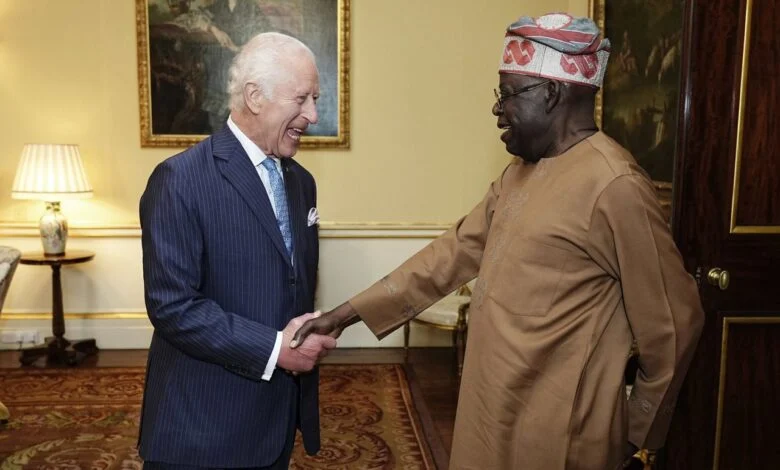
King Charles III ceremonially welcomed Nigerian President Bola Tinubu at Windsor Castle on Wednesday in the first state visit by the leader of Africa’s most populous nation in nearly four decades.
Tinubu has made less formal visits to Britain several times in his tenure, and the two countries remain major partners in trade, aid and defence. London is also home to a massive Nigerian diaspora.
King Charles and Queen Camilla greeted the president and his wife in Windsor, west of London, on a sunny afternoon as artillery fired Salutes
The Nigerian president and his wife earlier chatted with heir-to-the-throne Prince William and his wife Catherine at a hotel in Windsor.
The party then rode in carriages to the historic Windsor Castle, followed by cavalry in red and gold livery.
These include a Yoruba beaded throne presented to Queen Elizabeth II during an official visit in 1965.
They were also to view photographs of a Yoruba woman known as Sarah Forbes Bonetta, who became a protegee of Queen Victoria after being captured as a slave and taken to Britain by a naval captain.
In the evening, Charles and Tinubu were set to give speeches at a lavish state banquet.
‘Renewed chapter’
Nigeria’s presidency said the visit signalled a “renewed chapter” and reflected a shared commitment to “advancing trade and strengthening diplomatic ties”.
Calling the visit “historic”, London announced Nigerian companies, including banks, are expanding operations and creating hundreds of jobs in Britain, strengthening it as a global hub for African business.
Likely on the agenda are issues ranging from major Nigerian port renovations backed by Britain as well as trade, which reached £8.1 billion ($11 billion) in the year to September 2025, an 11.4 per cent year-on-year increase.
On Thursday, Tinubu is expected to meet British Prime Minister Keir Starmer as well as members of the Nigerian community abroad, according to the official schedule.
First Lady Oluremi Tinubu, a Christian pastor, is set to preach at London’s Lambeth Palace — the seat of the Archbishop of Canterbury — on Thursday and meet representatives of the Church of England.
The last Nigerian state visit to the UK took place in 1989, although Tinubu was received by Charles in September 2024.
Before the death of his mother, Queen Elizabeth II, in 2022, Charles also visited Nigeria four times as Prince of Wales.
The Federal Government has alleged that an embattled mining company, Jupiter Ltd, is planning what it described as a “campaign of calumny” against Nigeria during the planned state visit of President Bola Tinubu to the United Kingdom.
The Ministry of Solid Minerals Development said the alleged move was aimed at discrediting ongoing reforms in the mining sector and misleading the international community about the circumstances surrounding the revocation of certain mineral licences.
In a statement issued on Sunday by the Special Assistant on Media to the Minister of Solid Minerals Development, Segun Tomori, the ministry dismissed claims that Nigeria seized a British lithium project under armed guard, describing the allegation as false and misleading.
Tomori said the Federal Government had no legal or contractual relationship with any company known as Jupiter Lithium, stressing that Nigerian mining laws prohibit foreign companies from directly holding mineral titles.
The statement read, “It has come to the attention of the Ministry of Solid Minerals Development that an embattled mining firm, Jupiter Ltd, plans to orchestrate a campaign of calumny against the Federal Government of Nigeria during the state visit of President Bola Tinubu to the United Kingdom.
“Earlier in the week, the Special Adviser to the Minister of Solid Minerals Development, Kehinde Bamigbetan, authored a response to what we described as a tissue of falsehoods sponsored by Jupiter Ltd in a publication titled ‘Nigeria Seizes British Lithium Project Under Armed Guard.’
“Our response, titled ‘In Nigeria’s Mining Sector, The Law Is No Respecter of Persons,’ exposed the activities of one Steve Davis and Hamish MacDonald, whose enterprise in the mining sector eventually met the full weight of the law.”
According to the ministry, the controversy stemmed from the revocation of mineral titles belonging to Basin Mining Ltd, a Nigerian company linked to an Australian national, Steve Davis.
The government said the revocation followed the company’s failure to meet statutory financial obligations under Nigeria’s mining regulations.
Tomori stated that Basin Mining Ltd lost its mineral titles after failing to pay statutory annual service fees amounting to N2.494bn for the 2024 and 2025 fiscal years.
The unpaid fees covered mineral titles 45454ML, 45117ML, 45118ML, 40532ML and 40533ML, which were revoked after due notice was served on the company in line with existing regulations.
The ministry also dismissed claims that the titles were reassigned to a Chinese firm, describing the allegation as a fabrication intended to mislead the public and the international community.
It further alleged that Davis had interests in several mining companies operating in Nigeria, including Comet Minerals Ltd, Basin Mining Ltd, Range Mining Ltd, Northern Numero Ltd, Sunrise Minerals Ltd and Iron Ore Mining Ltd.
According to the government, such arrangements are often used by speculators to acquire mineral titles without undertaking actual mining operations.
The ministry said the practice had contributed to the problem of dormant mining licences and illegal mining activities in the country.
It noted that the Federal Government was determined to end such practices as part of ongoing reforms aimed at repositioning the mining sector as a key driver of economic growth.
“The Federal Government of Nigeria cannot and will not be intimidated or blackmailed into abandoning reforms by the antics of any individual or company,” Tomori added.
“Our commitment to transforming the mining sector into a major contributor to the nation’s Gross Domestic Product is unwavering.”
The ministry urged Nigerians and international stakeholders to disregard what it described as attempts by “discredited individuals” to undermine the country’s reform agenda.
Nigeria has intensified efforts in recent years to develop its solid mineral resources, including lithium, gold, iron ore and rare earth elements, as part of a broader strategy to diversify the economy away from crude oil.
PUNCH Online reports that Tinubu is scheduled to embark on a state visit to the United Kingdom from March 18 to 19, 2026, following an invitation from King Charles III, who will host the Nigerian leader at Windsor Castle.

Iran’s missile attack has injured over 140 residents, including Nigerians, in the United Arab Emirates (UAE). The UAE’s air defence intercepted nine missiles and 33 drones amid escalating tensions in the Middle East. Six fatalities were reported, with casualties among foreign nationals, including Nigerians, Pakistanis, and Bangladeshis.
Dubai, UAE – Amid the US/Israel-Iran war, Nigerians were among more than 140 residents injured after Tehran launched multiple ballistic missiles and unmanned aerial vehicles at the United Arab Emirates (UAE).
As reported on Sunday morning, March 15, by The Punch, the development raised fresh fears for thousands of Nigerians living and working in the Gulf nation.
The UAE Ministry of Defence disclosed on Saturday, March 14, that its air defence systems intercepted several missiles and drones fired from Iran, describing the attack as a major escalation in the ongoing regional tensions.
In a statement posted on its official X (formerly Twitter) handle, the ministry said its air defence units engaged nine ballistic missiles and 33 drones during the latest assault, adding that the attacks left six people dead and 141 others injured, including foreign nationals.
The ministry stated:
“The UAE air defence systems on March 14 engaged nine ballistic missiles and 33 UAVs launched from Iran.”
“Since the onset of this blatant Iranian aggression, UAE air defences have engaged 294 ballistic missiles, 15 cruise missiles, and 1,600 UAVs launched from Iran.”
UAE’s authorities’ post can be viewed below via X:
الدفاعات الجوية الإماراتية تتعامل مع 9 صواريخ باليستية و 33 طائرة مسيرة.
تعاملت الدفاعات الجوية الإماراتية (14 مارس 2026) مع 9 صواريخ باليستية، و 33 طائرة مسيرة قادمة من إيران.
ومنذ بدء الاعتداءات الإيرانية السافرة تعاملت الدفاعات الجوية الإماراتية مع 294 صاروخاً باليستياً، و… pic.twitter.com/UOVjVpjh7b
— وزارة الدفاع |MOD UAE (@modgovae) March 14, 2026
According to the ministry, those killed in the attacks included citizens of the UAE as well as foreign nationals from Pakistan, Nepal and Bangladesh. Although the authorities did not specify the exact locations where the casualties occurred, the ministry said the injured victims were from several countries, including Nigeria.
Meanwhile, when contacted about the situation, Nigerian resident Yinka Sodiq in the UAE expressed hope for safety, saying he is closely monitoring regional tensions amid reports of increased military activity in the Gulf. He also expressed full confidence in the country’s security measures to safeguard both residents and visitors.
He told Legit.ng:
“Alhamdulillah (praise be to God), for now, I am safe. We are also keeping our heads. May Allah continue to protect us all.”
Another resident, Remi Susan, addressed occasional sounds heard in the skies, clarifying that they pose no threat but are part of a defensive system designed to protect the population and secure the UAE’s airspace, a reflection, she said, of the country’s advanced defence capabilities and preparedness.
Susan said:
“Yes, there has been a lot of noise in the sky, even from my house. I saw like some missile or drone or whatever. But they have been intercepted. I trust the government.”
Dailyvoice.ng reports that escalating hostilities in the Middle East have sent shockwaves through Nigeria, grounding pilgrimages, disrupting travel plans, rattling the oil market and prompting anxious calls from Nigerians abroad. Besides, some members of the Islamic Movement in Nigeria (IMN), the Iran-inspired Shiite organisation founded in the late 1970s by Sheikh Ibrahim El-Zakzaky, have been staging protests in solidarity with the Iranians in some parts of the country, such as Kano, Kaduna and Lagos.
The Iranians, under attack from the United States (US) and Israel because of a long-running disagreement over Iran’s nuclear enrichment programme, have been firing retaliatory missiles at Israel and other countries considered US allies in the Gulf region, including Saudi Arabia, the UAE, Qatar, Bahrain, Jordan, among others.
So far, Iran’s supreme leader, Ayatollah Ali Khamenei, his family members and more than 700 citizens have died.


Politics2 days ago
Abuja Elections: APC Drags PDP To Courts

Politics3 days ago
2027 Shocker: Popular Nigerian Cleric Predicts Total Collapse of Three Major Parties

News3 days ago
BREAKING: Sultan Receives Moon Sighting Report, Announces Date of Eid-ul-Fitr in Nigeria

Sports9 months ago
Former Super Eagles Star Loses Life Savings, Duped By A Pastor of ₦1.2 Billion

Uncategorized9 years ago
These ’90s fashion trends are making a comeback in 2017

Lifestyle7 months ago