
Health
FACT CHECK: Is it True Judge Who Declared Tinubu the Winner Lost Eyesight After Surgery? Truth Emerges

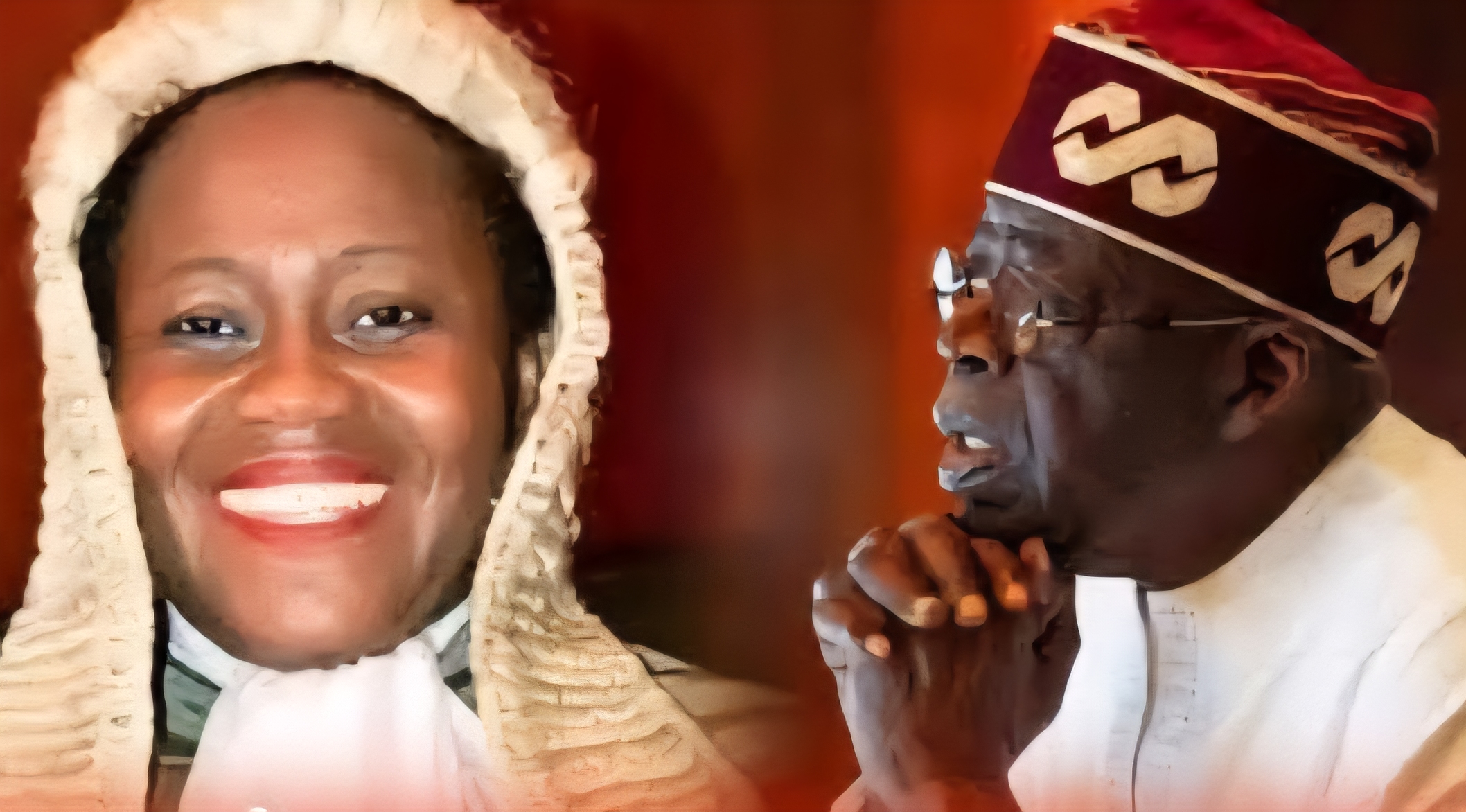
A Facebook page, I News, claimed that “Justice Tsamma Abubakar,” the judge who declared President Bola Tinubu winner of the 2023 presidential election, had lost his eyesight.
The page claimed Justice Abubakar went blind after undergoing eye surgery at a specialist hospital in London, United Kingdom
The post alleged that there were complications during the surgery that resulted in complete blindness.
“Breaking News: Judge Tsamma Abubakar, who declared Tinubu the winner in the 2023 presidential election, reportedly went blind in a London hospital after undergoing eye surgery.”
Verification
Dubawa, a fact-checking platform, discovered that the photograph attached to the viral claim was that of Ghana’s former Chief Justice, Justice Gertrude Torkornoo.
Findings revealed that no judge identified as “Tsamma Abubakar” was among any of the panels that handled the 2023 presidential election petitions.

The seven-member panel of judges at the Supreme Court were Justices Inyang Okoro, Adamu Jauro, Uwani Musa Abba Aji, Lawal Garba, I.N. Saulawa, Tijjani Abubakar, and Emmanuel Agim.
While those at the Court of Appeal panel members are Justice Haruna Tsammani, Justice Stephen Adah, Justice Misitura Bolaji-Yusuf, Justice Boloukuoromo Ugoh, and Justice Abba Mohammed.
The viral claim likely distorted the name of Justice Haruna Simon Tsammani, who chaired the 2023 Presidential Election Petition Court, to push the fake report.
Conclusion The claim that the judge who declared Tinubu of the All Progressive Congress (APC) the winner of the 2023 presidential election lost his eyesight after surgery is false.
There is no evidence, official statement or report from a credible news platform that any member of the 2023 election petition panels lost their eyesight after surgery in London.
Source: legit
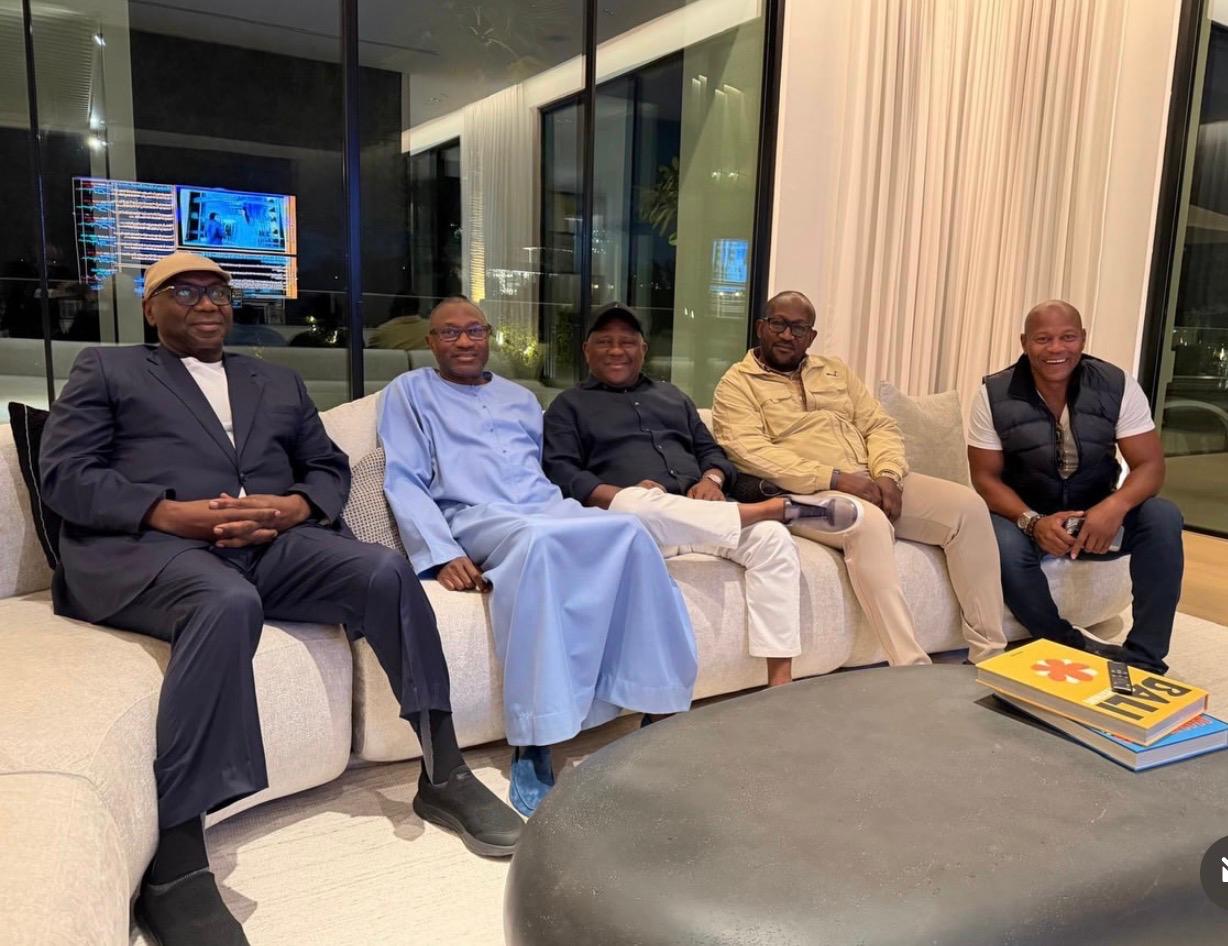
● How Dangote, Rabiu, Elumelu and Adenuga Keep Company With the Billionaire Abroad
There are houses, and there are addresses, but there are also those rare addresses that somehow acquire a life beyond their architecture, places whose significance is measured not merely in marble, acreage or the provenance of their furniture, but in the calibre of men who walk through their doors and the friendships that are renewed within them.
Across London, Dubai and Monaco, billionaire extraordinaire, Femi Otedola appears to have created precisely that kind of world. His homes abroad are unquestionably retreats of privilege, places where the billionaire businessman can withdraw from the turbulence of boardrooms and the relentless theatre of Lagos, yet increasingly they have also become intimate theatres of friendship, drawing into their orbit some of the most powerful Nigerians alive.
Aliko Dangote has been there, Abdul Samad Rabiu has been there, Tony Elumelu has been there, and more recently the famously private Mike Adenuga emerged in Monaco in Otedola’s company, producing one of those exceedingly rare photographs that immediately became a talking point back home.
It is an extraordinary constellation when one considers the industries and fortunes involved. Between them are businesses built across cement, telecommunications, banking, energy, manufacturing, oil and infrastructure, corporations that employ thousands and enterprises that have played consequential roles in the making of modern Nigerian capitalism. Yet when these men meet Otedola abroad, the tableaux are often strikingly uncomplicated, stripped of the usual podiums, conference backdrops, retinues of aides and corporate ceremony. Sometimes, all that remains is a sofa, a dining table, a terrace and an evening at home.
Perhaps that is what makes the photographs so fascinating. They offer small windows into a Nigeria that the public rarely sees, a private world in which men ordinarily encountered through balance sheets, annual reports, corporate transactions and billionaire rankings are seen simply in the company of friends.
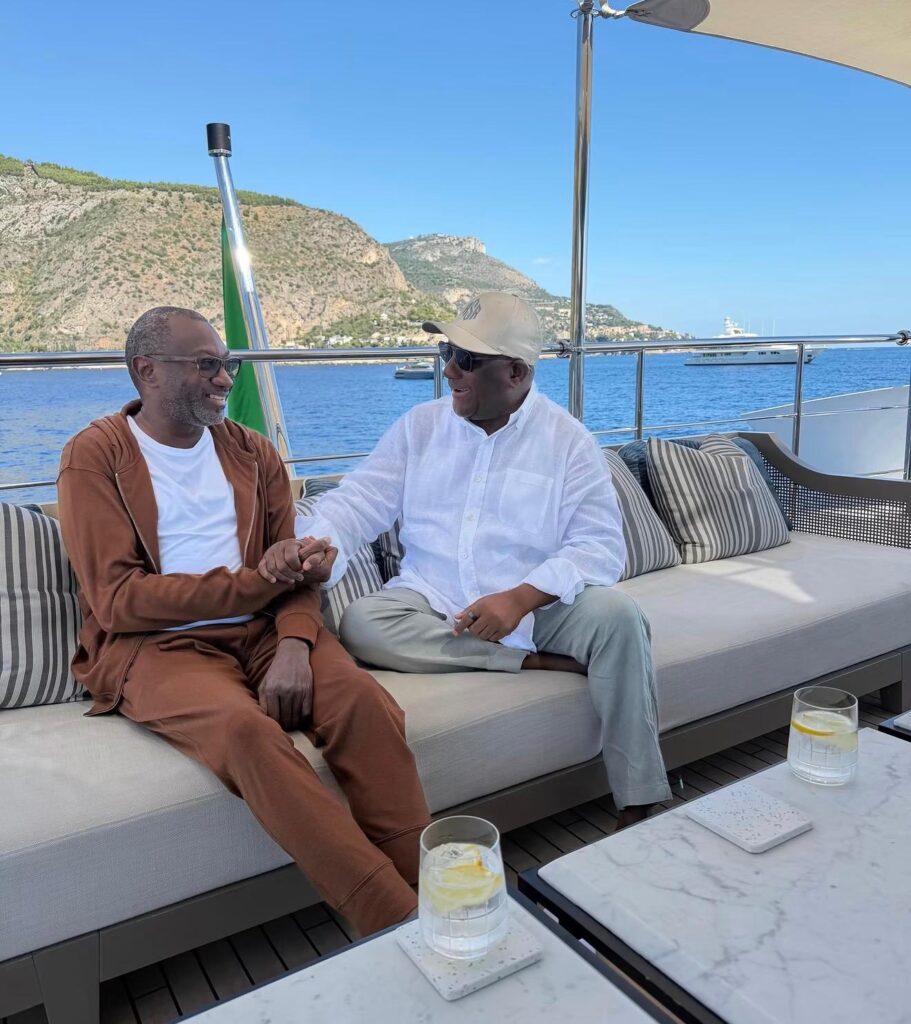
A Beautiful Day in Monaco
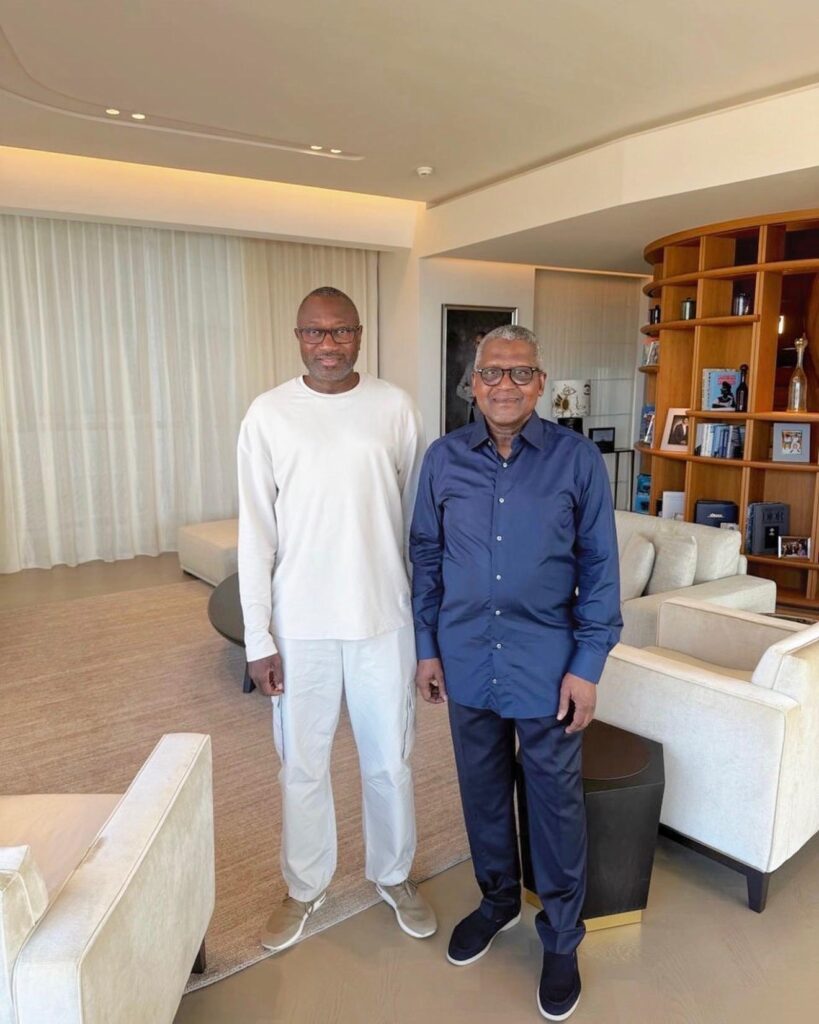
In June 2026, Otedola offered one such glimpse when he shared a photograph with Aliko Dangote from his home in Monaco. There was no elaborate ceremony around the encounter; the two men were seated casually together, relaxed and smiling, looking less like two of Africa’s most recognisable businessmen and more like old friends enjoying an easy afternoon.
Otedola described it as a “beautiful day at home in Monaco” with the man he affectionately called his “bestie,” adding that “friendship remains one of the greatest investments.” For men whose lives have been built around investments, acquisitions, expansion and enterprise, the choice of metaphor was telling because it suggested that, beyond the hard calculus of business, there are relationships that have acquired value of a different kind.
Dangote and Otedola have known each other through different seasons of corporate Nigeria. Their friendship has endured changes in fortune, the transformation of businesses and the shifting climate of the Nigerian economy, and Otedola has frequently spoken admiringly of Dangote’s industrial ambitions. Yet Monaco stripped the relationship of its corporate costume. There they were, simply two old friends at home, sharing the kind of ease that cannot be manufactured for the camera.
Monaco itself seems almost perfectly cast for such a scene. The tiny Mediterranean principality has for generations served as a sanctuary of extraordinary wealth, with yachts resting upon blue water, discreet residences rising against the hills and a social culture in which affluence is worn almost casually. Otedola has long been associated with a home there, and the sight of Dangote within that private world once again brought the residence into the Nigerian imagination.
There was wealth in the photograph, certainly, but there was something else too: ease, familiarity and the unforced comfort of friendship. Among extremely powerful men, that ease may well be the greater luxury.
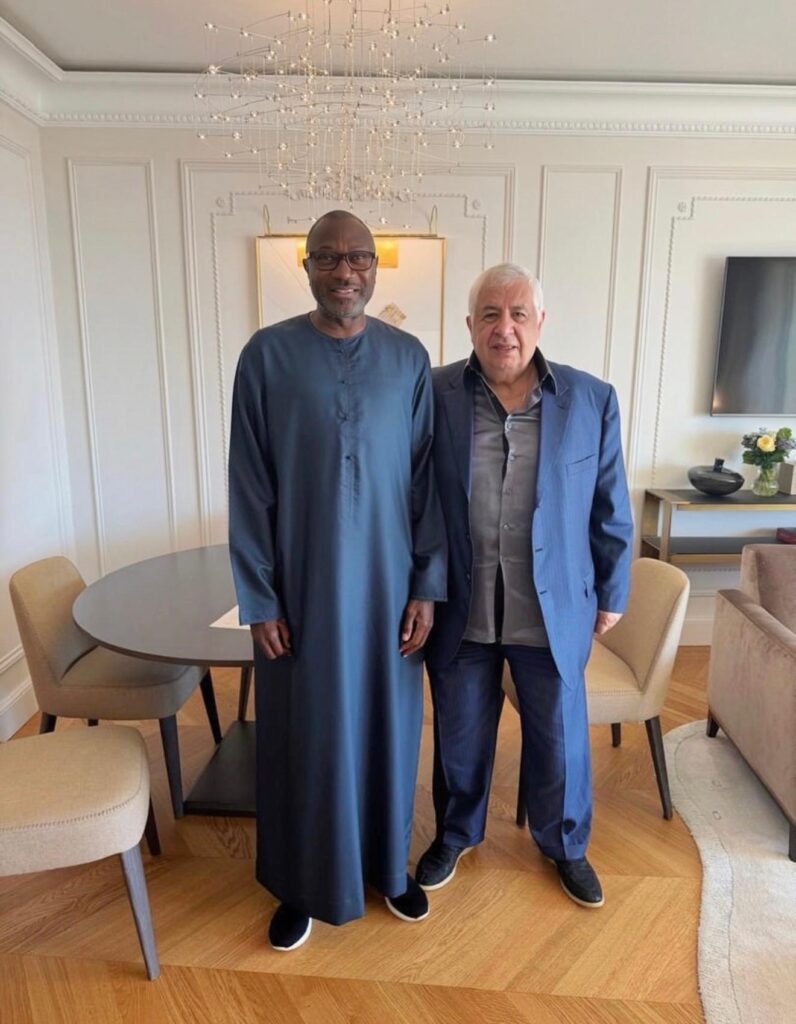
The ‘Chairman of Chairmen’ in Monaco
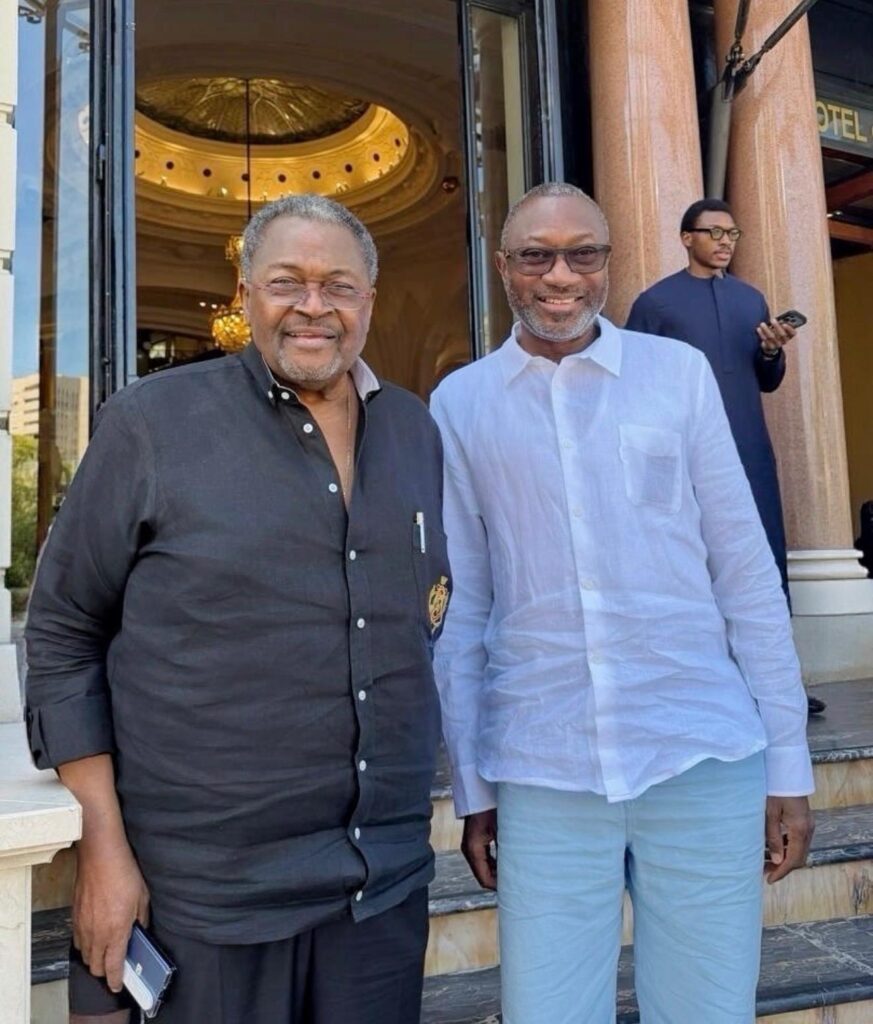
A few months later, Monaco yielded another remarkable sight when Mike Adenuga appeared in Otedola’s company.
That alone was enough to make the encounter unusual because Adenuga has always cultivated a far more private public profile than many of his billionaire contemporaries. Unlike businessmen whose movements frequently populate social-media timelines and society pages, the Globacom founder is capable of disappearing almost entirely from public view for long stretches, which is why photographs of him invariably attract attention.
When Otedola shared images of them together in Monte-Carlo in September 2026, the photographs travelled rapidly, not simply because two billionaires had met, but because one of them was Adenuga, a man whose public appearances have become increasingly rare.
Otedola introduced him with characteristic warmth and flourish as the “Chairman of Chairmen,” before acknowledging his collection of national and international honours. For those accustomed to Adenuga’s reserve, it was an uncommon picture: the famously private telecoms magnate smiling easily beside another billionaire who seems able, perhaps by temperament as much as by circumstance, to draw some of Nigeria’s most powerful businessmen into his social orbit.
The public accounts of the meeting confirm that the two men were together in Monte-Carlo, even if they do not conclusively establish that every photograph from the encounter was taken inside Otedola’s residence. Yet the symbolism remains compelling. Dangote had appeared in Monaco earlier in the year, and now Adenuga had surfaced there too, making the principality look, at least through the occasional photographs Otedola shares, like a Mediterranean meeting point for Nigeria’s billionaire class.
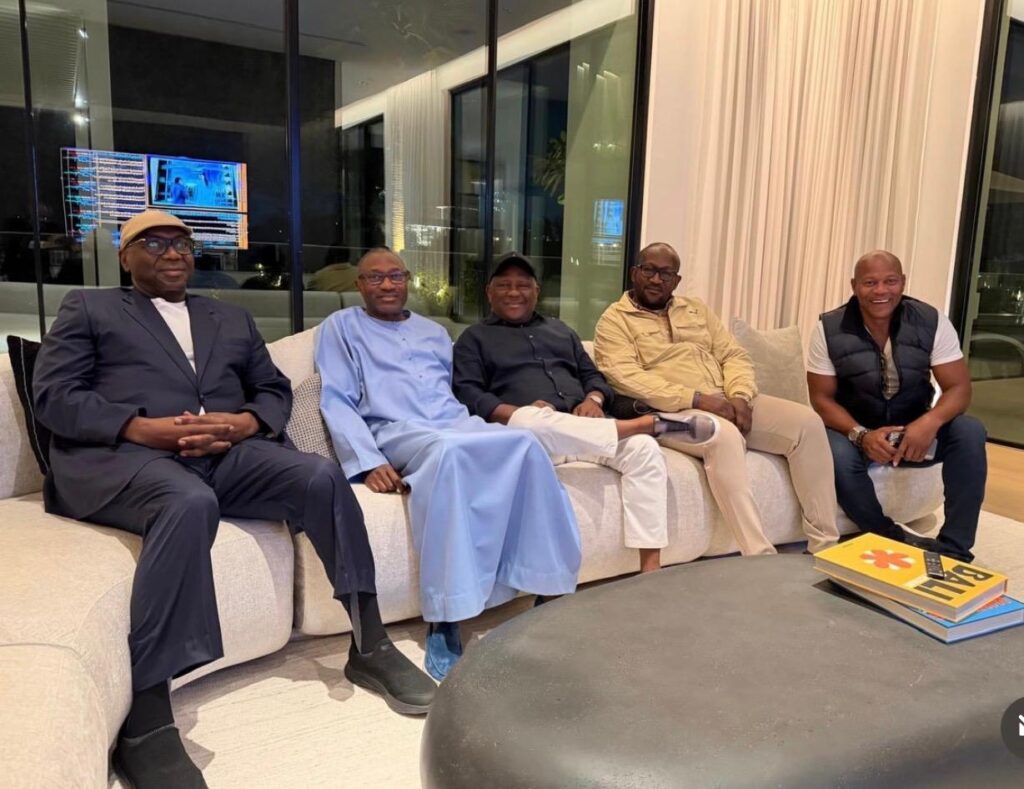
Dubai and the Ritual of Friendship
If Monaco is Otedola’s Mediterranean retreat, Dubai has become an even more expansive stage for his hospitality.
His relationship with the emirate is longstanding, and his homes there have surfaced from time to time in society photographs, family celebrations and social-media posts. Beyond the obvious luxury of the city, Dubai appears to offer what men of Otedola’s standing often value most: privacy, comfort, convenience and the freedom to receive friends away from the noise of Lagos.
Abdul Samad Rabiu is among those who have enjoyed that hospitality. In January 2026, Rabiu was hosted at Otedola’s Dubai home for a private gathering, and the photographs that followed showed the BUA chairman and other guests in relaxed company, far removed from the industrial seriousness with which their names are usually associated.
The friendship is evidently reciprocal, because Otedola also joined Rabiu at his own Dubai residence during Ramadan for Iftar. Those encounters suggest something more substantial than occasional society appearances; they speak instead to a familiarity in which each man appears comfortable entering the other’s private space, sharing a table and spending time away from the ceremonial obligations of public life.
For all the obsession with billionaires as economic abstractions, with who owns what, whose fortune has risen and who has gained or lost billions, their friendships are often far more ordinary than the numbers surrounding them might suggest. Otedola and Rabiu inhabit overlapping worlds of huge capital and national consequence, but the Dubai photographs tell a simpler story of men eating together, laughing together and observing the rituals of friendship outside the public gaze.
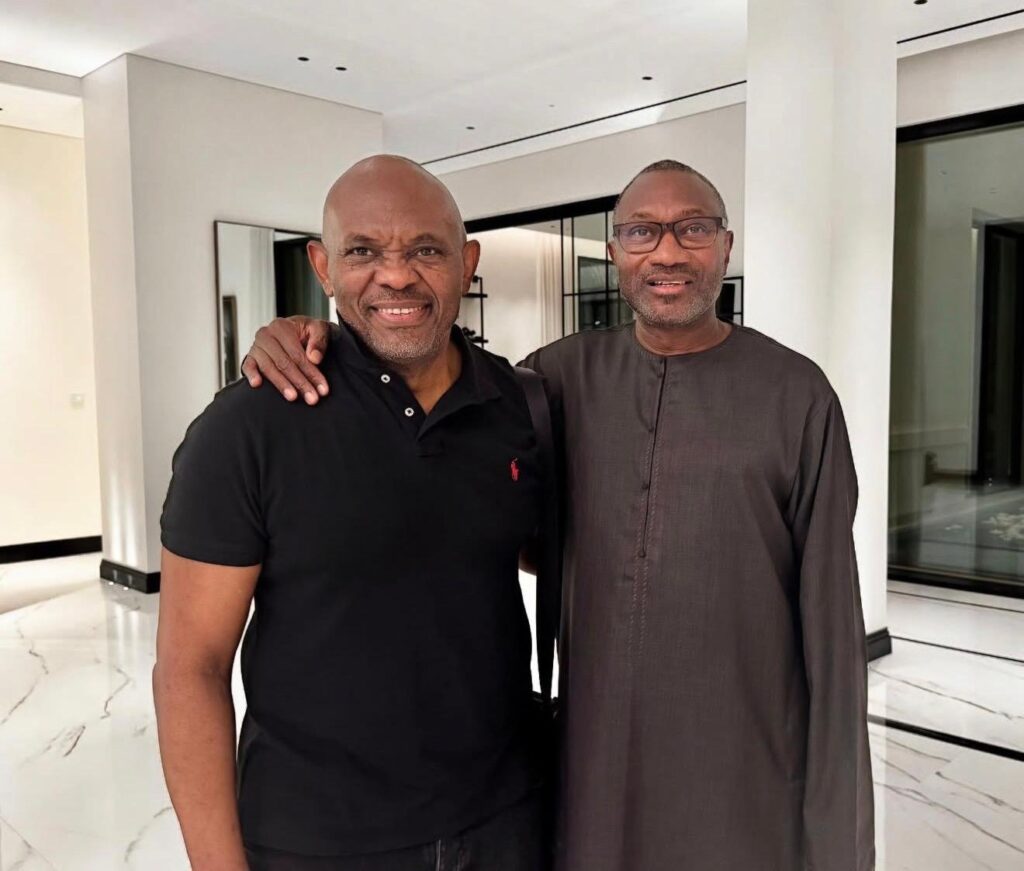
Otedola and Elumelu: Friendship Across London and Dubai
Tony Elumelu also belongs to that distinguished circle of Nigerian business leaders who have enjoyed Otedola’s hospitality abroad.
Their friendship has been glimpsed across continents. In 2022, Otedola received Elumelu at his London home, an encounter that offered another window into the private camaraderie among Nigeria’s most accomplished businessmen. Elumelu would later speak warmly of the residence, describing it as an “amazing house.”
Then came Dubai, where Otedola again hosted Elumelu at his residence. The atmosphere was relaxed and unmistakably personal, and Otedola referred to him affectionately as his good friend, “African Pride,” while speaking of building bridges, sharing visions and celebrating excellence.
There was something revealing in those photographs because here were two men whose names occupy prominent places in contemporary African enterprise, sitting together not beneath corporate insignia or before conference microphones, but within the quiet intimacy of a home. Elumelu has built an enormous footprint across banking, investment, energy and entrepreneurship, while Otedola’s own journey has traversed oil, power and finance, yet away from those imposing corporate identities their encounters reveal the more human dimension of wealth: friendship, conversation and the uncomplicated pleasure of being received by someone who knows you beyond your public title.
London, meanwhile, has become an even more substantial part of Otedola’s property story. His residence in St John’s Wood places him in one of the capital’s most coveted enclaves, close to Regent’s Park and within a neighbourhood where wealth generally prefers understatement to advertisement. Yet the more intriguing story is not merely that Otedola owns magnificent homes, because plenty of wealthy men do; what makes his homes interesting is what happens inside them and the people who keep passing through.
The Soft Architecture of Power
Society often makes the mistake of imagining that power lives only in offices, boardrooms, state banquets and polished conference rooms where advisers carry leather folders and minutes are taken. In truth, power has always possessed another geography, one found in dining rooms, private terraces, long lunches, discreet evenings and homes where important people no longer need appointments to see one another.
That does not mean every gathering of billionaires should be burdened with theories about transactions or influence. Friendship should not automatically be converted into conspiracy simply because the friends involved happen to be extremely wealthy. Indeed, what is most striking about Otedola’s own public language is how frequently he chooses the vocabulary of friendship rather than commerce, referring to friends as “bestie,” “brother” or simply “my good friend,” and repeatedly framing relationships in emotional rather than transactional terms.
There is a softness to that vocabulary that contrasts with the hard industries these men dominate. Dangote builds factories on a scale that has transformed entire sectors, Rabiu commands a vast industrial empire, Elumelu’s interests extend across banking, energy and investment, Adenuga built one of Africa’s most formidable indigenous telecommunications businesses, while Otedola himself has moved through petroleum marketing, shipping, power generation and banking with an instinct for reinvention that has defined much of his career.
Yet when these men meet abroad, the armour occasionally comes off. They sit together, eat together, laugh together, trade stories and pose for photographs, and for a few moments they appear removed from the empires attached to their names.
The Billionaire Who Likes to Host
Perhaps this is the more compelling portrait of Otedola. For all his reputation as a businessman and investor, he appears also to enjoy the ancient privilege of the host.
There is a certain kind of wealthy man who regards a beautiful house primarily as an achievement, another who sees it as a sanctuary, and then there is the man who derives particular pleasure from filling it with people. Otedola increasingly seems to belong to the latter category, and his homes have welcomed not only businessmen but musicians, family friends and figures from different corners of Nigerian public life.
That habit suggests that behind the gleaming façades lies something warmer than mere acquisition: hospitality.
For Nigerians, and particularly within Yoruba social tradition, the home has never been understood solely as shelter. It is also social territory, a place where relationships are renewed, food is shared, visitors are received and friendship is demonstrated through presence. The successful man does not merely build a large house; he keeps a table around which people can gather.
In Otedola’s case, only the geography has changed. The old courtyard has become Monaco, the veranda has moved to Dubai, and the parlour now occasionally overlooks London, while the visitors arrive carrying famous names, billion-dollar businesses and reputations recognised across the continent.
Beyond the Photographs
Perhaps years from now, the houses themselves will matter less than the friendships they witnessed. Fortunes change, companies rise and stumble, markets punish even the most assured investor, and today’s celebrated acquisition eventually becomes tomorrow’s footnote, but certain photographs endure because they capture powerful people briefly outside the formal identities by which history usually remembers them.
That is what gives these pictures their charm: Dangote relaxing with his friend in Monaco, Rabiu sharing a table in Dubai, Elumelu received with warmth in London and Dubai, and the elusive Adenuga suddenly appearing in Monte-Carlo beside a man who calls him the “Chairman of Chairmen.”
Seen separately, they are society photographs; seen together, however, they form an intriguing portrait of Femi Otedola, not simply as the billionaire investor associated with Geregu Power, banking and some of the world’s most exclusive addresses, but as the host whose homes have become gathering points for men who ordinarily occupy separate kingdoms.
In that sense, perhaps the most revealing line Otedola has used remains one of the simplest: “Friendship remains one of the greatest investments.”
For a man who has spent a lifetime understanding where value lies, it may also be the investment he appears most comfortable displaying.

The Nigerian delegation attending the 114th Session of the International Labour Conference (ILC) in Geneva is in mourning due to the passing of prominent labour leader Domingo Michael Adeleke.
Adeleke, who was serving as the Chairman of the Lagos State Joint Negotiating Council (JNC), reportedly died on Tuesday in Geneva after a brief illness. While participating in the conference, he fell ill and required medical attention, but unfortunately, he did not survive. His contributions to the labour movement will be remembered during this difficult time.
The incident was confirmed by an official of the Nigeria Labour Congress (NLC), who described him as a committed trade unionist devoted to workers’ welfare.
“It is with deep sorrow that the Nigeria Labour Congress and the entire trade union movement in Nigeria, especially the 2026 Workers’ Delegates to the International Labour Conference, announce the passing of Comrade Domingo Michael Adeleke, who died today in Geneva after a brief illness while attending the 114th Session of the International Labour Conference,” the official said.
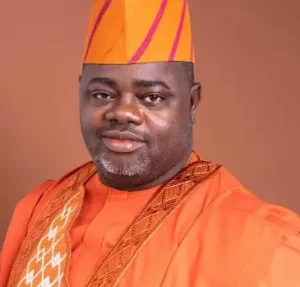
A member of the Nigeria Civil Service Union (NCSU), Adeleke led the Lagos State Joint Negotiating Council, where he was actively involved in labour advocacy and workers’ welfare initiatives.
According to the NLC, he remained committed throughout his career to promoting decent work and social justice.
“Comrade Domingo was a committed trade unionist whose dedication to Nigerian workers and the struggle for decent work took him to the global stage right to the end.
“His loss is felt deeply by all who knew him and worked alongside him,” the official added.
The NLC also confirmed that its leadership had visited the hospital where his remains are being kept and had begun arrangements for repatriation.
“The NLC leadership earlier today went to the hospital to see his body in solidarity, mourn his passing, and begin the process of arranging the necessary procedures,” the official said.
His death has cast a shadow over Nigeria’s participation in the ongoing International Labour Conference, which brings together governments, employers, and workers’ representatives from across the world to deliberate on labour and employment issues.
Tributes have continued to pour in from labour leaders and colleagues who described Adeleke as a passionate advocate for workers’ rights and welfare.
The NLC extended condolences to his family, colleagues, and the wider labour movement, describing his passing as a major loss.
“We extend our heartfelt condolences to his family, the NLC family and all comrades across Lagos State. May his soul rest in peace, and may his commitment to workers’ rights continue to inspire us,” the Congress said.
Adeleke is remembered by colleagues as a dedicated labour activist who spent much of his career advancing public service and protecting the interests of Nigerian workers.
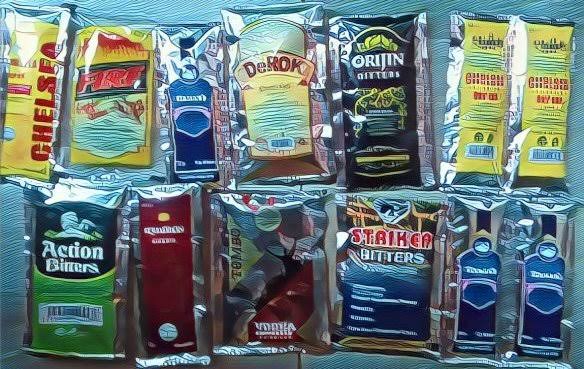
Nationwide tensions are on the rise as the National Agency for Food and Drug Administration and Control (NAFDAC) sticks to its guns over the full enforcement of a ban on alcoholic beverages in sachets and small bottles (200ml and below). The prevailing narrative surrounding the enforcement has been framed as a moral battle: profiteers on one side and public health defenders on the other. It is a powerful headline. It is also a misleading one.
To suggest that industry stakeholders are prioritising profit over public health is to oversimplify a complex policy issue and to mischaracterise the motivations of thousands of Nigerians whose livelihoods are directly tied to the sector. This debate is not about corporate greed. It is about economic survival, regulatory balance, and the interconnectedness of health and livelihoods.
Public health does not exist in isolation from economic stability. When policies trigger large-scale job losses, destabilise value chains, and threaten billions in local investments, the consequences ripple far beyond factory gates. They reach homes, schools, hospitals, and communities. They affect the same families whose welfare regulators say they are protecting. It is therefore disingenuous to reduce legitimate economic concerns to “profit-seeking.” What is at stake extends beyond balance sheets.
The sector impacted by the ban supports a vast ecosystem: manufacturers, distributors, small-scale retailers, logistics providers, packaging suppliers, marketers, and informal traders. Estimates referenced by labour groups indicate that millions of livelihoods may be affected directly and indirectly. Whether the precise figure is debated or not, the scale of economic exposure is undeniable.
When factories scale down or shut production lines, it is not shareholders who suffer first. It is line workers, drivers, depot staff, retail shop owners, and their dependents. In an economy already grappling with inflation, currency volatility, and high unemployment, the social consequences of abrupt regulatory shocks must be carefully weighed.
Economic displacement carries health consequences of its own. Poverty correlates strongly with deteriorating health outcomes. Job loss leads to reduced access to healthcare, increased stress, poorer nutrition, and vulnerability to mental health challenges. A regulatory action that triggers economic shockwaves can indirectly undermine public health in ways that are less visible but no less severe.
What’s more, the Director-General of NAFDAC, Mojisola Adeyeye, has emphasised concerns about underage access to alcohol in small, concealable packaging. The protection of minors is unquestionably a legitimate policy objective. No responsible stakeholder disputes the need to prevent underage drinking or substance abuse.
However, the central question remains: “does banning a packaging format sufficiently address the root causes of alcohol abuse?”
Product size alone does not create consumption behaviour. Underage access is primarily an enforcement issue. Retail compliance, age verification, perimeter control around schools, parental supervision, and community-level enforcement mechanisms play decisive roles. If minors are able to purchase alcohol, regardless of packaging size, then the regulatory focus must interrogate points of sale and enforcement gaps.
Furthermore, alcohol in larger containers remains legally available. The removal of sachet and small PET formats does not eliminate alcohol from the market. It merely alters packaging dynamics. If consumption is driven by behavioural and socio-economic factors, the packaging shift may not produce the intended public health outcome.
There is also the matter of proportionality. Regulatory action should be measured, targeted, and responsive to evolving economic conditions. The 2018 agreement referenced by NAFDAC outlined a phased approach. Yet between 2018 and 2024, Nigeria experienced unprecedented economic turbulence — including pandemic disruptions, supply chain shocks, foreign exchange volatility, and inflationary pressures that strained manufacturing capacity.
Phased compliance assumes a relatively stable economic environment. When that stability collapses, regulators must evaluate whether timelines remain feasible without disproportionate harm. Flexibility in policy implementation is not weakness. It is responsible governance.
Another dimension that deserves serious reflection is the risk of unintended consequences. Sudden restrictions on regulated products can create market distortions. When legitimate supply chains contract abruptly, informal and unregulated alternatives often emerge. Counterfeit production, illicit distribution, and unsafe substitutes become attractive gaps to exploit.
Nigeria’s regulatory history across multiple sectors has demonstrated that prohibition-style measures, if not carefully calibrated, may push demand underground rather than eliminate it. An unregulated alternative market would pose far greater public health risks than a monitored, licensed production environment.
It is therefore imperative to interrogate whether the current approach optimally balances health protection with economic stability and enforcement realism.
Equally troubling is the language deployed in public discourse. Framing the debate as a binary moral question — “Do we want children to die or do we want money?” — may resonate emotionally, but it does not elevate policy analysis. Such rhetoric risks polarising stakeholders rather than fostering collaborative solutions.
No serious industry actor advocates harm to children. No responsible labour union is indifferent to public health. The argument advanced by stakeholders is not that economic interests trump health; it is that both must be protected simultaneously.
Public health and economic health are not adversaries. They are interdependent pillars of national stability.
The involvement of labour organisations such as the Nigeria Labour Congress and the Trade Union Congress of Nigeria underscores that this debate transcends corporate interests. When labour unions raise alarms about job losses, they are fulfilling their mandate to defend workers, not to undermine health objectives.
In democratic governance, engagement with policymakers is neither subversive nor unethical. Consultation, advocacy, and dialogue are legitimate mechanisms for resolving complex policy conflicts. Casting stakeholder engagement as clandestine lobbying undermines the very participatory governance structures that sustain accountability.
The broader issue at hand is regulatory balance. Effective regulation should aim for outcomes that are sustainable, enforceable, and economically coherent. It should incorporate data transparency, measurable impact assessments, and periodic review mechanisms. It should also align with a comprehensive National Alcohol Policy framework to ensure consistency rather than fragmentation.
A policy that destabilises millions of livelihoods without conclusively addressing root behavioural drivers risks creating parallel crises: economic distress and public health strain.
Nigeria’s current socio-economic climate demands prudence. Youth unemployment remains high. Small and medium-scale enterprises are navigating a volatile operating environment. Manufacturing costs continue to rise. In this context, policy shocks reverberate intensely.
The country cannot afford solutions that inadvertently deepen economic fragility.
The question, therefore, should not be framed as “profit versus public health.” It should be reframed as “How do we protect public health while safeguarding livelihoods and economic resilience?”
That is the conversation worthy of a serious nation.
Protecting children from alcohol abuse requires comprehensive enforcement strategies, educational campaigns, community engagement, retailer accountability, and behavioural interventions. Packaging restrictions may form part of a broader toolkit, but they cannot substitute for systemic solutions.
Public health objectives are noble and necessary. Yet they must be pursued with economic intelligence and regulatory foresight.
In the final analysis, a nation’s strength lies in its ability to harmonise competing interests without sacrificing either. Health without livelihoods breeds poverty. Livelihoods without regulation breed disorder. The challenge is not choosing one over the other; it is integrating both responsibly.
According to key industry stakeholders, the economic disruption projected to arise from NAFDAC’s wholesale enforcement is in the region of 500,000 direct job losses, 5 million indirect job losses, and the loss of over N800 billion in investments. While NAFDAC is hell bent on the ban, the Office of the Secretary to the Government of the Federation (OSGF) and the National Security Adviser (NSA) had earlier directed a suspension, citing security and economic risks.
Some industry thought leaders also maintain that the ban may drive a radical and harmful shift with consumers gravitating toward dangerous, unregulated, or illicit alcohol alternatives.
Suffice it to say that reducing the debate to a morality play does not serve the Nigerian public. What is required is sober assessment, collaborative engagement, and a recalibration that ensures children are protected, workers are not abandoned, and economic stability is preserved.


Ebola fears: FG, States On Alert As Infected Diplomat Suffers Organ Failure

PDP Moves to Sanction Wike Over Alleged Support for APC

Stop Depending On FG For Electricity – Shettima Tells States


-
 News1 day ago
2027: Tinubu Announces New Appointments
-
 News3 hours ago
Kano Assembly Suspends Lawmaker Over Alleged Insult To Governor
-
 News3 hours ago
Stop Depending On FG For Electricity – Shettima Tells States
-
 Politics3 hours ago
PDP Moves to Sanction Wike Over Alleged Support for APC
-
 News3 hours ago
Ebola fears: FG, States On Alert As Infected Diplomat Suffers Organ Failure