
Business
Oando Reports Strong Q1 2025 Start

Oando Plc has released its unaudited results for the three months (Q1) ended March 31, 2025. Ahead of the Q1’25 scorecard, the company’s shares have seen remarkable rally on investors renewed interest. The N68.75 which the stock closed on Wednesday shows it has risen this year by 4.17 percent.
Wale Tinubu, Group Chief Executive, Oando Plc said the “Q1 2025 marked a strong start to the year for us, with a 72 percent year-on-year (YoY) increase in production volumes as a result of the successful integration of the NAOC assets into our portfolio, improved asset reliability and the reactivation of shut-in wells, reflecting early wins from our focus on operational efficiency and disciplined execution”.
“Beyond Nigeria, we have expanded our regional presence with our entry into Angola’s Kwanza Basin marking a major milestone in scaling our upstream footprint across Africa. Similarly, being named preferred bidder for the Guaracara Refinery in Trinidad and Tobago demonstrates the strength of our integrated business model, our growing role in the Afro-Caribbean landscape, and a reflection of our evolution into a more geographically diversified energy company”, he noted.
Oando Plc is Africa’s leading indigenous energy solutions provider listed on the Nigerian Exchange (NGX) and the Johannesburg Stock Exchange (JSE). Oando operates across the entire energy value chain, encompassing upstream exploration and production, trading and renewable energy initiatives.

“Following a transformative 2024, our priority is to maximize the value of our expanded upstream portfolio through targeted infrastructure upgrades, rig-less well interventions and an extensive drilling programme in the second half of the year.
“These activities are now enabled by the working capital we have secured, giving us financial flexibility to accelerate execution. We are also taking decisive action to restructure our balance sheet towards restoring financial resilience,” Tinubu noted further.
He added, “With a full-year contribution from the NAOC assets, a more diversified trading operations and an optimized balance sheet, we are confident in our ability to generate stronger cash flows, reduce leverage, and deliver sustainable value to our shareholders.”
Read also: Here’s how to bridge Nigeria’s investment gap, unlock trillions

The performance highlights in Q1…
The company’s revenue grew by 2 percent year-on-year to N933 billion (Q1 2024: N915 billion), supported by higher upstream volumes and FX revaluation gains. Gross profit increased by 172 percent to N85 billion (Q1 2024: N31 billion), reflecting stronger E&P margins.
Capital expenditure rose to N45 billion (Q1 2024: N9 billion), driven by asset integration and production optimisation initiatives following the NAOC acquisition.
Pursuant to shareholder approval, the Board approved the distribution of 1.28 billion ordinary shares, reinforcing value return commitments.
Through its subsidiaries, Oando Energy Resources and Oando Trading, the Company holds interests in onshore and offshore oil and gas assets and maintains a significant presence in the global energy trading market.
Exploration and production
Oando achieved average daily production of 37,595 boepd (within guidance), up 72 percent year-on-year, driven by the full consolidation of NAOC assets and well reactivations. Crude oil production rose 132 percent to 11,369 bopd, gas volumes grew 56 percent to 25,185 boepd, and NGL production increased 30 percent to 1,040 bpd.
Oando recorded zero lost-time injuries (LTIs) and 12.3 million LTI-free hours, underscoring continued HSE excellence. It was awarded operatorship of Block KON 13 in Angola, marking a strategic entry into the Kwanza Basin and expanding Oando’s African upstream footprint.
Trading
6 crude oil cargos (5.96 MMbbl) traded in Q1 2025, up from 4 cargos (4.86MMbbl) in Q1 2024, driven by stronger offtake execution. No PMS cargos traded in Q1 2025 (Q1 2024: 4 cargos), reflecting lower market demand post-subsidy removal and increased local refinery supply. Increased crude volumes partially offset reduced PMS activity, with new pre-financing structures advancing to support future growth. Selected as preferred bidder for the Guaracara Refinery in Trinidad & Tobago, establishing a strategic foothold in the Caribbean downstream market.
Read also: Oando, Dangote Sugar, CWG stocks push market higher by 1.22%
Clean Energy
Achieved 53,941 EV rides in Q1 and 42,779 kg of CO₂ emissions averted through 2 operational e-buses under the electric mobility programme.
Advanced development of a 1.2GW solar PV module assembly plant, with land secured and financial modelling completed.
Progressed PET recycling facility with land acquisition finalised and revised contracting strategy in place for a 2,750 tons/month plant.
Re-evaluated waste-to-energy project with BGE due to capital cost considerations; feasibility review ongoing.
Completed techno-economic study for a 6MW geothermal pilot, continued engagements with key partners.
Published Nigeria’s National Wind Resource Capacity Report, identifying state-level wind potential across the country.
Mining and Infrastructure
Advanced partnerships on bitumen and lithium development; sample testing confirmed resource viability.
Launched early-stage assessments for gold and tin assets, supporting long-term diversification into base metals.
Focused on de-risking and progressing assets with near-term production potential while securing strategic funding and technical partners.
2025 Outlook
Oando’s target full-year production of 30–40 kboepd was maintained, driven by a balanced capital programme of 3 new wells, 9 workovers, and 6 rig-less interventions
Projected capex of $250–270 million focused on drilling, infrastructure, and ESG projects, with a 20 percent cost reduction goal
Trading guidance of 25 – 35 MMbbl crude oil; 750,000 – 1,000,000 MT refined products
50 electric buses to be deployed in 2025; progress solar PV module assembly plant toward FID.
Executing capital restructure and liquidity optimisation to improve financial resilience and returns.
Businessday.ng

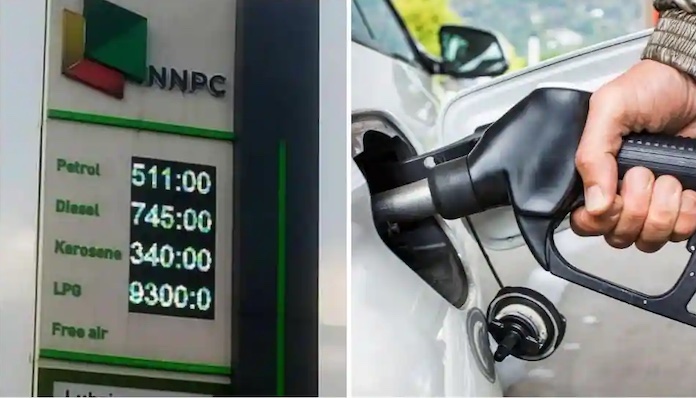
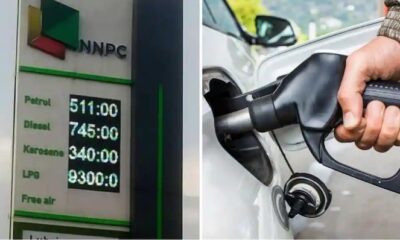
Pump prices of Premium Motor Spirit (PMS) have begun to drop at filling stations in some parts of Lagos and Ogun states following the recent reduction in the gantry price of petrol by the Dangote Petroleum Refinery. This price adjustment responds to the reduction in global crude oil prices as Iran and the United States reached an agreement.
Punch reports that at the SGR filling station in Mowe, Ogun state, a litre of petrol sells for N1,199, the lowest price encountered at the stops we visited. NIPCO, SAO, AP and MRS filling stations dispense a litre of fuel at N1,205 per litre, while Mobil petrol stations sell at N1,220 per litre.
A litre at Heyden’s station in Iperu went for N1,285 per litre. Other filling stations selling petrol at N1,245 per litre include NNPC Retail outlets in Ogun state.
Chinedu Ukadike, the Public Relations Officer of the Independent Petroleum Marketers Association of Nigeria (IPMAN), told Legit. during an interview that many filling stations are yet to reduce prices below N1,300 per litre because they are still managing old stock purchased at higher rates.
He explained that immediate price cuts could lead to losses for marketers still holding expensive inventory.
Ukadike said: “This announcement is enabling people who have old stocks to clear out their stocks, not only clearing out their stocks but also enabling them to prepare to take the fresh stocks.”
“Once the Dangote refinery announces a new price, there is a serious pause in loading. It will enable people who just bought new products to see how they can clear the old stocks within a window of a day or two.” He said once new products enter circulation, pricing adjustments will naturally follow.
Ukadike identified the cost of funds as another key factor affecting petrol pump prices, noting that financing expenses influence how quickly marketers adjust prices.

The Federal Government has disclosed that local petrol production has increased from effectively zero in 2023 to about 48 million litres per day. Special Adviser to the President on Oil and Gas, Mrs. Olu Verheijen, disclosed this at the Nigerian-British Chamber of Commerce Energy Day 2026.
A text of her presentation at the event, held recently in Lagos, was made available to the News Agency of Nigeria on Tuesday.
Speaking on the topic, “Energy in Nigeria: From Potential to Reality”, Verheijen noted that, for the first time in a generation, the majority of the petrol Nigerians consume is now refined at home. “This is where energy reform meets the strength of the Naira.
“For decades, every cargo of imported petrol was a standing demand for scarce dollars, a structural drain that weakened our currency. “As local refining has risen, that drain has eased: petrol imports fell from about N2.3 trillion in the first quarter of 2025 to under N90 billion a year later.
“Fewer dollars spent on fuel means less pressure on the Naira. Energy security and currency stability are not separate goals. They are the same goal,” she said.
On crude oil and condensate production, the Special Adviser said the country had restored investors’ confidence. According to her, crude oil and condensate production averaged 1.64 million barrels per day in 2025. She said the production was up by roughly 400,000 barrels a day since 2023, and the highest onshore level in two decades.
Verheijen also disclosed that over
four billion dollars in international oil company divestments had been concluded.
She said the divestment had helped to deepen indigenous participation in onshore, while the majors re-focused on deep-water and integrated gas.
“Every additional barrel matters — for revenue, for jobs, and for the strength of the federation,” she said
Reflecting on what the administration met on the ground in 2023, Verheijen said that the sector was under severe strain. She recalled that subsidies had become fiscally unsustainable while foreign-exchange distortions had weakened investment. “Production was below potential; Power-sector debt was strangling the gas-to-power chain. “The country had resources, but the system was not converting them into national value.
“So our first task was to stop the bleeding and rebuild the foundations,” she said.
In addressing the challenges, Verheijen recalled that President Tinubu’s administration restored fiscal credibility by removing the fuel subsidy and reforming the exchange rate.
According to her, the decisions were hard, but necessary.
“The results are visible. Total federation revenue rose to about N21 trillion in 2024, up from roughly N12 trillion in 2023 – nearly doubling in a single year,” she said.
She noted that, despite the deregulation, the government has prevented the chronic nationwide petrol queues that once defined scarcity.
NAN

Nigeria’s current account surplus rose sharply by 255.7 per cent quarter-on-quarter to $4.98bn in the first quarter of 2026, driven by higher crude oil, gas and refined petroleum exports, as well as a steep decline in petroleum product imports, according to the latest Balance of Payments report released by the Central Bank of Nigeria on Wednesday.
The apex bank, in its Q1 2026 Balance of Payments Highlights, stated that “provisional balance of payments statistics for Q1 2026 show a current account surplus of $4.98bn, which was higher than the $1.40bn and $3.41bn recorded in the preceding quarter (Q4 2025) and corresponding period (Q1 2025), respectively.”
The report showed that the current account surplus expanded by 255.71 per cent from the $1.40bn recorded in the fourth quarter of 2025 and was 46.04 per cent higher than the $3.41bn surplus posted in the corresponding period of 2025.
According to the CBN, the improvement was supported by increased earnings from crude oil exports, gas exports and refined petroleum product exports, alongside a significant reduction in refined petroleum product imports and lower net out-payments on the primary income account.
A breakdown of the external sector data showed that the goods account, which is the largest component of the current account, recorded a surplus of $5.95bn in Q1 2026, compared with $1.77bn in Q4 2025 and $3.35bn in Q1 2025.
The CBN said, “The goods account (a major sub-account in the current account) recorded a significantly higher surplus of $5.95bn in Q1 2026, as against $1.77bn and $3.35bn recorded in the preceding quarter and corresponding period of 2025.”
The stronger goods account position was underpinned by a rise in total exports to $15.49bn from $13.36bn in the previous quarter, largely due to higher crude oil and gas exports. Meanwhile, total imports fell to $9.54bn from $11.59bn, reflecting lower imports of refined petroleum products and non-oil goods.
Crude oil exports increased by 19.79 per cent quarter-on-quarter to $8.11bn, while gas exports rose by 12.95 per cent to $2.53bn. Refined petroleum product exports jumped by 20.3 per cent to $2.37bn. Non-oil exports also improved marginally by 4.62 per cent to $2.49bn.
On the import side, non-oil imports declined by 10.49 per cent to $7.85bn, while refined petroleum product imports dropped sharply to $0.31bn from $2.48bn. However, crude oil imports rose to $1.39bn from $0.34bn recorded in Q4 2025.
The report also showed mixed performances across other current account components. Net out-payments on services increased to $3.71bn from $3.32bn, driven largely by higher net debits in travel and other business services.
“The increase in net out-payments for services was largely due to increases in net debits in travel and other business services,” the bank stated.
The primary income deficit narrowed to $2.83bn from $3.27bn in the preceding quarter, reflecting lower dividend and interest payments to foreign investors. According to the report, “This was largely attributable to a decrease in out-payments (dividend and interest) to non-residents’ investments, mostly to direct investors.”
The secondary income account surplus, which largely captures remittance inflows, declined to $5.57bn from $6.21bn. Personal transfers from Nigerians in the diaspora fell to $5.30bn from $5.72bn in Q4 2025.
Despite the stronger current account position, the financial account remained in a net borrowing position. The report showed that net borrowing increased to $2.51bn in Q1 2026 from $1.96bn in the previous quarter.
Portfolio investment inflows strengthened during the period, rising to $6.03bn from $5.27bn in Q4 2025, while direct investment inflows moderated slightly to $1.03bn from $1.11bn. Nigerian investments abroad recorded outflows of $0.20bn under direct investment assets and $0.26bn under portfolio assets.
The CBN attributed developments in the financial account to increased portfolio investment inflows, a marginal decline in direct investment inflows, accretion to external reserves, and increased acquisition of portfolio investment assets abroad by residents.
Further analysis of the balance of payments data showed that Nigeria recorded an overall balance of payments surplus of $2.38bn in Q1 2026, lower than the $2.67bn surplus achieved in Q4 2025. The stock of external reserves, however, rose significantly to $48.35bn at the end of March 2026 from $45.75bn at the end of December 2025.
The report also highlighted a deterioration in net errors and omissions, which widened to negative $7.49bn in Q1 2026 from negative $3.36bn in the preceding quarter.
The latest figures indicate that improvements in oil production, rising petroleum exports and reduced dependence on imported fuel continued to strengthen Nigeria’s external position during the first quarter, helping to offset weaker remittance inflows and higher service-related outflows.


Tinubu Announces New Ambassadorial Appointment

FULL LIST: Names of Four Newly Elected Senators Officially Sworn In Today

Court Fixes June 30 For Ruling On Sowore’s Bail Application

Former Super Eagles Star Loses Life Savings, Duped By A Pastor of ₦1.2 Billion

I’m A Married Man, I Can Never Get Myself Involved With Such A Thing, Delta Gov Aide Reveals Why He Offered Comfort ₦500,000 Job

Lagos Imposes ₦250,000 Fine For Illegal Waste Disposal

-
 Business1 day ago
Petrol Prices Drop at Filling Stations Nationwide
-
 Tech2 days ago
Fact Check: What We Know About Viral Claims on Obasanjo’s Death
-
 Politics1 day ago
Fresh Crisis Hits APC as Popular Serving Senator Dumps Party
-
 News6 hours ago
Tinubu Announces New Ambassadorial Appointment
-

 News1 day ago
JUST IN: FG Announces Another Top Appointment
-
 Politics2 days ago
BREAKING: PRP Breaks Silence Following Reports Of Selling Nomination Forms To Kwankwaso
-

 Tech1 day ago
BREAKING: Ex-APC Chairman Dies in Bandits’ Custody (PHOTO)
-
 News1 day ago
JUST IN: Electricity Company Announces Total Blackout in Three States [FULL LIST]