
Opinion
The Americans Are Coming

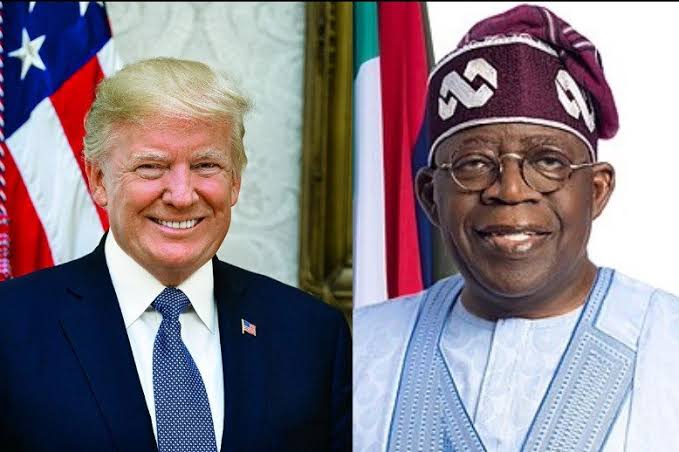
The Americans are coming and Nigerians are running helter-skelter, clawing at each other. In the space of a week, every Nigerian—Muslim, Christian, non-affiliate—has become a religious Voltron and a foreign policy expert. In the storm of public commentaries, “expert” analysis and social media expressions, it became clear that we are not listening to each other. We are, both Muslims and Christians alike, more spurred by emotions than reason. This emotive state of the nation made me quite reluctant to even address this issue because I doubt there will be any sort of objective reading of any kind of opinion. But in the end, these are issues that must be addressed.
I will try to avoid issues that have been over-analysed across several fora in the last few days. At this point, it doesn’t seem like any Nigerian can be convinced one way or the other whether there is a “Christian genocide” or not, as not many people are willing to change their opinion on this.
So, I will start by acknowledging that even a broken clock is right at least twice a day, and in all his rants, US President Donald Trump may be wrong about many things, but he is right on one issue—labelling Nigeria a “disgraced country.”
What country with any self-worth allows itself to be disgraced by a bunch of rag-tag groups of terrorists, criminals, militias, militants, gunmen, looters and every scallywag with balls? What sort of resource-and-population-rich country allows itself to be in a position to be threatened with the withholding of foreign aid or “military action” by a foreign power over a rascally lot we should have efficiently dealt with years ago?

Our ancestors said one should not look to where one fell but at where one tripped. There have been a series of mistakes and oversights that have got us to this point where our sovereignty is being dragged through the mud of the international village square. We caused it. Our governments did.
The first mistake we made was tolerating the existence of terrorist and criminal gangs across the country. Nigeria has successfully, through gross negligence, incompetence, complicity and corruption, democratized violence. The rise of ethnic militias that were unleashed at our return to democracy in 1999 and the communal violence that we witnessed in places like Kano, Kaduna, Jos, Sagamu, Lagos, etc., and the vigilantisation of the South East region, along with the government’s woeful handling of these situations, set us on this track.
Successive governments’ failure to secure Nigerians at that time was only compounded by the failure to dispense justice after those irrational bursts of violence. Mass murderers were shielded by this lack of justice; their crimes were waved away and they were allowed to continue walking among the people whose loved ones they killed.
This directly gave birth to militias and terrorists hiding under the guise of addressing these injustices the state overlooked. Fulani militias will claim they are avenging the murders of their loved ones and the rustling of their cattle by “Christian youths,” who in turn will claim they are avenging the injustices done to them when the herdsmen raided their farmlands. Even the worst scourge we have had in this country, Boko Haram and ISWAP, claimed they were fighting social injustice and carving out an “Islamic state” from Nigeria for themselves, to be governed by their twisted notion of justice, as their only option. The same arguments are being made by IPOB, who seek to carve out a separate state that they believe will be just to their people, as the Nigerian state has been unjust to them. The Niger Delta militancy, though not aspiring to secession, was fuelled by the decades of social and environmental injustices the region had suffered. This same rationale fuelled the OPC agitations.

Instead of dispensing justice, Nigeria has cavorted with terrorists and criminal gangs, cultivated them for political positioning and nurtured them for corrupt gains. “Repentant” Boko Haram members are pardoned and reintegrated into society without ever facing justice and with no regard for their victims; pro-tempore “repentant” bandits who have abducted hundreds and murdered dozens are presented before the press and treated as celebrities at “peace” events, where they come wearing their weapons like war medals, and leave with them only to resume their killings after a short while.
Our failure to handle this insecurity better—from Jonathan, to Buhari and now Tinubu, who all made campaign promises centring on this issue, and failed to follow up on them—led us here. I have written columns on massacres in Zamfara, Katsina, Plateau and Benue, where the government promises to find the horde of perpetrators and promptly sweeps aside the issue. We have been disgraced by these terrorists and the steady stream of headlines reporting mind-boggling massacres long before Trump decided to strip us naked in the village square.
This culture of neglect directly led to the second mistake—our failure to appoint ambassadors for two years. How any country, especially one that aspires to play a major role in the comity of nations, cannot have ambassadors to secure and advance its national interest is something that confounds. It is possible that the presence of an ambassador in the US, for example, might have mitigated the strength of misinformation deployed to push this narrative. Of course, there is no guarantee that would have prevented the stupendous misreading and oversimplification of the situation by the US government, but there is no way of knowing that, is there?
Other mistakes we have made have included not being deliberate about fostering national unity—which admittedly is a hard task when our concept of social justice is dangerously kwashiokored. Neither have we bothered to properly document the killings in the country to acknowledge the sheer scale of it, to honour and remember the victims, and remind ourselves never to let it happen again. Instead, we content ourselves with ineffectual presidential condemnations.
On the other hand, it would be really easy to dismiss Trump’s posturing and declaration as the actions of an impulsive man, but upon closer scrutiny, it may be far from it. For over a century, the US has lifted from a tested playbook. Most recently, we saw the deployment of the “Weapons of Mass Destruction” and other disinformation campaigns to put US boots on the ground in Iraq, to firebomb Gaddafi’s convoy in Libya and intervene in several countries where the populace anticipated the intervention would improve their lot. Most of these countries and their people have discovered that that hasn’t been the case.
Nigeria must be careful how it responds to this play by the US and not rush into the mistake that Colombia made. In 1928, striking Colombian banana plantation workers demanding better pay and working conditions threatened the interests of powerful US businesses—the United Fruit Company (UFC), which at the time had enormous influence and control over the banana trade in South and North America, generating billions in revenue.
To protect its interests, UFC worked closely with the US Ambassador to Colombia, Jefferson Caffery, who dispatched telegrams to the US Secretary of State portraying the strike as a communist uprising that must be quelled immediately.
Much as it is doing today, the US government of Calvin Coolidge, deliberately misinformed and misled, pressured the Colombian government to deal with the striking workers or risk being invaded by the US marines stationed just off the coast. In its panic to avoid invasion and end the strike, the Colombian government opened fire on its own citizens, killing about 2000 people who just wanted to be paid for their labour in what has become known as the Banana Massacre.
As in that case, a lot of disinformation and manipulation was employed, as was the case in Iraq and Libya, and other places the US had set eyes upon, and as is the case in Nigeria today. Whatever interest is being pursued by this narrative must not come at the expense of more Nigerian lives than are being lost already, but make no mistake, the terrorists killing Nigerian Muslims and Christians must be dealt with decisively and efficiently.
If there is anything worthwhile in this shameful episode, it is that Trump’s words and posturing might have lighted the fire that will force the Nigerian government to act decisively. Our government needs the kick in the backside. If the wails and whimpers of thousands of dying Nigerians and the streams of our blood have failed to convey the urgency of the situation, then perhaps these scathing words might serve the purpose.
It would be a terrible shame for the Americans to come; their words should suffice. Nigeria cannot afford to mismanage this crisis as we have mismanaged our security situation in the last two decades. But it is high time we put this house in order. After all, we can blame Trump’s unilateralism, but there has to be a crack in the wall for a lizard to crawl into.

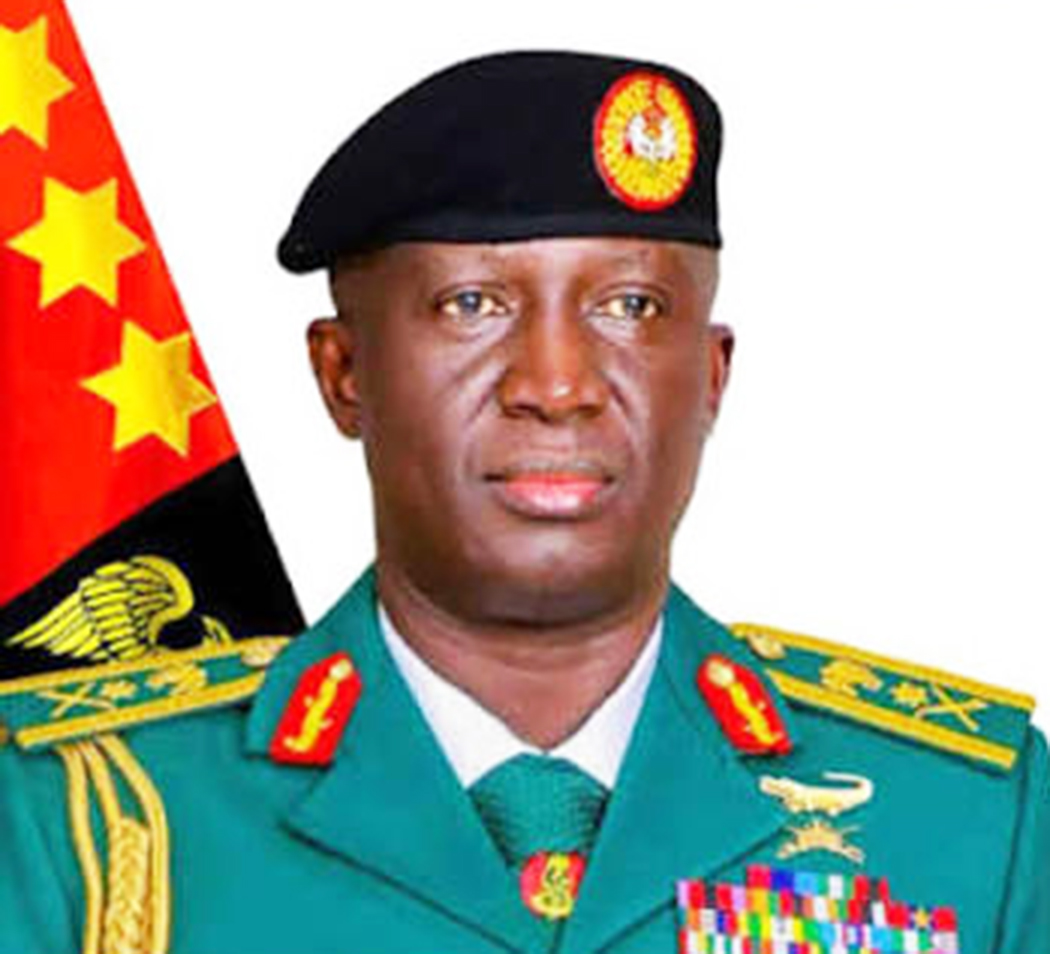
It was another sad day last Monday when the news broke that a serving colonel of the Nigerian Army had been killed while his wife was shot in an attack on their residence near Abuja.
The slain officer, Colonel Abdussalam Ude, was attacked shortly after returning to his home in Kurudu District of the nation’s capital, on Monday evening. His driver and security guard also sustained gunshot wounds during the assault.
Citing security sources, PRNigeria said the attackers attempted to abduct the officer but met stiff resistance. After failing to take him away, the assailants allegedly shot the officer multiple times before fleeing the scene.
His wife, driver and security guard, who were caught in the attack, were rushed to hospital and were receiving treatment for varying degrees of gunshot injuries.
The killing has sent shockwaves through military circles, coming at a time Colonel Ude was preparing for his promotion to the rank of Brigadier General.
An indigene of Enugu State, the late officer served in several strategic intelligence and counter-terrorism roles within the Armed Forces. LawEnforcement
Colleagues described him as a courageous and highly respected intelligence officer whose dedication to duty earned him widespread admiration within the military.
Besides the fact that the killing has renewed concerns over attacks on serving and retired military officers in Abuja and other parts of the country, the killing of a senior military officer by gunmen right inside his residence, also shows how unsafe the country has become for both ordinary and privileged Nigerians.
It is particularly worse for military personnel. They are not safe on the battlefront; they are not safe at home and they are safe in retirement.
The incident comes about two years after retired Brigadier General Uwem Harold Udokwere was killed by armed men who invaded his residence in the Lokogoma area of Abuja while he was defending his family. The attackers reportedly escaped with his firearm and other valuables.
The federal government has to seriously come up with a strategy on how to end the incessant killings in the country. In the last one week, over 70 people have been killed across the country. Nigerians cannot continued to leave in fear.
-THISDAY
BREAKDOWN EMERGES
Nigerian ambassadors’ pay packages have come under renewed attention. Fresh figures revealed that while basic salaries remained modest, allowances significantly boosted overall compensation for diplomats posted abroad
Reports showed that total monthly take-home pay often reached several million naira, reflecting the high costs of overseas postings
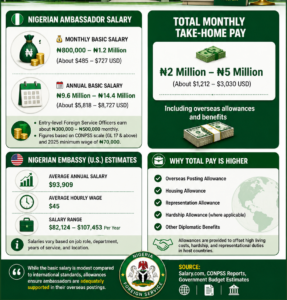
According to Salary.com, as of December 2025, the average annual salary for employees at the Nigerian Embassy in the United States stood at $93,909. This translated to an approximate hourly wage of $45.
Salaries at the embassy typically ranged from $82,124 to $107,453 annually, reflecting the diverse roles and levels of experience within the organisation. Reports indicated that pay was influenced by factors such as job role, department, years of service, and location.
Nigerian Ambassador Salary Structure
Rufai Oseni of Arise TV reported that the salary of Nigerian ambassadors was governed by the Consolidated Diplomatic, Consular and Foreign Service Cadre Salary Structure (CONPSS) in the Nigerian public service. Ambassadors usually fell into the highest grade levels, GL 17 or equivalent, with additional allowances for overseas postings.
Based on government budget allocations, salary surveys, and reports on foreign service personnel costs, the basic salary was described as modest by international standards but supplemented by substantial allowances.
Basic Salary of Nigerian Ambassadors Monthly Basic Pay:
Approximately ₦800,000 to ₦1,200,000 (about $485–$727 USD).
Annual Basic Salary: ₦9.6 million to ₦14.4 million (about $5,818–$8,727 USD).
These figures were drawn from the CONPSS scale for top-tier diplomatic officers. Entry-level foreign service officers reportedly earned around ₦300,000–₦500,000 monthly, but ambassadors, being at the top of the career ladder, commanded the upper end.
The figures also aligned with general public sector pay for Grade Level 17 officers, adjusted for inflation and the 2025 minimum wage increase to ₦70,000.
Allowances and Total Compensation
Reports highlighted that basic pay alone did not reflect the full compensation package.
Nigerian ambassadors posted overseas received allowances designed to offset high living expenses, hardship, and representational duties.
Total monthly take-home pay often exceeded ₦2–5 million ($1,212–$3,030 USD), depending on the host country.
The release of estimated salaries shed light on the financial structure of Nigeria’s foreign service. While the basic salary remained modest compared to international standards, allowances ensured that ambassadors were adequately supported in their overseas postings.

The Nigeria Police Force has outlined the application process for obtaining a Police Character Certificate and Tinted Glass Permit through its Police Specialised Services Automation Project portal.
According to the guidelines on the POSSAP platform, applicants can complete most of the process online before visiting a designated police command or formation for biometric capture.
Here are the steps and requirements:
Police Character Certificate
So This Happened (EP 413): Zamfara Gunmen Abduct Council Chairman, Kill Four Security Personnel0:09 / 1:01
Applicants are required to fill out an online request form with the following details:
• Identification type (National Identification Number, Bank Verification Number or International Passport)
• Identification number
• Full name
• Phone number
• Email address
• Gender
• State of residence
• Local Government Area
• Residential address
• Alternative contact information (optional)
STEP-BY-STEP

Tinted Glass Permit
The application process follows four stages:
• Select the tinted glass permit service
• Complete the online request form
• Confirm submitted details and submit the application
• Make the required payment
Applicants must provide the same personal information required for the Police Character Certificate, including:
• Identification type and number
• Full name
• Phone number
• Email address
• Gender
• State
• Local Government Area
• Residential address
• Optional alternative contact details
Important guidelines for applicants
The Nigeria Police Force reserves the right to approve or reject any application based on its operational guidelines and security considerations.
Submission of false information, forged documents or fake biometric data will lead to automatic rejection of the application and may attract penalties.
Applicants residing in Nigeria must appear in person at their selected police command or formation for biometric capture on their scheduled appointment date.
A one-time, non-refundable application and processing fee is required for each request.
Payments must be made only through the POSSAP platform using the payment invoice generated during the application process .
Applicants are not required to pay any additional fees at police formations for biometric capture or collection of certificates or permits.
Processing and issuance of applications require a minimum of 72 hours.
Apply here: http://possap.gov.ng/p/login


ADC Secretary Resigns from Party Ahead of 2027 Election, Joins New Party

BREAKING: Sultan of Sokoto Speaks on Endorsing Tinubu’s 2027 Re-election Bid

JUST IN: Fresh Trouble For Atiku as Powerful ADC Senator Resigns, Joins New Party

Former Super Eagles Star Loses Life Savings, Duped By A Pastor of ₦1.2 Billion

I’m A Married Man, I Can Never Get Myself Involved With Such A Thing, Delta Gov Aide Reveals Why He Offered Comfort ₦500,000 Job

Lagos Imposes ₦250,000 Fine For Illegal Waste Disposal

-
 Business2 days ago
Dollar To Naira Exchange Rate Today, August 4th, 2026
-

 Politics1 day ago
2027 Election: Oriyomi Hamzat Makes Major Move, Picks Female Running Mate
-

 Tech2 days ago
Did Lady Who Filmed Oloolu Masquerade Procession Die? Truth Emerges
-
 News2 days ago
Full List: How Sylva’s Alleged Coup Funds Were Shared Among Soldiers, Clerics
-

 Business2 days ago
Good News as Cooking Gas Prices Crash, NLNG Suspends Exports Amid New Policy
-

 Business1 day ago
BREAKING: Again, Dangote Reduces Petrol Prices
-
 Uncategorized1 day ago
BREAKING: President Tinubu Approves New Salary Package for Armed Forces Personnel
-

 News1 day ago
BREAKING: Nigerian Gov Announces 19 New Appointments