News
NASS To Harmonise Electoral Bill On Monday

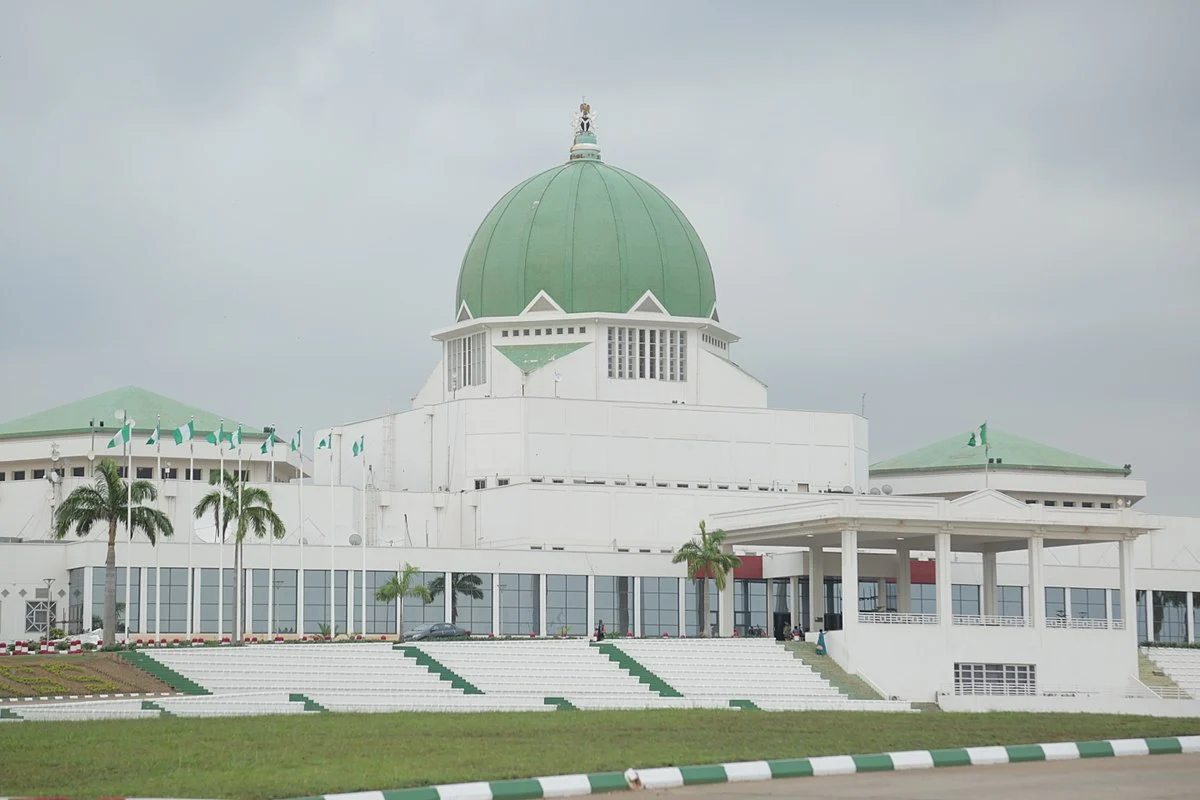
Members of the Joint National Assembly Conference Committee constituted to reconcile differences in the Electoral Amendment Bill passed separately by the Senate and the House of Representatives are expected to meet on Monday as lawmakers move to transmit a harmonised version to President Bola Tinubu for assent.
Findings by The PUNCH on Thursday showed that the joint panel, made up of members from both chambers, has been given a one-week window to resolve contentious provisions in the bill — notably those dealing with the electronic transmission of election results.
The decision to harmonise the bill follows the passage of different versions by the Senate and the House, particularly on the role of technology in result collation and transmission. Under legislative procedure, where both chambers pass varying texts of the same bill, a conference committee is set up to produce a single version acceptable to both sides before transmission to the President.
The current amendment process is coming on the heels of the controversies that trailed the 2023 general election, especially the failure of the Independent National Electoral Commission to upload presidential election results to its Result Viewing Portal in real time.
Civil society groups, opposition parties and several lawmakers have since pressed for clearer statutory backing for the electronic transmission of results to prevent ambiguity and strengthen electoral transparency ahead of 2027.
Although many lawmakers have remained silent on the likely outcome of the harmonisation process, some admitted privately that they were keenly awaiting the meeting to know the committee’s final position on the disputed clauses.
A National Assembly source confirmed that the harmonisation exercise would begin on Monday.

“It is taking place on Monday,” the source stated via a WhatsApp message.
When approached after a recent interaction with journalists on the proposed meeting date, the lawmaker representing Bayelsa West, Senator Seriake Dickson, told The PUNCH Monday was a likely date for the harmonisation of the bill.
“I don’t know the actual date since I am not a member of the Conference Committee. But we are hoping it may take place next Monday,” he said.
Efforts to obtain clarification from the Senate spokesman, Senator Yemi Adaramodu, and the Chairman of the Senate Committee on Judiciary, Human Rights and Legal Matters, Senator Niyi Adegbonmire, were unsuccessful, as they neither answered calls nor responded to text messages seeking comment.
The development comes amid heightened public interest in the fate of the Electoral Amendment Bill, following recent disagreements over provisions relating to the electronic transmission of results.
The PUNCH had earlier reported that Dickson, on Wednesday, urged members of the Conference Committee to adopt entirely the version passed by the House of Representatives, warning that weakening the electronic transmission clause could erode public confidence in the electoral process.
The former Bayelsa State governor spoke in Abuja, less than 48 hours after the Senate reversed an earlier position and restored electronic transmission of election results to INEC’s Result Viewing Portal, IReV, while allowing manual collation as a fallback in the event of technological failure.
Dickson, a member of the Senate Committee on Electoral Matters, maintained that extensive consultations had been undertaken by lawmakers and stakeholders to strengthen the country’s electoral legal framework before the Senate’s initial alterations.
Senate President Godswill Akpabio had also indicated that the harmonised bill would be transmitted to President Tinubu for assent before the end of the month, raising expectations that the amendments could be concluded well ahead of preparations for the 2027 general election.
Meanwhile, a source familiar with the process told The PUNCH that Senator Simon Lalong, representing Plateau South, had earlier confirmed Monday, February 16, 2026, as the date for the committee meeting to reconcile the bill ahead of its transmission for presidential assent.
“Senator Lalong has given Monday as the day of the meeting on the bill. I think the members may have been excused from the ongoing budget defence exercise by the various Ministries, Departments and Agencies to work on the bill, given its importance to the 2027 election,” the source said.
Although he did not expressly confirm the Monday meeting, the House spokesman, Akin Rotimi, said members drawn from both chambers had already begun consultations.
“They are already engaging,” he said, without offering further details.
In the same vein, two members of the committee, Sada Soli (APC, Katsina) and Iduma Igariwey (PDP, Ebonyi) said the meeting will likely hold on Monday.
“It’s possible but not yet confirmed,” Soli said while Igariwey added, “not yet confirmed.”
The outcome of the meeting is expected to determine the final shape of the amended Electoral Act and signal the National Assembly’s position on the central issue that has dominated electoral reform debates since the last general election — the place of technology in safeguarding the credibility of Nigeria’s polls.
Although the House approved real-time transmission of election results in Section 60 (3), the Senate’s version excluded it but bowed to pressure earlier in the week to approve electronic transmission with a provision that, when technology fails, manual transmission will suffice.
The House version read, “The Commission shall electronically transmit the results from each polling unit to the IREV portal in real time, and such transmission shall be done simultaneously with the physical collation of results.”
On its part, the Senate version provides that “The Presiding Officer shall electronically transmit the results from each polling unit to the INEC Result Viewing Portal, and such transmission shall be done after the prescribed Form EC8A has been signed and stamped by the Presiding Officer and countersigned by the candidates or polling agents where available at the polling unit.
“But if the electronic transmission of the result fails as a result of communication failure, and it becomes impossible to transmit the result electronically, the signed and stamped Form EC8A by the Presiding Officer, and countersigned by the candidates or polling agents where available, shall in such a case be the primary source of collation and declaration of results.”
House okays affidavit
The House also strengthened Section 31 of the Principal Act, which focused on the withdrawal of a candidate in an election.
In the Electoral Act 2022, the Section read, “A candidate may withdraw his or her candidature by notice in writing signed by him and delivered personally by the candidate to the political party that nominated him for election, and the political party shall convey such withdrawal to the Commission not later than 90 days to the election.”
The version amended by the 10th House read, “A candidate may withdraw his or her candidature by notice in writing signed by him together with a sworn affidavit and delivered personally by the candidate to the political party that nominated him for election, and the political party shall convey such withdrawal to the Commission not later than 90 days to the election.”
Tribunal timeline reduced
The House also amended Section 137 of the Principal Act on the Establishment of Area Council Election Appeal Tribunal, proposing in sub-section 7 that “The tribunal shall deliver a judgment in writing within 150 days from the date of the filing of the petition. This contrasts with the Principal Act, which provides for 180 days from the date a petition is filed.”
Meanwhile, the Senate stated that real-time transmission of election result does not automatically translate to electronic voting, contrary to insinuations in some quarters in the past few days.
The Senator representing Ondo Central, Adeniyi Adegbonmire, made this known while speaking on an Arise News programme on Thursday.
According to him, INEC does not have the capacity to conduct e-voting at present, noting that the Commission has clarified that the Result Viewing Portal (IReV) “is not an e-voting platform, but a platform where the election results that have been manually counted and declared at the polling units are uploaded and publicised.”
Adeggbonmire, who chairs the Senate Ad-hoc Panel to Review the 2026 Electoral Bill, said Nigeria had not transitioned to an e-voting system, contrary to what some people had insinuated or what some media platforms want the public to believe.
He said, “People need to understand what real-time means. Real-time transmission can only happen if INEC adopts an e-voting system. For now, INEC does not have the capability for e-voting. Maybe in two or three years, we can adopt e-voting. But as of today, INEC has not put an e-voting system in place.
“This is the misconception that the media has brought into play. The provision you keep emphasising says the presiding officer will first fill in the result manually in Form EC8A. It is the Form EC8A that has been filled manually that will be transmitted to IReV. If we change ‘transmit’ to ‘upload’ in the Electoral Bill, 2026, will it change anything? The answer is ‘No.’”
Adegbonmire, a Senior Advocate of Nigeria and Chairman, Senate Committee on Judiciary, Human Rights and Legal Matters, further explained the misconception about IReV, which, according to him, should be corrected considering its implications for the country’s peaceful co-existence.
The lawmaker, therefore, pointed out that IReV “is not a voting platform, but a podium meant to publicise election results already declared by the presiding officers at polling units across the federation.
“It is important, first of all, to understand what IReV does because there is a lot of misconception about it or deliberate misrepresentation of what it stands for. The Senate never said INEC should not use IReV for the 2027 elections. So, what is IReV? It is a software developed by INEC to publicise the results by INEC.
“IReV is not an e-voting platform as some people think. This is the misinformation some people are peddling. This is not an emotional argument. I heard people say the version of the House of Representatives should be adopted. It is a sheer misconception. What does the version say? It simply says the presiding officer shall electronically transmit the result from each polling unit to the IReV portal in real time, and such transmission shall be done after Form EC8A has been signed by the presiding officer and countersigned by the candidate or polling agent at the polling unit.”
He also explained that IReV, as an electronic platform to display election results, had “a pattern of working, and the National Assembly cannot change the software by mere legislation. It was a sheer misconception to conclude that the Senate declined the use of IReV for the transmission of election results.”
He argued that semantics won’t change what the platform was meant to achieve, saying, “whether we call it upload, transfer, or transmission, as far as it says IReV must be used, it will be used in the manner it was configured. That is the point I am making. You must first manually write out the figures. After you have written out the figures at the polling unit, then you can upload, transfer or transmit, depending on the nomenclature we want to use.
“When you have not complied with the proper filing of Form EC8A, you cannot transfer, transmit or upload it. That is what people must understand. When you talk about transmission, it has nothing to do with the sanctity of the voting process. If you are given a ballot paper to thumbprint, it is counted manually after the election. It is not IReV or BVAS that counts ballots. The vote count is manually done.
“In my own case, for instance, I come from Akure. I vote in Akure. All the electoral materials are brought into Akure two to three days before the election. They are kept in the Central Bank of Nigeria (CBN). The night before, they start transporting them to different locations across the state. In Ondo State, there are places where one has to travel for eight hours to get there. In some cases, they have to use boats to get to the riverine areas.
“This means voting cannot start at the same time nationwide. In Akure, voting can start at 10am. In other parts of the state, voting may not start until 2pm, even some at 4pm in some cases. Most likely, they will finish the vote count by 10pm.
“In Akure, for instance, the presiding officers will upload election results at polling units at 4pm because voting is concluded as scheduled. In Arugbo Ijaw, however, voting kicks off at 4. This is the reality in the country, and we must take it into consideration in our reforms. The truth of the matter is that you are not going to see how you voted on the IReV because it is not an e-voting platform.
“What the Senate has done is that we do not want a situation in which somebody will say this man ought to have uploaded this result at 2pm. You and I know that it is not every time you put something on the Internet that it will go through freely. If we are not careful, the smallest thing will spark an issue.
“If somebody said the election result was declared at 2pm, how did you put it on IReV at 7pm? They will simply assume that the election results must have been rigged. The media needs to be careful how they report all these issues.”
Agbakoba reacts
A former President of the Nigerian Bar Association, Dr Olisa Agbakoba, on Thursday called on the National Assembly to amend the Electoral Act to allow mandatory real-time electronic transmission of election results.
In a statement made available to The PUNCH on Thursday, Agbakoba argued that real-time transmission would guarantee transparency and credibility, similar to the Option A4 system used in the June 12, 1993 election, widely regarded as Nigeria’s freest and fairest poll.
He said, “The National Assembly must act decisively to embed mandatory real-time electronic transmission of results in the Electoral Act. Democracy demands nothing less.”
Agbakoba described the June 12 election as Nigeria’s benchmark for electoral credibility, attributing its success to transparency rather than technology.
“The Option A4 system allowed voters, party agents and observers to openly verify results at polling units before collation,” he said.
“If manual transparency could deliver such credibility in 1993, imagine the transformative impact of real-time electronic transmission in our digital age.”
He maintained that Nigeria’s electoral framework remained flawed despite previous amendments to the Electoral Act.
According to him, the country’s electoral crisis is rooted in “the absence of strong regulatory processes backed by express statutory authority,” noting that repeated amendments have failed to address fundamental defects.
“With every election cycle, we rush to amend the Electoral Act, yet we continue to grapple with the same challenges. This vicious cycle must end,” he said.
Agbakoba added that persistent legal uncertainty continued to undermine democratic outcomes and pushed the courts into the role of deciding election winners.
The lawyer said the 2023 general election exposed weaknesses in Nigeria’s electoral legal framework, particularly on electronic transmission of results, as the Supreme Court ruled that the IReV innovation lacked legal force.
“The court was clear that because electronic transmission is not expressly provided for in the Electoral Act 2022, it is not legally binding,” he stated.
“The IReV portal, according to the court, serves merely for public viewing and is not admissible evidence of results in election petitions.
“The ruling sent an unmistakable message that without explicit statutory provision, electronic transmission remains optional and legally inconsequential, no matter how transparent or efficient it may be.”
He warned that the legal gap had imposed an “insurmountable evidentiary burden” on election petitioners, making it practically impossible to successfully challenge flawed elections.
Citing the late Justice Pat Acholonu’s concurring opinion in Buhari v. Obasanjo (2005), Agbakoba recalled the jurist’s observation that a petitioner would need between 250,000 and 300,000 witnesses nationwide to prove a presidential election case.
“Justice Acholonu warned that even a successful challenge could amount to an ‘empty victory bereft of any substance’ because the president-elect might already have completed the four-year tenure. Tragically, no presidential election petition has succeeded since 1999,” he said.
Former Commissioner of Police in Niger State, Diseye Desire Nsirim, rtd, has died after a brief illness.
Nsirim died on Monday, September 21, 2026, in a hospital, according to the Niger State Police Command.
The late police officer, who hailed from Kolokuma/Opokuma Local Government Area of Bayelsa State, served as the 27th Commissioner of Police in Niger State between 2012 and 2014.
She was the first and, according to the command, the only female Commissioner of Police to have served in the state.
The command said that during her tenure, Nsirim contributed to crime prevention, public safety and the maintenance of law and order in the state.
It listed the dismantling of the Darul-Salam group in Mokwa and the busting of another terrorist group in Minna among her notable achievements as Commissioner of Police.
In a statement issued on Tuesday, the Niger State Police Public Relations Officer, SP Wasiu Abiodun, said the command’s current Commissioner of Police, Adamu Abdullahi Elleman, commiserated with Nsirim’s family, relatives, colleagues and associates.
Elleman described the late officer’s contributions to policing in Niger State and national security as significant.
He prayed for strength and fortitude for the family to bear the loss.

A civil servants’ group, the Federal Workers Forum (FWF), has formally written to President Bola Tinubu and the National Assembly demanding that the federal minimum wage be raised from N70,000 to N300,000, with a maximum salary of N1.5 million for Level 17 officers.
As reported on Thursday, September 3, by The Punch, the letter, dated September 2, 2026, was signed by National Coordinator Andrew Emelieze and General Secretary Ogundele Ayodele.
It was addressed to the Senate President and Speaker of the House of Representatives through the Clerk of the National Assembly, with President Tinubu, the Chief Justice of Nigeria, and the Head of the Civil Service of the Federation listed as additional recipients.
The forum argued that the N70,000 minimum wage passed in 2024 had not been properly carried out, saying workers received only a blanket N40,000 addition regardless of grade level.
“The Federal Government has not fully implemented the new national minimum wage since July 2024. We have been in the battle for full consequential adjustment of the new minimum wage,” the group said in the letter.
The FWF insisted that the statutory three-year review cycle should not stop the government from acting urgently, describing the current situation as an emergency.
“It is suicidal for the federal workers to continue in this ugly situation,” the letter read. “Federal workers are dying in instalments; we are suffering in silence; our salary is too poor; it is not taking us home.”
The group also claimed some workers had borrowed from microfinance banks and mobile loan applications just to cover transport to work, while others had resorted to cooking with firewood because they could no longer afford gas.
The forum attached a full pay scale to the letter.
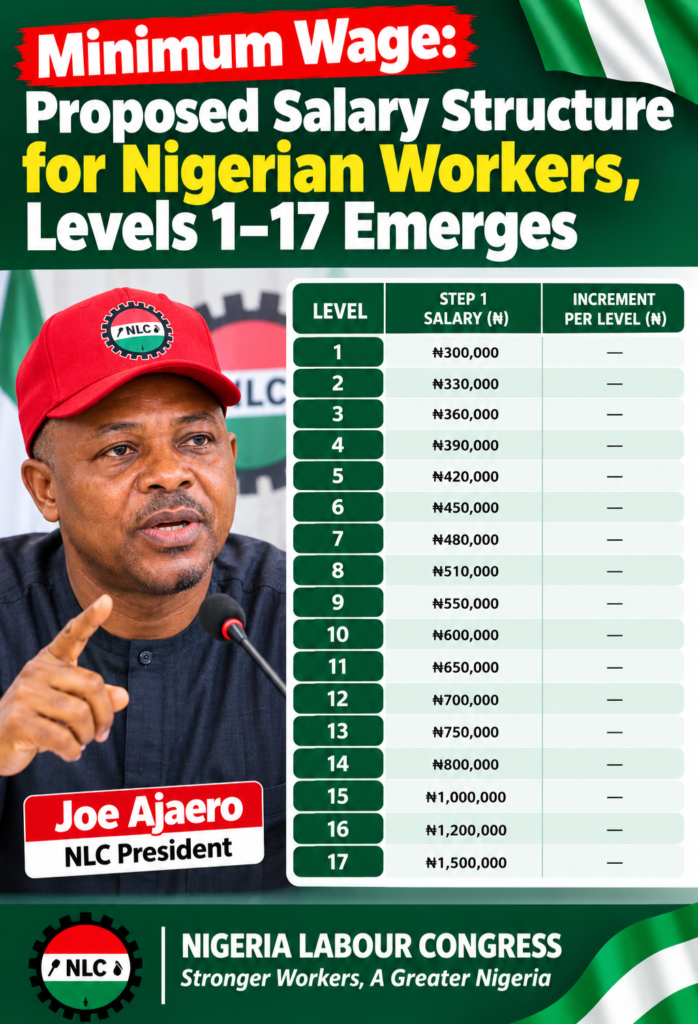
Beyond wages, the FWF demanded payment of all outstanding salaries and promotion arrears, implementation of a 40 per cent peculiar allowance, a permanent Cost of Living Allowance, family support payments, comprehensive health insurance, and housing and car loan schemes for federal workers.
The forum also called for free education for children of federal workers in federal institutions, reduced taxation on allowances, and a broader social security programme for unemployed Nigerians.
On pensions, the group asked the National Assembly to investigate claims that part of workers’ contributory pension savings was being borrowed by the executive, demanding an immediate stop and full refund if confirmed.

President Bola Ahmed Tinubu is set to give Minister of the Federal Capital Territory, Nyesom Wike, a defined role in his 2027 presidential campaign, with the former Rivers State governor expected to coordinate the campaign structure in Rivers State and the Federal Capital Territory.
The arrangement is expected to allow Tinubu’s campaign to benefit from Wike’s political network in the two territories while avoiding a formal change in the minister’s party affiliation.
Wike remains a member of the Peoples Democratic Party despite his open support for Tinubu’s re-election bid.
This appointment is coming against the background of disagreements between Wike and some APC governors over the best way to mobilise support for Tinubu.
Wike has consistently maintained that he does not need to join the APC before supporting the President in 2027.
He has also rejected the idea that his political relevance should be measured by whether he occupies a top position in the APC Presidential Campaign Council.
In August, Wike made his position clear after the APC unveiled its Presidential Campaign Council and appointed former Zamfara State Governor, Abdulaziz Yari, as Director-General.
The FCT minister said he would rather concentrate on Rivers State and the FCT than pursue the position of campaign director-general.
“What’s important is that you are able to deliver those two states. So it’s not about being DG. If you’re DG and you don’t win your state, what’s the essence of the DG?” Wike said.
“I don’t want to lose my state,” he added.
The proposed arrangement would therefore give Wike a specific responsibility without placing him under the formal hierarchy of the APC.
His expected assignment is particularly significant because of his political influence in Rivers State, where he served as governor for eight years, and the FCT, where he has served as minister since 2023.
Wike has repeatedly claimed responsibility for the political structure in both territories and has promised to work for Tinubu’s victory in the presidential election.
During a recent media engagement, he described himself as the “General Commander of the Political Infantry” and insisted that occupying the office of governor was not the only way to remain politically influential in a state.
“You do not need to be governor before you can be in charge. I am the General Commander of the Political Infantry; therefore, I am in charge,” Wike said.
The minister has also drawn a distinction between supporting Tinubu for president and supporting individual candidates seeking other elective positions.
He recently said his support for the President should not be interpreted as an undertaking to help politicians win their respective state-level contests.
Wike said his focus would remain the presidential election and that politicians seeking victories in governorship and legislative elections should handle their own political battles.
“Rainbow coalition has nothing to do with the APC. Rather, it is our own way of mobilising support across political parties for Mr President, who has done well to deserve a second term,” Wike said.
The Rainbow Coalition promoted by Wike is made up of politicians and political interests from different parties who support Tinubu’s return to office in 2027.
However, the arrangement has created tension with some APC governors who have questioned the need for a separate political structure outside the party.
The disagreement became more pronounced after Imo State Governor and Chairman of the Progressive Governors’ Forum, Hope Uzodimma, announced that APC governors had rejected the Rainbow Coalition.
Wike subsequently criticised some APC governors, including Uzodimma and Kwara State Governor AbdulRahman AbdulRazaq.
He accused some politicians of being more interested in being seen as the people working for Tinubu than in building genuine support for the President.
“You see, the problem with people, they want them to be seen, that they are the people working for the President. I don’t do that,” Wike said.
Under the new role, Wike would focus on Rivers and the FCT, while other senior members of the campaign would handle their own areas of responsibility.
Yari is expected to remain Director-General of the Presidential Campaign Council.
However, the proposed structure is not expected to operate strictly through a single chain of command.
Senate President Godswill Akpabio and Deputy Senate President Jibrin Barau are reportedly not expected to report directly to Yari despite their roles within the campaign structure.
Another prominent figure expected to play a major role in the campaign is Minister of Aviation and Aerospace Development, Festus Keyamo.
Keyamo is being considered for a major spokesperson position in the campaign.
He has considerable experience in presidential campaign communication.
He served as a spokesperson and Director of Public Affairs during Tinubu’s 2023 presidential campaign.
He also played a senior communications role in former President Muhammadu Buhari’s 2019 re-election campaign.
Keyamo later served as Minister of State for Labour and Employment under Buhari before becoming the Minister of Aviation and Aerospace Development under Tinubu.


Courts Sacks ADC Prominent Candidate

Ex Police Commissioner Dies

Minimum Wage: Proposed Salary Structure for Nigerian Workers, Levels 1–17 Emerges

Former Super Eagles Star Loses Life Savings, Duped By A Pastor of ₦1.2 Billion

I’m A Married Man, I Can Never Get Myself Involved With Such A Thing, Delta Gov Aide Reveals Why He Offered Comfort ₦500,000 Job