News
Breaking: Saudi Arabia Announces 2026 Eid al-Fitr Day


Saudi Arabia has announced that Friday, March 20, will be the day for the celebration of the 2026 Eid al-Fitr festival as the holy month of Ramadan approaches its end. Reports that emerged from the Kingdom indicated that the crescent moon for the month of Shawwal 1447 was not sighted in any part of Saudi Arabia.
The development indicated that the 2026 Ramadan month will complete 30 days on Thursday, March 19 and that Eid al-Fitr will be celebrated on Friday, March 20. This was disclosed in a report by HaramainInfo, a Saudi-based media outlet. The media accompanied the report with the quote:
“May Allāh allow us to utilise the remaining moments of this blessed month to engage in that which pleases Him, may He accept our siyām, qiyām & a’māl and may He allow us to witness many more Ramadāns in good health. Āmīn.”
However, the announcement has started generating reactions from Muslims around the world. Below are some of their comments:
Usman expressed his joy for the festive period:
“Getting another day of Ramadan is actually ‘Mohlat’. Allah wants us to ask a little more, cry a little more. These 24 hours can change our destiny.”
Farida shared prayers about Ramadan:

“Alhamdulillah for the remaining days of Ramadan! May Allah accept all our fasts, prayers, and good deeds. Let’s make the most of these final moments to earn His pleasure. May He grant us many more Ramadans in health and faith. Eid Mubarak iAbijr expressed gratitude to Allah for the grace of the holy month:
“24 more hours of Ibadat. Some of us may not witness another Ramadan, so please let’s finish this strong, and may Allah SW accept our saum.”
Rahman commented on the discrepancies in the announcement sighting of the moon in Nigeria: “As I want to do 30 now, no be the one when the day Saudi go announce 29 people go say wait till His Eminence announce it too o.” advance to everyone, filled with joy and blessings.”
RedVikingFC faulted Saudi Arabia’s statement
“Why do you always make a unanimous decision for the Muslim Ummah? What if the moon is sighted in Senegal or Turkey? Would you change your stance and join the rest of the world in observing Eid Al Fitr?”
Alabi Rabiu stated:
“There is no Eid in Saudi Arabia on 19th Mar 2026 alone, we don’t follow Saudi Arabia, we follow the teachings of Annabi Mohammad S.A.W., so we await the rest of the world’s verdict.”
You can read full details on X here:
BREAKING NEWS | The crescent moon has NOT been sighted in Saudi Arabia. Therefore, #EidAlFitr will be celebrated on Friday, 20th March 2026.
May Allāh allow us to utilise the remaining moments of this blessed month to engage in that which pleases Him, may He accept our siyām,… pic.twitter.com/xLwJ1dEpL1
— 𝗛𝗮𝗿𝗮𝗺𝗮𝗶𝗻 (@HaramainInfo) March 18, 2026

Former Commissioner of Police in Niger State, Diseye Desire Nsirim, rtd, has died after a brief illness.
Nsirim died on Monday, September 21, 2026, in a hospital, according to the Niger State Police Command.
The late police officer, who hailed from Kolokuma/Opokuma Local Government Area of Bayelsa State, served as the 27th Commissioner of Police in Niger State between 2012 and 2014.
She was the first and, according to the command, the only female Commissioner of Police to have served in the state.
The command said that during her tenure, Nsirim contributed to crime prevention, public safety and the maintenance of law and order in the state.
It listed the dismantling of the Darul-Salam group in Mokwa and the busting of another terrorist group in Minna among her notable achievements as Commissioner of Police.
In a statement issued on Tuesday, the Niger State Police Public Relations Officer, SP Wasiu Abiodun, said the command’s current Commissioner of Police, Adamu Abdullahi Elleman, commiserated with Nsirim’s family, relatives, colleagues and associates.
Elleman described the late officer’s contributions to policing in Niger State and national security as significant.
He prayed for strength and fortitude for the family to bear the loss.

A civil servants’ group, the Federal Workers Forum (FWF), has formally written to President Bola Tinubu and the National Assembly demanding that the federal minimum wage be raised from N70,000 to N300,000, with a maximum salary of N1.5 million for Level 17 officers.
As reported on Thursday, September 3, by The Punch, the letter, dated September 2, 2026, was signed by National Coordinator Andrew Emelieze and General Secretary Ogundele Ayodele.
It was addressed to the Senate President and Speaker of the House of Representatives through the Clerk of the National Assembly, with President Tinubu, the Chief Justice of Nigeria, and the Head of the Civil Service of the Federation listed as additional recipients.
The forum argued that the N70,000 minimum wage passed in 2024 had not been properly carried out, saying workers received only a blanket N40,000 addition regardless of grade level.
“The Federal Government has not fully implemented the new national minimum wage since July 2024. We have been in the battle for full consequential adjustment of the new minimum wage,” the group said in the letter.
The FWF insisted that the statutory three-year review cycle should not stop the government from acting urgently, describing the current situation as an emergency.
“It is suicidal for the federal workers to continue in this ugly situation,” the letter read. “Federal workers are dying in instalments; we are suffering in silence; our salary is too poor; it is not taking us home.”
The group also claimed some workers had borrowed from microfinance banks and mobile loan applications just to cover transport to work, while others had resorted to cooking with firewood because they could no longer afford gas.
The forum attached a full pay scale to the letter.
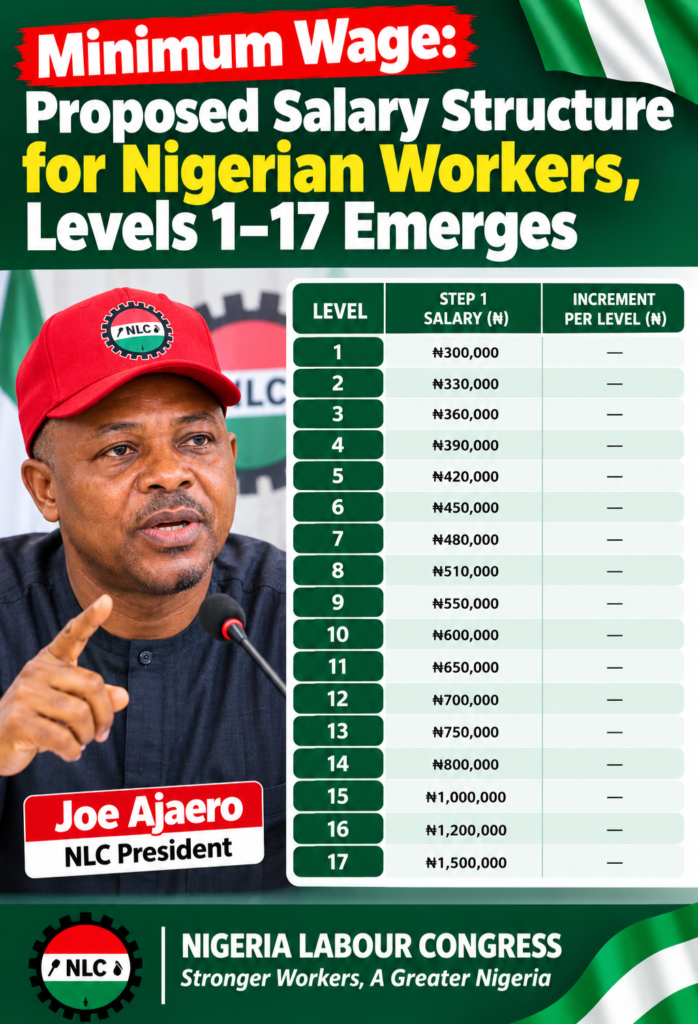
Beyond wages, the FWF demanded payment of all outstanding salaries and promotion arrears, implementation of a 40 per cent peculiar allowance, a permanent Cost of Living Allowance, family support payments, comprehensive health insurance, and housing and car loan schemes for federal workers.
The forum also called for free education for children of federal workers in federal institutions, reduced taxation on allowances, and a broader social security programme for unemployed Nigerians.
On pensions, the group asked the National Assembly to investigate claims that part of workers’ contributory pension savings was being borrowed by the executive, demanding an immediate stop and full refund if confirmed.

President Bola Ahmed Tinubu is set to give Minister of the Federal Capital Territory, Nyesom Wike, a defined role in his 2027 presidential campaign, with the former Rivers State governor expected to coordinate the campaign structure in Rivers State and the Federal Capital Territory.
The arrangement is expected to allow Tinubu’s campaign to benefit from Wike’s political network in the two territories while avoiding a formal change in the minister’s party affiliation.
Wike remains a member of the Peoples Democratic Party despite his open support for Tinubu’s re-election bid.
This appointment is coming against the background of disagreements between Wike and some APC governors over the best way to mobilise support for Tinubu.
Wike has consistently maintained that he does not need to join the APC before supporting the President in 2027.
He has also rejected the idea that his political relevance should be measured by whether he occupies a top position in the APC Presidential Campaign Council.
In August, Wike made his position clear after the APC unveiled its Presidential Campaign Council and appointed former Zamfara State Governor, Abdulaziz Yari, as Director-General.
The FCT minister said he would rather concentrate on Rivers State and the FCT than pursue the position of campaign director-general.
“What’s important is that you are able to deliver those two states. So it’s not about being DG. If you’re DG and you don’t win your state, what’s the essence of the DG?” Wike said.
“I don’t want to lose my state,” he added.
The proposed arrangement would therefore give Wike a specific responsibility without placing him under the formal hierarchy of the APC.
His expected assignment is particularly significant because of his political influence in Rivers State, where he served as governor for eight years, and the FCT, where he has served as minister since 2023.
Wike has repeatedly claimed responsibility for the political structure in both territories and has promised to work for Tinubu’s victory in the presidential election.
During a recent media engagement, he described himself as the “General Commander of the Political Infantry” and insisted that occupying the office of governor was not the only way to remain politically influential in a state.
“You do not need to be governor before you can be in charge. I am the General Commander of the Political Infantry; therefore, I am in charge,” Wike said.
The minister has also drawn a distinction between supporting Tinubu for president and supporting individual candidates seeking other elective positions.
He recently said his support for the President should not be interpreted as an undertaking to help politicians win their respective state-level contests.
Wike said his focus would remain the presidential election and that politicians seeking victories in governorship and legislative elections should handle their own political battles.
“Rainbow coalition has nothing to do with the APC. Rather, it is our own way of mobilising support across political parties for Mr President, who has done well to deserve a second term,” Wike said.
The Rainbow Coalition promoted by Wike is made up of politicians and political interests from different parties who support Tinubu’s return to office in 2027.
However, the arrangement has created tension with some APC governors who have questioned the need for a separate political structure outside the party.
The disagreement became more pronounced after Imo State Governor and Chairman of the Progressive Governors’ Forum, Hope Uzodimma, announced that APC governors had rejected the Rainbow Coalition.
Wike subsequently criticised some APC governors, including Uzodimma and Kwara State Governor AbdulRahman AbdulRazaq.
He accused some politicians of being more interested in being seen as the people working for Tinubu than in building genuine support for the President.
“You see, the problem with people, they want them to be seen, that they are the people working for the President. I don’t do that,” Wike said.
Under the new role, Wike would focus on Rivers and the FCT, while other senior members of the campaign would handle their own areas of responsibility.
Yari is expected to remain Director-General of the Presidential Campaign Council.
However, the proposed structure is not expected to operate strictly through a single chain of command.
Senate President Godswill Akpabio and Deputy Senate President Jibrin Barau are reportedly not expected to report directly to Yari despite their roles within the campaign structure.
Another prominent figure expected to play a major role in the campaign is Minister of Aviation and Aerospace Development, Festus Keyamo.
Keyamo is being considered for a major spokesperson position in the campaign.
He has considerable experience in presidential campaign communication.
He served as a spokesperson and Director of Public Affairs during Tinubu’s 2023 presidential campaign.
He also played a senior communications role in former President Muhammadu Buhari’s 2019 re-election campaign.
Keyamo later served as Minister of State for Labour and Employment under Buhari before becoming the Minister of Aviation and Aerospace Development under Tinubu.


Court Bans INEC From Accepting NDC Candidate For Imo East

EFCC Arrests Olori Tejuoso Over Alleged N600m Fraud

Courts Sacks ADC Prominent Candidate

Former Super Eagles Star Loses Life Savings, Duped By A Pastor of ₦1.2 Billion

I’m A Married Man, I Can Never Get Myself Involved With Such A Thing, Delta Gov Aide Reveals Why He Offered Comfort ₦500,000 Job