
Lifestyle
Christmas: List of African Countries That Don’t Celebrate Birth of Jesus


Christmas celebrations in Africa vary significantly depending on the country’s religion, culture, and government policies.
Conversely, nations such as Algeria, Libya, Somalia, Mauritania, Guinea-Bissau, and Morocco observe Christmas minimally, influenced by their predominantly Muslim demographics.
This disparity underscores how local customs and religious compositions shape the observance of Christmas across the continent.
Countries like Zambia, Rwanda, and Nigeria feature vibrant public festivities due to their sizable Christian populations.
Data from World Population Review shows that not all 206 countries worldwide observe Christmas, even though it is celebrated in predominantly Christian nations such as the United Kingdom and the United States, and even in some Muslim-majority countries like Iraq, Syria, and surprisingly, the UAE.
In Africa, Christmas traditions vary widely. Countries like Zambia, Rwanda, and Nigeria mark the day with public holidays, large-scale festivities, and community gatherings. In contrast, in other parts of the continent, December 25 passes quietly, or not at all, shaped by local religious beliefs, cultural traditions, and government policies.
In Nigeria, for example, Christmas is a major national event, celebrated with church services, family gatherings, and lively public festivities that reflect the country’s large Christian population. Similarly, South Africa, Seychelles, and even Egypt host ceremonies, music performances, and community events, underscoring how central Christmas is to social and cultural life.
Countries Where Christmas Is Not Widely Observed
A small number of African nations do not formally recognize Christmas or observe it as a public holiday. Algeria, Libya, Somalia, Mauritania, Guinea-Bissau, and Morocco fall into this category. While Christian communities exist, they are small, and celebrations are typically private, low-key, or geared toward tourists rather than national observances.

In Algeria, for example, Christians make up less than 2% of the population, and December 25 passes like any other day. In Libya, where around 2.7% of the population is Christian, celebrations are largely restricted to homes and private gatherings, often occurring under the shadow of insecurity for minority communities.
A wonderful-picture of a-woman celebrating Christmas at the Giza-Pyramids
A wonderful-picture of a-woman celebrating Christmas at the Giza-Pyramids
Strict Observance and Private Celebrations
Somalia and Mauritania, both nearly 100% Muslim, largely ignore Christmas, treating December 25 as a normal working day. In Somalia, public celebrations are banned entirely, reflecting strict interpretations of Islamic law.
Morocco and Guinea-Bissau offer notable exceptions. In Morocco, major cities with strong tourism sectors, such as Marrakech and Casablanca, feature festive decorations, special hotel menus, and midnight masses for Christian expatriates, blending European traditions with local culture. Guinea-Bissau’s Christian minority celebrates quietly at home, often with modest meals and small gifts.
Countries like Zambia, Rwanda, and Nigeria feature vibrant public festivities due to their sizable Christian populations.
Countries like Zambia, Rwanda, and Nigeria feature vibrant public festivities due to their sizable Christian populations.
Why Christmas Celebrations Differ
The variation in observance across Africa is shaped by religion, culture, and government policy. Countries with large Christian populations, such as the Democratic Republic of Congo, Lesotho, and Namibia, treat Christmas as a major national event with public holidays, church services, family gatherings, and community celebrations.
In predominantly Muslim nations, Christmas is typically a private or low-key event. Local religious norms, sometimes reinforced by law, limit public festivities, and political or security considerations may further restrict celebrations.
Ultimately, these differences highlight how Christmas, a globally recognised holiday, is experienced differently depending on local faith, cultural practices, and governance. In some African nations, it brings lights, music, and public celebrations; in others, it remains a quiet, private observance, or passes like any other day.
Business
From Kabiru to Khalifa: How Abdul Samad Rabiu is Quietly Positioning his Son in the Corridors of Business and Power
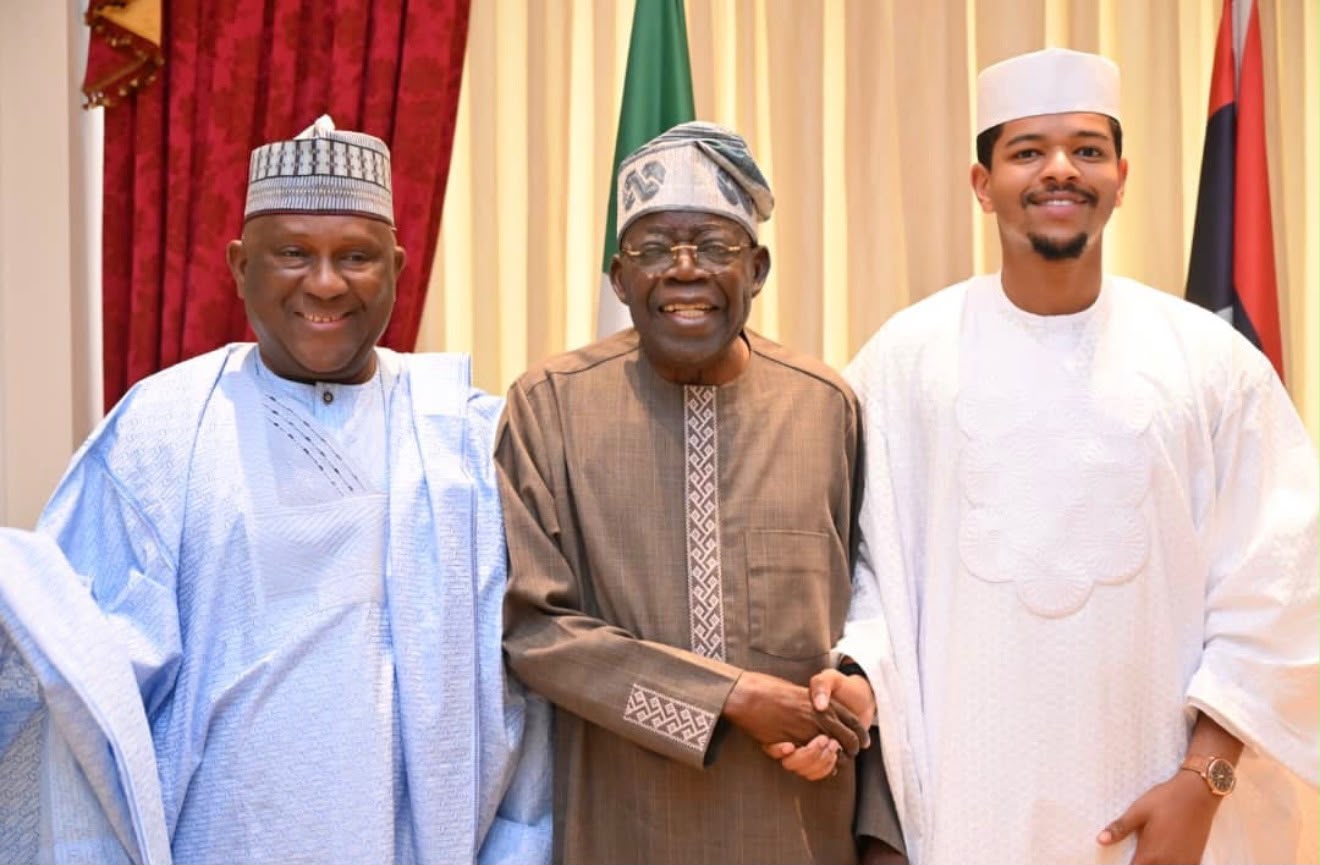
Once, his younger brother Kabiru was one of the familiar family figures around the BUA empire. Now another generation is moving steadily into view as Abdul Samad Rabiu brings his son, Khalifa, closer to the business, relationships and rarefied circles surrounding one of Africa’s largest industrial fortunes.
On Friday, October 2, 2026, when Abdul Samad Rabiu went calling on President Bola Ahmed Tinubu at his Ikoyi residence in Lagos, he did not go alone. Beside the billionaire industrialist was his son, Isyaku Abdulsamad “Khalifa” Rabiu, the young BUA executive whose presence increasingly seems to accompany his father into rooms where business, government and influence converge. Rabiu said the visit afforded an opportunity to reflect on Nigeria’s journey and its future, while other reports confirmed that the BUA chairman was among several prominent business and political figures received by the President that day.
On the surface, there was nothing extraordinary about it. Wealthy fathers travel with their sons, introduce them to friends and take them to important engagements every day. Yet, when the father is Abdul Samad Rabiu, founder of an industrial empire painstakingly assembled over decades, and the son has recently moved into a strategic executive position within that empire, the optics acquire a different texture. A photograph becomes more than a photograph; a handshake begins to look like an introduction, and what appears to be a simple father-and-son outing starts to resemble that ancient ritual through which successful men gradually acquaint the next generation with the world they may one day have to navigate without them.
For those who have watched Abdul Samad through the years, the changing silhouette around him is difficult to miss. There was a time when his younger brother, Kabiru Rabiu, represented one of the most prominent family presences within the BUA establishment, rising through the group’s operations and eventually becoming Group Executive Director, while also serving as a non-executive director of BUA Foods and BUA Cement. He remains firmly embedded in the conglomerate, with more than two decades of experience across edible oils, cement and infrastructure.
Kabiru belongs to Abdul Samad’s generation, however, and that distinction matters because every family empire, no matter how vast or professionally managed, eventually encounters the question that money alone cannot answer: what happens when the generation that built it begins to make room for the generation that must preserve it?
It is within that quiet, complicated passage that Khalifa is increasingly becoming interesting.
His emergence has not arrived with trumpets, ceremonial titles or the public unveiling of a successor. Abdul Samad has not declared him heir to BUA, and nothing in the public record justifies such a conclusion. What has become visible instead is something subtler and perhaps more meaningful: a gradual accumulation of responsibility, exposure and proximity, the three ingredients through which the children of powerful business families are often introduced to the burden behind the privilege.
Khalifa is no longer merely the billionaire’s son appearing occasionally beside his father. On January 29, 2026, BUA Foods appointed him Chief Officer, Global Procurement and Strategic Operations, giving him responsibility for the company’s end-to-end global procurement function and strategic operational initiatives. Before that appointment, he served as Director for Special Operations at BUA Group, where his work included transformation projects, supplier relationships, wheat sourcing, animal-feed production, the commercial reintroduction of BUA rice and other operational initiatives.
There is something instructive about where he has been placed. For the son of one of Africa’s wealthiest industrialists, a grand office and ornamental designation would have been easy enough to manufacture, the sort of corporate embroidery with which family businesses sometimes decorate heirs who have yet to acquire the scars of enterprise. Khalifa, however, has been taken closer to procurement, supply chains and operations, into the less glamorous entrails of an industrial organisation where fortunes are not discussed in abstract terms but depend on the relentless movement of wheat, sugar, machinery, ships, suppliers, currencies, warehouses and markets.
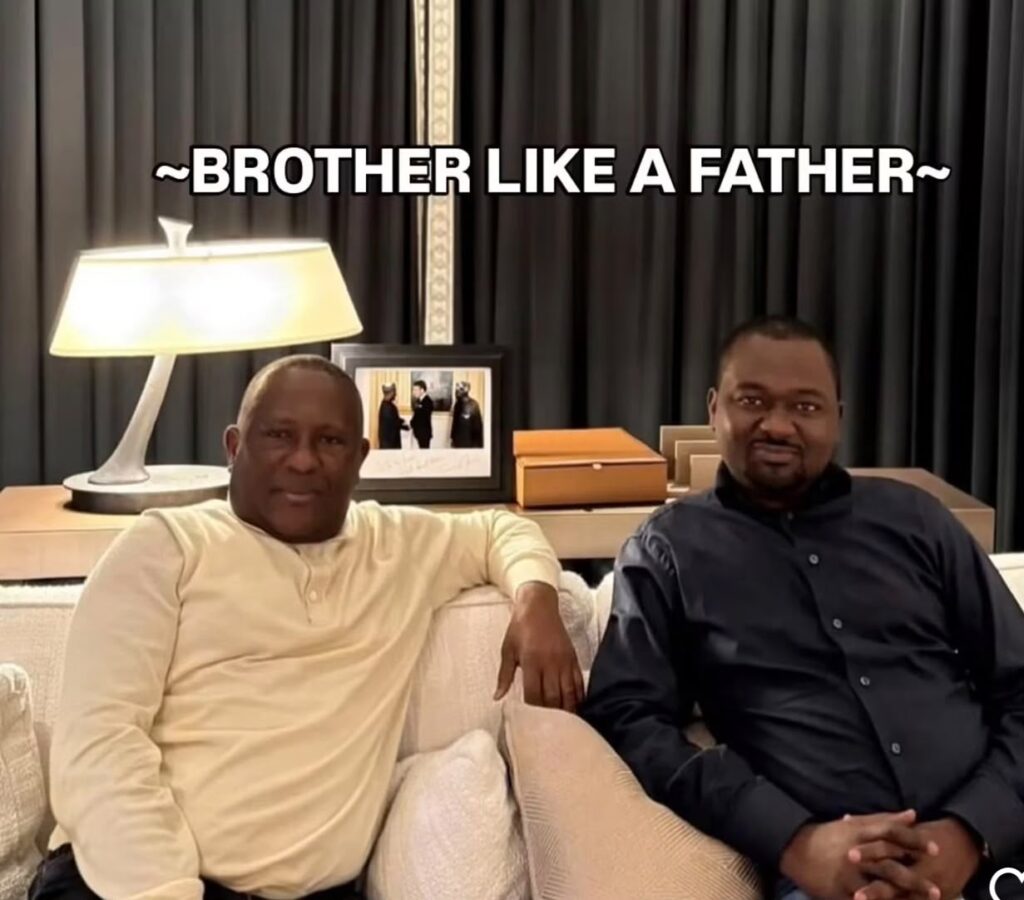
Perhaps that is the more revealing education his father is giving him. Abdul Samad appears less interested in merely showing the young man the assets than in allowing him to understand how those assets breathe.
Factories photograph beautifully, particularly when they rise from acres of land in steel and concrete, but the real life of an industrial empire occurs away from the cameras, in the anxious arithmetic of raw-material costs, shipping schedules, exchange rates, energy, regulation, financing and distribution. The young man who may someday occupy a larger place within such a system must learn that wealth is not sustained by the serenity of the chairman’s office but by countless decisions made under pressure, many of them invisible to the public until one of them goes wrong.
Khalifa’s academic preparation seems almost tailored to the wider world awaiting him. He studied International Relations at Regent’s University London and later earned a Master’s in Management from Georgetown University’s McDonough School of Business, combining an education in states, diplomacy and institutions with the language of management and enterprise.
That marriage of disciplines becomes particularly interesting when considered against the circles into which he has been born and the ones into which he is now increasingly being introduced.
There is, of course, another dimension to his story. Khalifa is one of the children from Abdul Samad Rabiu’s former marriage to Hannatu Musawa, the lawyer, writer and public official who currently serves in President Tinubu’s cabinet as Minister of Art, Culture, Tourism and the Creative Economy. Musawa has herself spoken publicly about her former marriage to Rabiu and the enduring ties between their families.
There is nothing publicly established to suggest that he is preparing to contest an election or embark on a conventional political career. What he possesses instead is exposure: a father situated at the commanding heights of Nigerian private enterprise and a mother operating within the upper reaches of government, two worlds that remain distinct but inevitably encounter each other wherever industry, regulation, investment and public policy meet.
That is why Friday’s visit to President Tinubu is noteworthy without needing to be exaggerated. Its importance lies less in whatever may have been discussed behind closed doors than in the simple fact that Khalifa was there, standing beside his father and becoming familiar with another environment in which his surname, responsibilities and future may eventually carry their own weight.
Such encounters form a peculiar education unavailable in lecture halls. Universities can teach capital allocation and international relations, but they cannot completely teach the temperament of power: how an industrialist speaks to a president without becoming obsequious, how one carries disagreement without converting it into hostility, how old relationships are tended, how new ones are cultivated, or how to distinguish those who are merely attracted to wealth from those whose trust survives difficult seasons.
Those lessons are absorbed by watching.
They reside in airport lounges and factory inspections, private dinners and waiting rooms, board meetings and courtesy visits, in introductions that appear inconsequential until, perhaps ten years later, a name remembered from a handshake becomes the person sitting across a negotiating table.
This is how relationships are inherited, if relationships can ever truly be inherited at all. A father may leave his son factories, shares, houses and an enviable portfolio of assets, but he cannot simply insert forty years of trust into an estate document. The son must accumulate his own credit among bankers, investors, regulators, political leaders, employees and business partners, even when the father’s name opens the first door.
Abdul Samad should understand the intricacies of that inheritance better than most. He was himself born into the formidable commercial tradition of the late Khalifah Isyaku Rabiu, the Kano merchant, scholar and industrialist whose name carried considerable weight long before BUA became the corporate colossus it is today. Abdul Samad inherited a tradition of enterprise but did not merely preserve it; he recast it for another age, moving far beyond the familiar pathways of trading into manufacturing on a scale that turned cement, sugar, flour and other essential commodities into the pillars of a modern industrial fortune.
Now the wheel appears to be turning again.
There is an almost poetic symmetry in the fact that another Khalifa is moving towards the centre of the Rabiu story, although it would be simplistic to describe what is happening as a transfer of the crown. BUA is today too sprawling and professionally structured to be reduced to a princely succession tale, and Kabiru Rabiu remains an important figure in its leadership. The more compelling point is that Khalifa has moved beyond merely being part of the family photograph; he now occupies a position where he can be tested by responsibility, measured by results and introduced gradually to the ecosystem surrounding the family enterprise.
That is how serious succession often begins, not with coronation but with apprenticeship. A young man is first handed work that can expose his weaknesses, then brought into relationships that can test his temperament, before the people who have dealt with his father for decades begin, cautiously, to deal with him in his own right. The family name may secure the introduction, but eventually the young man must demonstrate whether there is substance behind it.
For Abdul Samad, therefore, legacy will one day amount to considerably more than deciding how factories, shares and investments are distributed among heirs. The harder inheritance will be culture, discipline, judgement and the instinct for survival that allowed a family trading heritage to become an industrial institution. Kabiru represents an important part of the generation that travelled that journey alongside him; Khalifa increasingly represents the question of what follows after it.
Seen from that perspective, the young man’s growing presence around his father acquires a meaning beyond privilege. He is watching a man who has spent decades learning the peculiar choreography of Nigerian capitalism, where enterprise lives constantly in conversation with government, regulation, foreign capital, infrastructure and politics without necessarily becoming politics itself. He is being allowed to observe not simply how a fortune is enjoyed but how influence is managed, relationships are preserved and institutions are kept alive through changing governments and economic seasons.
That may ultimately be the most valuable thing Abdul Samad can give him.
Factories can be inherited. Shares can change names on a register. Houses and aircraft can pass from father to son with the neat efficiency of lawyers and trustees. What cannot be transferred so easily is the confidence of people who matter, the discipline to remain composed when markets rebel, the instinct to recognise danger before it announces itself and the ability to enter a room full of powerful men without being diminished by them or intoxicated by their attention. Those things take time.
And perhaps that is the deeper meaning of Khalifa walking beside his father into President Tinubu’s Lagos residence on Friday: the young man is no longer being shown only the empire.
He is being introduced, carefully and gradually, to the world around it.
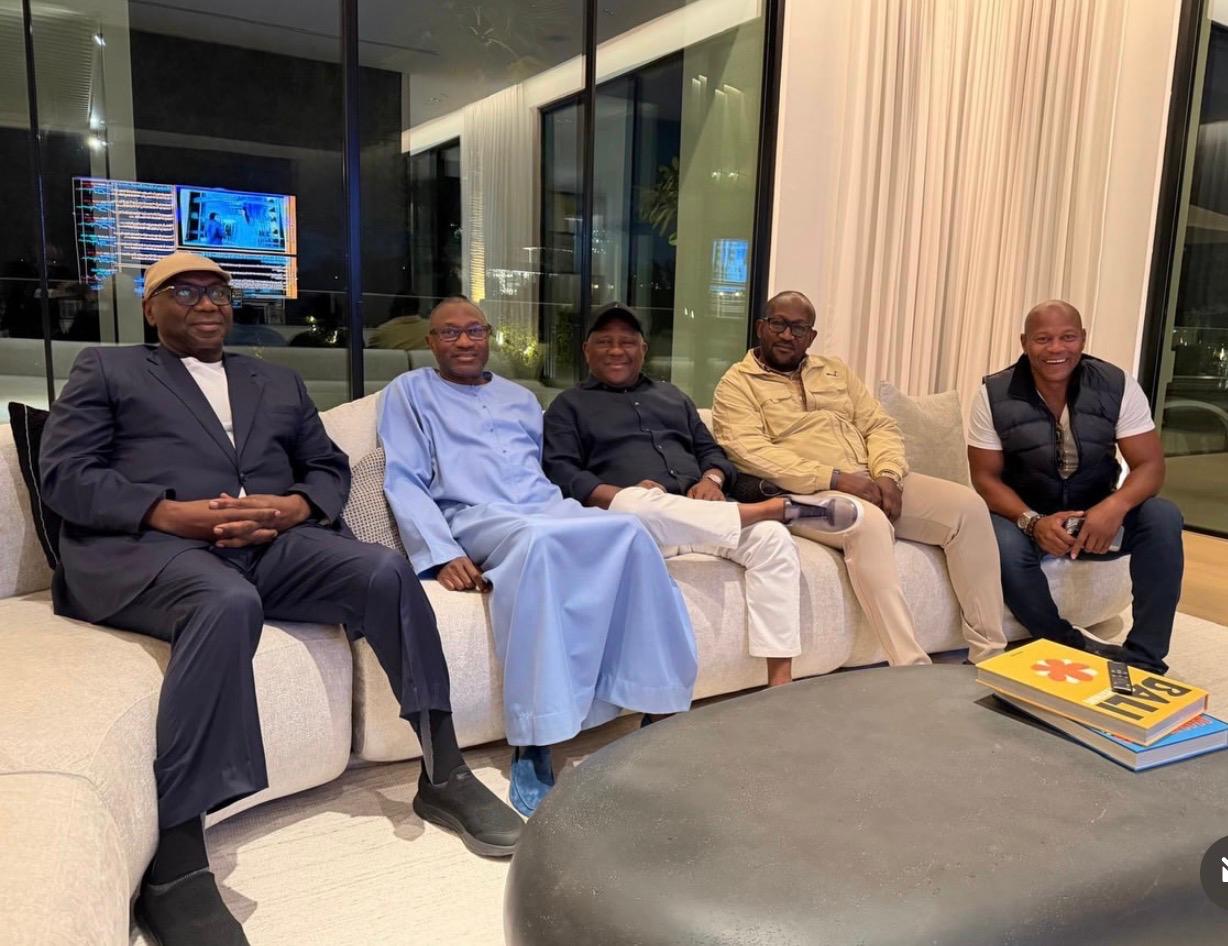
● How Dangote, Rabiu, Elumelu and Adenuga Keep Company With the Billionaire Abroad
There are houses, and there are addresses, but there are also those rare addresses that somehow acquire a life beyond their architecture, places whose significance is measured not merely in marble, acreage or the provenance of their furniture, but in the calibre of men who walk through their doors and the friendships that are renewed within them.
Across London, Dubai and Monaco, billionaire extraordinaire, Femi Otedola appears to have created precisely that kind of world. His homes abroad are unquestionably retreats of privilege, places where the billionaire businessman can withdraw from the turbulence of boardrooms and the relentless theatre of Lagos, yet increasingly they have also become intimate theatres of friendship, drawing into their orbit some of the most powerful Nigerians alive.
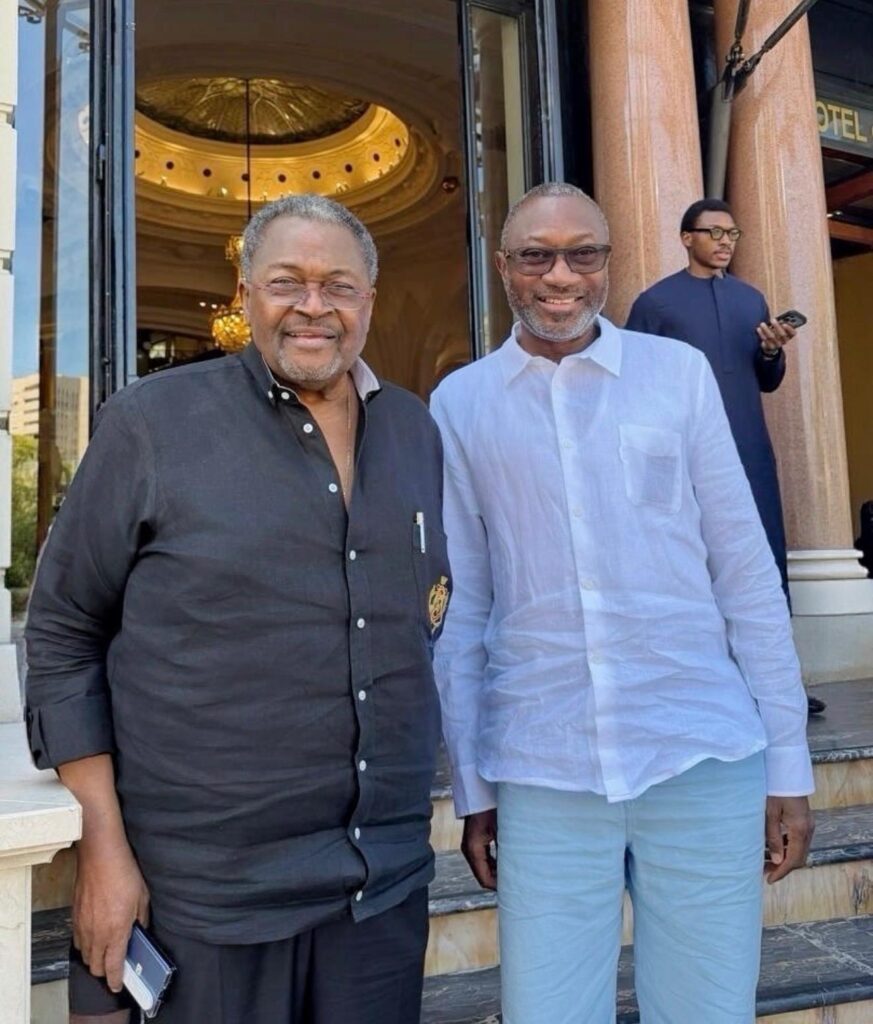
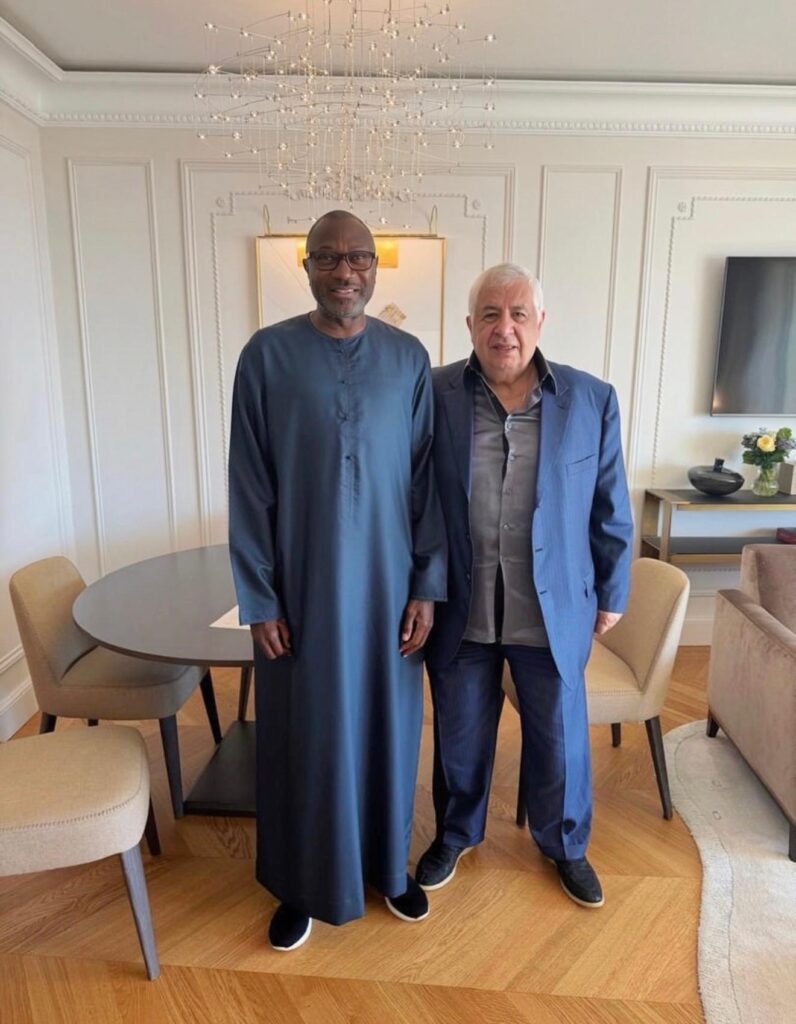
Aliko Dangote has been there, Abdul Samad Rabiu has been there, Tony Elumelu has been there, and more recently the famously private Mike Adenuga emerged in Monaco in Otedola’s company, producing one of those exceedingly rare photographs that immediately became a talking point back home.
It is an extraordinary constellation when one considers the industries and fortunes involved. Between them are businesses built across cement, telecommunications, banking, energy, manufacturing, oil and infrastructure, corporations that employ thousands and enterprises that have played consequential roles in the making of modern Nigerian capitalism. Yet when these men meet Otedola abroad, the tableaux are often strikingly uncomplicated, stripped of the usual podiums, conference backdrops, retinues of aides and corporate ceremony. Sometimes, all that remains is a sofa, a dining table, a terrace and an evening at home.
Perhaps that is what makes the photographs so fascinating. They offer small windows into a Nigeria that the public rarely sees, a private world in which men ordinarily encountered through balance sheets, annual reports, corporate transactions and billionaire rankings are seen simply in the company of friends.
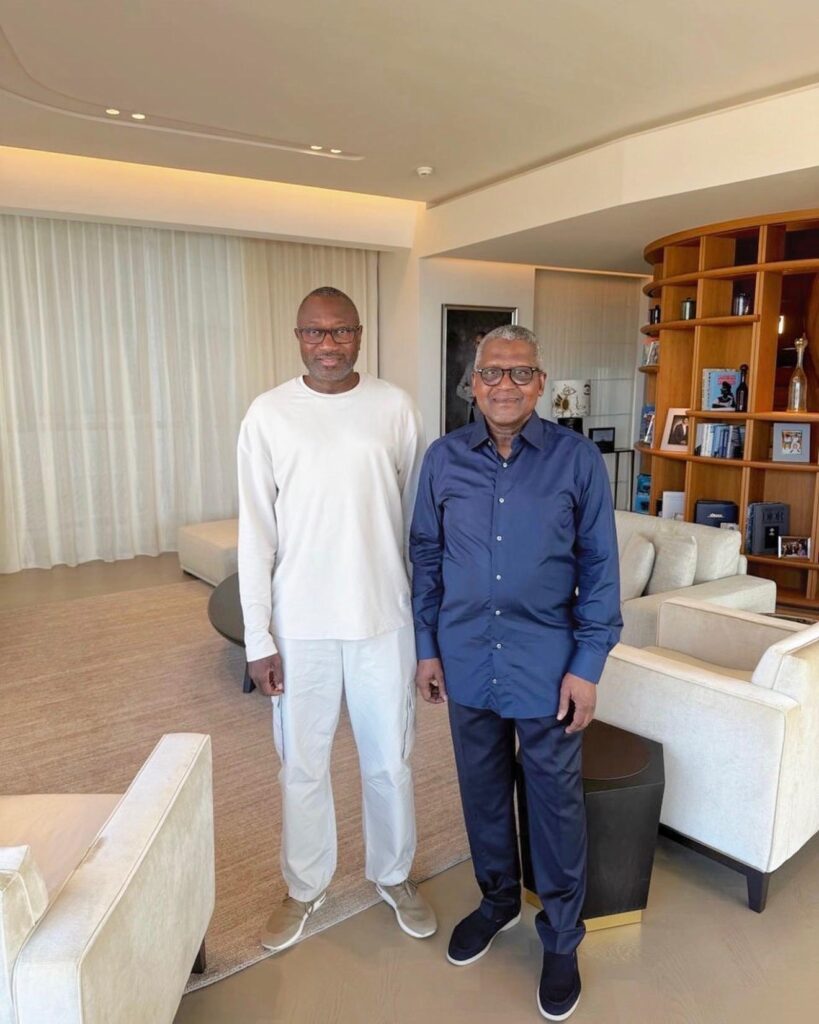
A Beautiful Day in Monaco
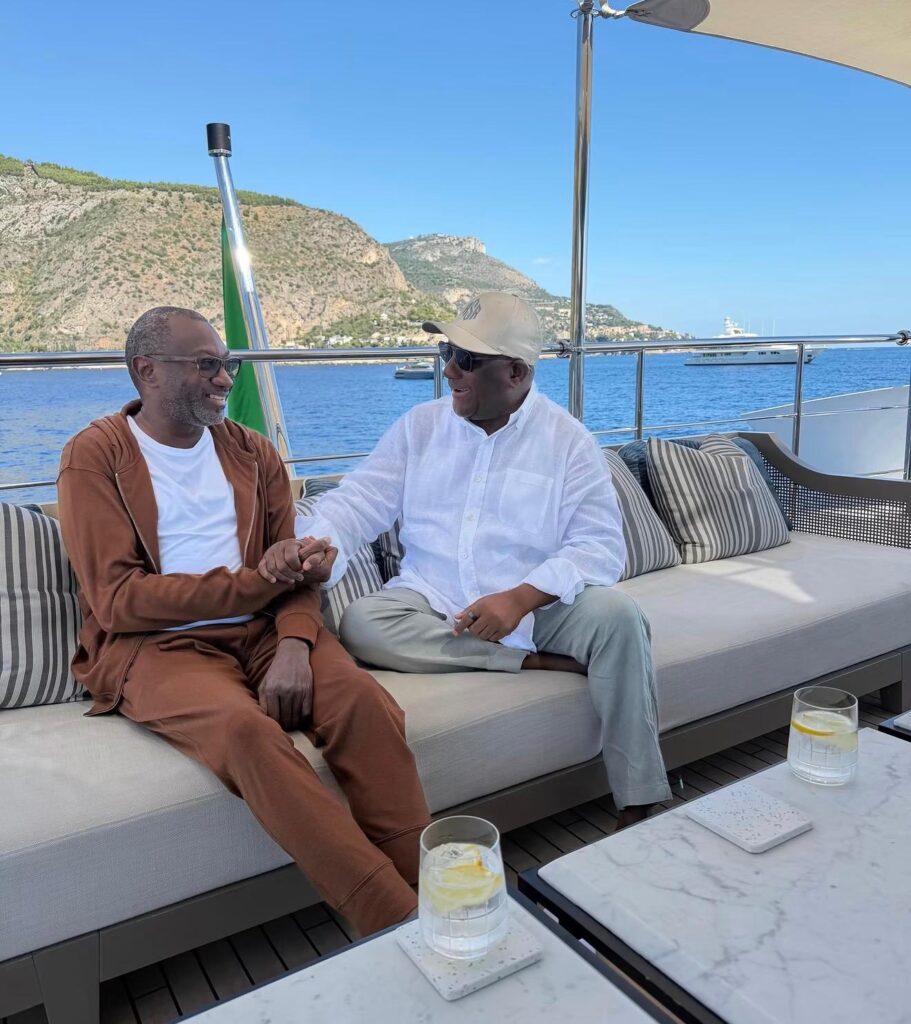
In June 2026, Otedola offered one such glimpse when he shared a photograph with Aliko Dangote from his home in Monaco. There was no elaborate ceremony around the encounter; the two men were seated casually together, relaxed and smiling, looking less like two of Africa’s most recognisable businessmen and more like old friends enjoying an easy afternoon.
Otedola described it as a “beautiful day at home in Monaco” with the man he affectionately called his “bestie,” adding that “friendship remains one of the greatest investments.” For men whose lives have been built around investments, acquisitions, expansion and enterprise, the choice of metaphor was telling because it suggested that, beyond the hard calculus of business, there are relationships that have acquired value of a different kind.
Dangote and Otedola have known each other through different seasons of corporate Nigeria. Their friendship has endured changes in fortune, the transformation of businesses and the shifting climate of the Nigerian economy, and Otedola has frequently spoken admiringly of Dangote’s industrial ambitions. Yet Monaco stripped the relationship of its corporate costume. There they were, simply two old friends at home, sharing the kind of ease that cannot be manufactured for the camera.
Monaco itself seems almost perfectly cast for such a scene. The tiny Mediterranean principality has for generations served as a sanctuary of extraordinary wealth, with yachts resting upon blue water, discreet residences rising against the hills and a social culture in which affluence is worn almost casually. Otedola has long been associated with a home there, and the sight of Dangote within that private world once again brought the residence into the Nigerian imagination.
There was wealth in the photograph, certainly, but there was something else too: ease, familiarity and the unforced comfort of friendship. Among extremely powerful men, that ease may well be the greater luxury.
The ‘Chairman of Chairmen’ in Monaco
A few months later, Monaco yielded another remarkable sight when Mike Adenuga appeared in Otedola’s company.
That alone was enough to make the encounter unusual because Adenuga has always cultivated a far more private public profile than many of his billionaire contemporaries. Unlike businessmen whose movements frequently populate social-media timelines and society pages, the Globacom founder is capable of disappearing almost entirely from public view for long stretches, which is why photographs of him invariably attract attention.
When Otedola shared images of them together in Monte-Carlo in September 2026, the photographs travelled rapidly, not simply because two billionaires had met, but because one of them was Adenuga, a man whose public appearances have become increasingly rare.
Otedola introduced him with characteristic warmth and flourish as the “Chairman of Chairmen,” before acknowledging his collection of national and international honours. For those accustomed to Adenuga’s reserve, it was an uncommon picture: the famously private telecoms magnate smiling easily beside another billionaire who seems able, perhaps by temperament as much as by circumstance, to draw some of Nigeria’s most powerful businessmen into his social orbit.
The public accounts of the meeting confirm that the two men were together in Monte-Carlo, even if they do not conclusively establish that every photograph from the encounter was taken inside Otedola’s residence. Yet the symbolism remains compelling. Dangote had appeared in Monaco earlier in the year, and now Adenuga had surfaced there too, making the principality look, at least through the occasional photographs Otedola shares, like a Mediterranean meeting point for Nigeria’s billionaire class.
Dubai and the Ritual of Friendship
If Monaco is Otedola’s Mediterranean retreat, Dubai has become an even more expansive stage for his hospitality.
His relationship with the emirate is longstanding, and his homes there have surfaced from time to time in society photographs, family celebrations and social-media posts. Beyond the obvious luxury of the city, Dubai appears to offer what men of Otedola’s standing often value most: privacy, comfort, convenience and the freedom to receive friends away from the noise of Lagos.
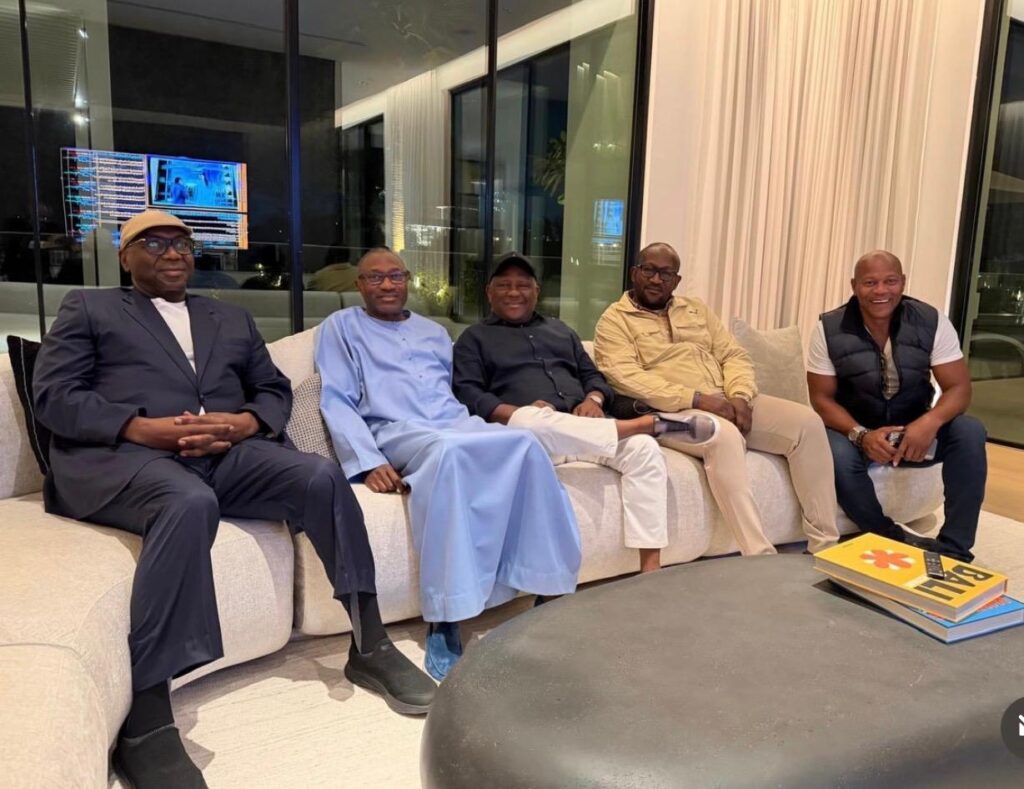
Abdul Samad Rabiu is among those who have enjoyed that hospitality. In January 2026, Rabiu was hosted at Otedola’s Dubai home for a private gathering, and the photographs that followed showed the BUA chairman and other guests in relaxed company, far removed from the industrial seriousness with which their names are usually associated.
The friendship is evidently reciprocal, because Otedola also joined Rabiu at his own Dubai residence during Ramadan for Iftar. Those encounters suggest something more substantial than occasional society appearances; they speak instead to a familiarity in which each man appears comfortable entering the other’s private space, sharing a table and spending time away from the ceremonial obligations of public life.
For all the obsession with billionaires as economic abstractions, with who owns what, whose fortune has risen and who has gained or lost billions, their friendships are often far more ordinary than the numbers surrounding them might suggest. Otedola and Rabiu inhabit overlapping worlds of huge capital and national consequence, but the Dubai photographs tell a simpler story of men eating together, laughing together and observing the rituals of friendship outside the public gaze.
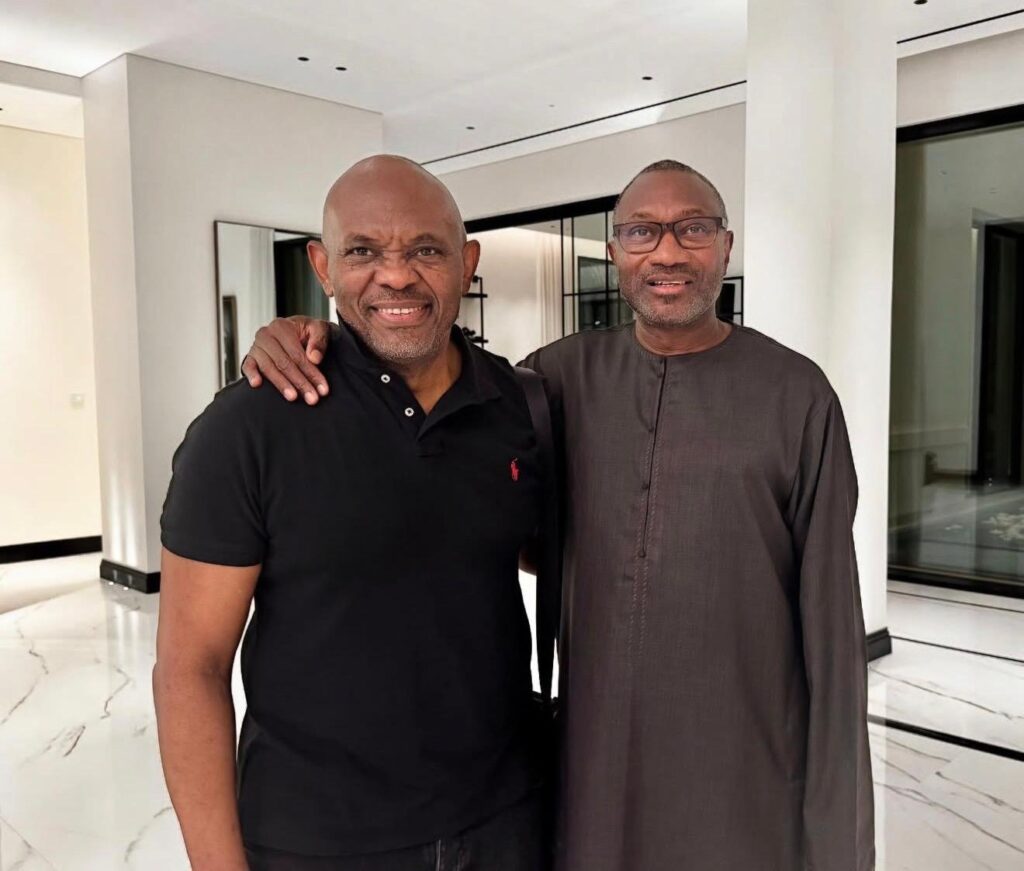
Otedola and Elumelu: Friendship Across London and Dubai
Tony Elumelu also belongs to that distinguished circle of Nigerian business leaders who have enjoyed Otedola’s hospitality abroad.
Their friendship has been glimpsed across continents. In 2022, Otedola received Elumelu at his London home, an encounter that offered another window into the private camaraderie among Nigeria’s most accomplished businessmen. Elumelu would later speak warmly of the residence, describing it as an “amazing house.”
Then came Dubai, where Otedola again hosted Elumelu at his residence. The atmosphere was relaxed and unmistakably personal, and Otedola referred to him affectionately as his good friend, “African Pride,” while speaking of building bridges, sharing visions and celebrating excellence.
There was something revealing in those photographs because here were two men whose names occupy prominent places in contemporary African enterprise, sitting together not beneath corporate insignia or before conference microphones, but within the quiet intimacy of a home. Elumelu has built an enormous footprint across banking, investment, energy and entrepreneurship, while Otedola’s own journey has traversed oil, power and finance, yet away from those imposing corporate identities their encounters reveal the more human dimension of wealth: friendship, conversation and the uncomplicated pleasure of being received by someone who knows you beyond your public title.
London, meanwhile, has become an even more substantial part of Otedola’s property story. His residence in St John’s Wood places him in one of the capital’s most coveted enclaves, close to Regent’s Park and within a neighbourhood where wealth generally prefers understatement to advertisement. Yet the more intriguing story is not merely that Otedola owns magnificent homes, because plenty of wealthy men do; what makes his homes interesting is what happens inside them and the people who keep passing through.
The Soft Architecture of Power
Society often makes the mistake of imagining that power lives only in offices, boardrooms, state banquets and polished conference rooms where advisers carry leather folders and minutes are taken. In truth, power has always possessed another geography, one found in dining rooms, private terraces, long lunches, discreet evenings and homes where important people no longer need appointments to see one another.
That does not mean every gathering of billionaires should be burdened with theories about transactions or influence. Friendship should not automatically be converted into conspiracy simply because the friends involved happen to be extremely wealthy. Indeed, what is most striking about Otedola’s own public language is how frequently he chooses the vocabulary of friendship rather than commerce, referring to friends as “bestie,” “brother” or simply “my good friend,” and repeatedly framing relationships in emotional rather than transactional terms.
There is a softness to that vocabulary that contrasts with the hard industries these men dominate. Dangote builds factories on a scale that has transformed entire sectors, Rabiu commands a vast industrial empire, Elumelu’s interests extend across banking, energy and investment, Adenuga built one of Africa’s most formidable indigenous telecommunications businesses, while Otedola himself has moved through petroleum marketing, shipping, power generation and banking with an instinct for reinvention that has defined much of his career.
Yet when these men meet abroad, the armour occasionally comes off. They sit together, eat together, laugh together, trade stories and pose for photographs, and for a few moments they appear removed from the empires attached to their names.
The Billionaire Who Likes to Host
Perhaps this is the more compelling portrait of Otedola. For all his reputation as a businessman and investor, he appears also to enjoy the ancient privilege of the host.
There is a certain kind of wealthy man who regards a beautiful house primarily as an achievement, another who sees it as a sanctuary, and then there is the man who derives particular pleasure from filling it with people. Otedola increasingly seems to belong to the latter category, and his homes have welcomed not only businessmen but musicians, family friends and figures from different corners of Nigerian public life.
That habit suggests that behind the gleaming façades lies something warmer than mere acquisition: hospitality.
For Nigerians, and particularly within Yoruba social tradition, the home has never been understood solely as shelter. It is also social territory, a place where relationships are renewed, food is shared, visitors are received and friendship is demonstrated through presence. The successful man does not merely build a large house; he keeps a table around which people can gather.
In Otedola’s case, only the geography has changed. The old courtyard has become Monaco, the veranda has moved to Dubai, and the parlour now occasionally overlooks London, while the visitors arrive carrying famous names, billion-dollar businesses and reputations recognised across the continent.
Beyond the Photographs
Perhaps years from now, the houses themselves will matter less than the friendships they witnessed. Fortunes change, companies rise and stumble, markets punish even the most assured investor, and today’s celebrated acquisition eventually becomes tomorrow’s footnote, but certain photographs endure because they capture powerful people briefly outside the formal identities by which history usually remembers them.
That is what gives these pictures their charm: Dangote relaxing with his friend in Monaco, Rabiu sharing a table in Dubai, Elumelu received with warmth in London and Dubai, and the elusive Adenuga suddenly appearing in Monte-Carlo beside a man who calls him the “Chairman of Chairmen.”
Seen separately, they are society photographs; seen together, however, they form an intriguing portrait of Femi Otedola, not simply as the billionaire investor associated with Geregu Power, banking and some of the world’s most exclusive addresses, but as the host whose homes have become gathering points for men who ordinarily occupy separate kingdoms.
In that sense, perhaps the most revealing line Otedola has used remains one of the simplest: “Friendship remains one of the greatest investments.”
For a man who has spent a lifetime understanding where value lies, it may also be the investment he appears most comfortable displaying.

The Economic and Financial Crimes Commission (EFCC) has arrested Olori Halima Tejuoso in connection with an alleged N600 million fraud involving Mrs Mary Oluwaseye Sholoye and Mallam Ibrahim Gidado.
Tejuoso was arrested on Tuesday, September 15, 2026, after allegedly failing to honour an invitation by the Commission following her release on administrative bail.
Confirming the development, EFCC spokesman, Dele Oyewale, said Tejuoso was arrested after she allegedly jumped the administrative bail earlier granted to her by the Commission.
According to Oyewale, Gidado, who is also linked to the investigation, had been arrested earlier and arraigned before a court.
Tejuoso was reportedly accused of obtaining about N600 million from Sholoye by false pretence in connection with Gidado.
She had earlier appeared before the EFCC, where she reportedly told investigators that Gidado had allegedly defrauded her of the money she was accused of collecting from Sholoye.
However, following Gidado’s arrest and subsequent invitation by the Commission, Tejuoso reportedly failed to appear and could not be reached.
The EFCC subsequently declared her wanted on April 27, 2026, as part of its investigation into the alleged fraud.
Her arrest on September 15 brings to an end several months during which the Commission had been seeking her whereabouts.
The latest development is expected to allow the EFCC to proceed with further investigation into the circumstances surrounding the alleged N600 million transaction and Tejuoso’s relationship with the other parties involved.
The Commission’s position indicates that the matter involving Gidado has already progressed to court, while further legal steps concerning Tejuoso are expected to follow the completion of the ongoing investigation and necessary legal processes.
However, the allegations against Tejuoso remain unproven until determined by a court of competent jurisdiction.
All parties involved are presumed innocent unless and until found guilty by a court of law.
-Source: Daily Times Nigeria


Obasanjo’s Son Picks Side In 2027 Race

NISS: President Tinubu Makes Fresh Appointment

Ebola fears: FG, States On Alert As Infected Diplomat Suffers Organ Failure


-
 News2 days ago
2027: Tinubu Announces New Appointments
-
 News16 hours ago
Kano Assembly Suspends Lawmaker Over Alleged Insult To Governor
-

 Politics16 hours ago
PDP Moves to Sanction Wike Over Alleged Support for APC
-
News40 minutes ago
NISS: President Tinubu Makes Fresh Appointment
-
 News16 hours ago
Stop Depending On FG For Electricity – Shettima Tells States
-
 Politics32 minutes ago
Obasanjo’s Son Picks Side In 2027 Race
-
 News15 hours ago
Ebola fears: FG, States On Alert As Infected Diplomat Suffers Organ Failure