
News
Tension In APC As NWC Dumps Tinubu’s Governor’s Ticket Control

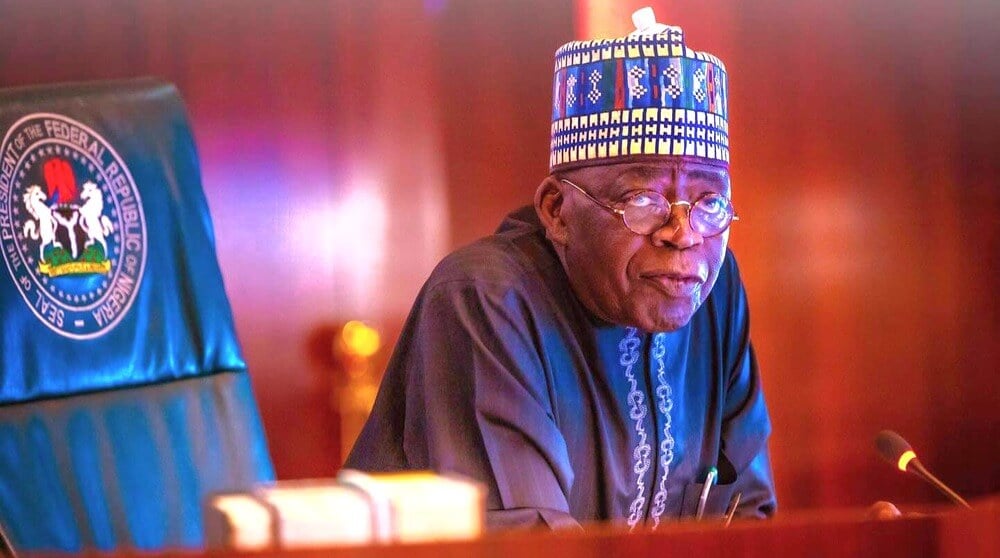
There is growing tension within the All Progressives Congress (APC) as members of the party’s National Working Committee (NWC) move to resist President Bola Tinubu’s directive granting state governors significant control over party tickets ahead of the primaries.
An uneasy calm pervades the party, with findings indicating a widening rift between the presidency and the APC leadership.
Insiders warn that the directive risks eroding the authority of the party’s central structure, weakening internal democracy and triggering widespread disaffection across states.
The development followed Tinubu’s conferment of powers on the 31 governors under the APC to decide the fate of aspirants in their states ahead of the 2027 general election.

Sources within the NWC told THE WHISTLER that the president’s position, which effectively empowers governors to determine candidates in their states, has sidelined the party leadership and undermined its relevance.
“What the president has done is to remove powers from the party leadership, make them redundant and kill the party,” an NWC member said.
Consequently, multiple sources disclosed that some within the NWC are already weighing options to push back against the directive, including leveraging aggrieved aspirants as a pressure point to force a rethink.
According to one official, “If this stands, the party structure becomes irrelevant. There are already suggestions that those who feel shortchanged should be allowed to ventilate their grievances, even if it unsettles the system, in order to compel a reversal.”

The controversy follows recent remarks by President Tinubu in which he signalled that state governors should take the lead in determining party candidates ahead of the primaries, arguing that they best understand the political dynamics within their states and should therefore guide the process.
The president said this was necessary to preserve the party’s unity and cohesion ahead of the poll in 2027.
However, party insiders insist the pronouncement has had unintended consequences, emboldening state-level power blocs, intensifying rivalries, and triggering open contests for control.
Infighting Spreads Across States
The directive has already fuelled internal battles in several states and widened already existing crises in some states. In Abia State, a fierce supremacy contest has erupted between Deputy Speaker of the House of Representatives, Benjamin Kalu, and former governor, Senator Orji Uzor Kalu, with both men laying claim to presidential backing as the party’s leader in the state.
Abia is led by a governor under the platform of the Labour Party, Dr Alex Otti.
The Deputy Speaker said he has been chosen by Tinubu to lead the APC in the state.
Orji Uzor Kalu – an outspoken campaigner for Tinubu’s second term – has dismissed the claims, insisting that Tinubu chose him to lead the party in the state.
Delta, Nasarawa Crises Deepen
In Delta State, the directive has intensified a brewing contest between Senator Ifeanyi Okowa and former Deputy Senate President Ovie Omo-Agege. Governor Sheriff Oborevwori is reportedly backing Okowa, his predecessor, for a return to the Senate – placing him at odds with Omo-Agege and his loyalists.
A serving commissioner in the state hinted that all three serving senators may fail to secure return tickets, a development that has heightened anxiety and uncertainty among party stakeholders.
Party leaders argue that such outcomes reflect the diminishing role of the NWC in ensuring fairness and balance.
“All the privileges and influence tied to purchasing tickets and conducting primaries have been lost,” an NWC member lamented. “Rather than creating a level playing field, the president has made things difficult by lighting an over-dried grass.”
In Nasarawa State, a similar crisis is unfolding. Governor Abdullahi Sule’s alleged backing of Senator Ahmed Wadada – who only recently defected from the Social Democratic Party (SDP) – has sparked resistance among long-standing party members.
Former Inspector-General of Police, Mohammed Adamu Idris, has rejected the governor’s position and is preparing to challenge the arrangement, with the backing of former governor Tanko Al-Makura, setting the stage for a high-stakes internal showdown.
Cross River, Others on Edge
In Cross River State, tensions are also mounting as founding members of the party push back against recent defectors, insisting they should have priority in the allocation of tickets.
They are reportedly pressuring Governor Bassey Otu to sideline new entrants from the Peoples Democratic Party (PDP), a move that could reshape the state’s political calculations.
As a result, figures like Senator Jarigbe Agom are said to be at risk of losing out to former governor Ben Ayade, while several House of Representatives seats – particularly in northern Cross River – are being pencilled in for long-standing party members as compensation.
The development has created palpable tension, with defectors threatening a showdown if denied fair opportunities.
Warning Signs from Party Leadership
The crisis is not limited to a few states. Similar fault lines are reportedly emerging in Rivers, Akwa Ibom, Enugu, Benue, Kwara, Lagos, Ogun and Ondo, raising concerns about a nationwide ripple effect ahead of the primaries.
In Rivers State, the contest which portends danger for the APC is between the Governor, Siminalayi Fubara, and FCT Minister Nyesom Wike. Wike was instrumental to the emergence of Tinubu as president while Fubara is the party leader as a governor in the state.
With the president’s pronouncement, Fubara camp said they have been given the upper hand, which would pit him against Wike.
However, some APC leaders in the state have said there is likely to be a sharing formula where the Governor will concede some candidates to the Wike-led PDP as the APC, including the president, would not allow the APC to lose out completely during the elections in the state.
Meanwhile, in Benue, the power struggle is between Governor Hyacinth Alia and the Secretary to the Government of the Federation, George Akume, which has effectively split the party’s structure in the state and forced elected officials to take sides.
Party sources have expressed worries that the struggle portends danger and could imperil the prospects of the party in 2027.
Similarly, in Plateau State, the Governor, Caleb Mutfwang, who decamped from the PDP to the APC, is seen as an outsider who wants to usurp power and has been told by the old guards that he would have no control over the party tickets despite the president’s directive.
In Akwa Ibom State, the conflict is between the governor and the third most powerful constitutional officer, Senate President Godswill Akpabio.
Akpabio, as the presiding officer of the Senate and the leader of the delegation that went to Tinubu to lobby unsuccessfully for automatic tickets, carries with him the institutional prestige of an office that the President’s directive has now, in effect, subordinated to that of his home-state governor.
That this arrangement has begun to generate friction.
The senators’ meeting with Tinubu, at which the plea for automatic tickets was rebuffed, was led by Akpabio, who returned from that encounter with the knowledge that the President had, in effect, signalled that the governor of Akwa Ibom, not the Senate President, would determine who gets the APC ticket in that state.
A member of the APC National Executive Committee (NEC) warned that the directive could significantly weaken the party’s electoral strength, as aggrieved members may withdraw from mobilisation efforts.
“No one would be interested again in mobilising for the party because they would be aggrieved that they lost out unfairly,” the source said.
He added that “party politics is dicey and tricky and requires careful management, not pronouncements that can unsettle unity and give the opposition the opportunity to capitalise and wreak havoc.”
When contacted, the spokesman of the APC, Felix Morka expressed reservations about making comments that he may be misunderstood. Questions sent to him for further comments were not answered.
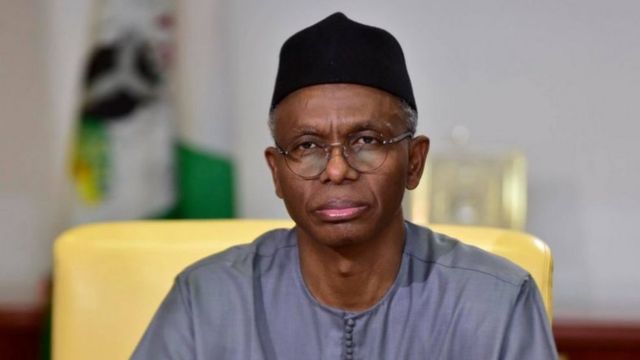
The trial of former Kaduna State Governor, Nasir El-Rufai, was on Monday stalled after two co-defendants failed to appear before a Federal High Court in Kaduna.
El-Rufai, who is standing trial on charges of alleged abuse of office, fraud, and financial misconduct filed by the Independent Corrupt Practices and Other Related Offences Commission (ICPC), was present in court for the proceedings.
The former governor arrived at the court alongside officials of the ICPC, operatives of the Department of State Services (DSS), and police personnel.
However, the court could not proceed with the case due to the absence of the two co-defendants, leading to an adjournment.
The matter was subsequently adjourned to June 28, 2026, for continuation of the hearing.
El-Rufai has consistently denied all allegations against him, while prosecutors allege that public funds were improperly released for projects that were either not executed or were irregularly handled during his tenure as governor.

The Federal High Court in Abuja has ordered the Independent National Electoral Commission (INEC) to deregister the African Democratic Congress (ADC), Accord Party (AP), and three other political parties.
Justice Peter Lifu, who delivered the judgment, also directed that the order apply to the Action Peoples Party (APP), Action Alliance (AA), and Zenith Labour Party (ZLP).
The ruling stemmed from a suit marked FHC/ABJ/CS/2637/2026, filed by the National Forum of Former Legislators.
In the suit, the plaintiffs asked the court to determine whether INEC has a constitutional obligation to deregister political parties that fail to meet the performance thresholds set out in Section 225A of the 1999 Constitution (as amended), the Electoral Act 2022, and INEC regulations.
According to the former legislators, the five political parties had consistently failed to meet the required constitutional benchmarks. These include winning at least 25 percent of votes in a state during a presidential election or securing at least one elective seat at the national, state, or local government level.
They further told the court that the ADC and the four other parties performed poorly in the 2023 general elections and subsequent by-elections, failing to secure seats across key tiers of government. The plaintiffs argued that the continued recognition of the parties is unlawful and undermines the integrity of Nigeria’s electoral system.
On that basis, they urged the court to declare that INEC is duty-bound to deregister such parties and compel the commission to do so before preparations for the 2027 elections progress further. They also sought, and obtained, an order restraining the affected parties from participating in elections or engaging in political activities such as campaigns, rallies, and primaries.
Additionally, the suit sought an injunction barring INEC from recognizing or dealing with the parties in any official capacity.

The Borno, Oyo and Kebbi State Governments has declared Tuesday a public holiday to commorate the first day of the Islamic Calender Year, 1448 after Hijira.
The year 1448 AH (Anno Hegirae) is the current year in the Islamic calendar.
Since the Hijri calendar is based on lunar cycles, it is approximately 11 to 12 days shorter than the Gregorian calendar.
As a result, the year 1448 AH overlaps parts of both the 2026 and 2027 Gregorian calendar years.
In a statement released on Sunday, the state Commissioner for Information and Internal Security, Usman Tar urged residents to use the period to rededicate themselves to peaceful co-existance and service to humanity and development.
The statement reads “This is to inform the general public that His Excellency, the Executive Governor of Borno State, Prof. Babagana Umara Zulum, CON, mni, FNSE, has declared Tuesday 1st Day of Muharram 1448 After Hijira (AH), which is equivalent to Tuesday 16th June 2026 as a Public Holiday to commerate the first day of the Islamic Calender Year 1448 (AH).
“All citizens are therefore enjoined to be faithful and reflect on this important date and rededicate themselves to peaceful co-existance and service to humanity and development of our dear state in particular” he stated.
Tar also enjoined citizens to embrace the virtues of unity, solidarity, togetherness, tolerance, justice, mercy and multiculturalism that are essential to ensuring unity in diversity and unity of mankind.
“The Government and good people of Borno are committed to the unity, prosperity and existence of Nigeria, and to projecting Nigeria’s good image among the comity of nations in a globalised universe” he noted.
The commissioner said Governor Zulum enjoined the people of the state to pray for a peaceful, plural democratic entity, calling on all communities and faith groups to live in harmony and togetherness.
The Oyo State Government has declared Tuesday, June 16, 2026, as a public holiday.
This was made known in a circular signed by the Secretary to the State Government (SSG), Prof. Musibau Adetunji Babatunde, and made available to newsmen on Monday.
According to the release, the work-free day is in honour of the Hijrah 1448AH celebration across the world. The government urged the citizens, especially Muslim faithful, to use the occasion to pray for the continued peace, unity, and progress of the state and the country in general.


BREAKING: Niger Governor, Bago Declares One-Day Public Holiday

BREAKING: Kenneth Okonkwo Dumps Atiku, Gives Shocking Reason

Popular ADC Supporter Withdraws Support For Atiku, Cites Reasons

Former Super Eagles Star Loses Life Savings, Duped By A Pastor of ₦1.2 Billion

I’m A Married Man, I Can Never Get Myself Involved With Such A Thing, Delta Gov Aide Reveals Why He Offered Comfort ₦500,000 Job

Lagos Imposes ₦250,000 Fine For Illegal Waste Disposal

-
 Politics1 day ago
REVEALED: 48 Powerful Lawmakers Who Lost APC Primaries (FULL LIST)
-

 News5 hours ago
Nigerian Government Announces June 16 Public Holiday
-
 Politics1 day ago
No Going Back: APC Declares Primaries Result Ahead 2027 Elections
-

 Uncategorized2 days ago
BREAKING: PDP Takes Early Lead Over APC in LG Election Results
-

 News1 day ago
Fresh Tension as Bandits Kidnap Monarch, Shot Wife
-
Politics9 hours ago
FULL LIST: APC Governorship Candidates for 2027 Elections Emerge
-
 Politics3 hours ago
BREAKING: Kenneth Okonkwo Dumps Atiku, Gives Shocking Reason
-

 Business1 day ago
No More N2.400/kg: Cooking Gas Landing Cost Crashes, as Dealers Release Fresh Prices