
News
Walkout Rocks House As State Police Bill Passes

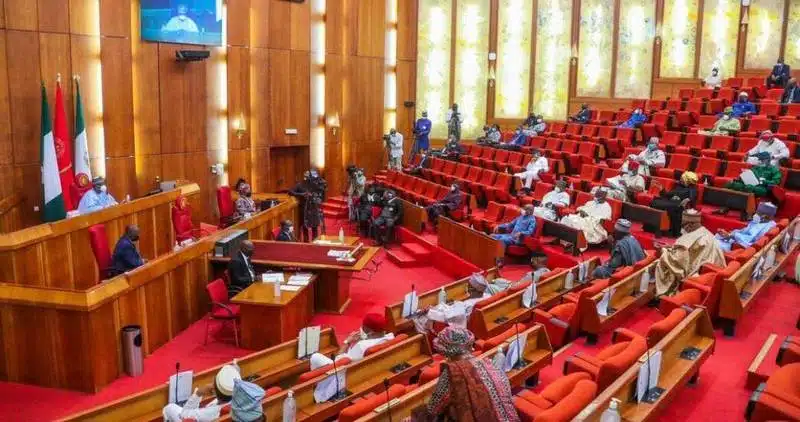
The House of Representatives on Thursday approved the Constitution Alteration Bill seeking to establish State Police across Nigeria, despite a protest and walkout by members of the minority caucus, who argued that the legal framework required further refinement and that the constitutional amendment process was not properly followed.
The bill, titled “A Bill for an Act to alter the Constitution of the Federal Republic of Nigeria, 1999 to provide for the establishment of state police services and for related matters,” secured the constitutionally required two-thirds majority after consideration by the House.
The legislation was transmitted to the National Assembly by President Bola Tinubu as part of the administration’s efforts to decentralise policing and strengthen the country’s security architecture amid persistent insecurity across several parts of Nigeria.
If it is harmonised with the Senate version, approved by at least two-thirds of the 36 state Houses of Assembly and assented to by the President in line with constitutional requirements for constitutional amendments, the legislation will create the constitutional basis for the establishment of State Police Services.
Presenting the report of the House Committee on Constitution Review, Deputy Speaker and Committee Chairman, Benjamin Kalu, described the proposal as one of the most significant constitutional reforms in Nigeria’s security sector.
He commended President Tinubu for transmitting the executive bill, saying it reflected constructive cooperation between the executive and legislative arms of government.
According to him, the amendment is designed to bring policing closer to the people, improve intelligence gathering, strengthen community policing and enable state governments respond more effectively to evolving security threats.

“This bill is not merely about creating another policing institution. It is about bringing policing closer to the people, strengthening intelligence gathering, enhancing community policing, improving coordination among security agencies and empowering governments to respond more effectively to the complex and evolving security challenges confronting our nation,” Kalu said.
He acknowledged that the proposal might not satisfy every stakeholder but argued that constitutional reform is an incremental process.
According to him, the amendment only establishes the constitutional foundation for State Police, while critical implementation issues—including recruitment, training, operational standards, funding, accountability and intergovernmental coordination—would be addressed through subsequent legislation.
“We must not allow the pursuit of perfection to become the enemy of meaningful progress,” he added, urging lawmakers to support what he described as a historic reform.
Controversy over voting
Proceedings, however, took a dramatic turn during the Committee of the Whole.
Rather than conducting a clause-by-clause consideration and vote, as is customary for constitutional amendment bills, the Speaker, Tajudeen Abbas read the long title of the bill before putting it to a voice vote.
Before the vote, Abbas announced that 311 lawmakers had indicated support for the legislation. According to him, the figure comprised 211 members of the All Progressives Congress, 65 lawmakers from other political parties physically present in the chamber and 35 members participating virtually through the House’s electronic platform.
He explained that the Constitution requires the support of at least two-thirds of the 360-member House—240 votes—for a constitutional amendment to succeed.
Rowdy session
Many Opposition lawmakers staged a walkout in protest over what they described as a breach of parliamentary procedure.
The protest followed the Speaker of the House, Tajudeen Abbas’ decision to put the bill to a voice vote without reading and considering each of its 26 clauses individually, despite attempts by members of the minority caucus to raise objections.
The Minority Leader, Frederick Agbedi, repeatedly sought to raise a point of order during the proceedings but was not recognised by the Speaker.
Rather than subject each clause of the bill to separate consideration and voting, Abbas called for a voice vote, asking members in support of the state police bill to say “aye” and those against it to say “nay.”
After declaring that the “ayes” had prevailed, the Speaker’s ruling prompted members of the minority caucus to stage a walkout from the Green Chamber in protest.
This turned the session into a chaotic situation with the Speaker repeatedly hitting the gavel to in a bid to bring semblance of order.
Minority faults process
Addressing journalists after the walkout, the minority caucus spokesman, Afam Ogene, questioned both the method used to determine the number of members present and the voting procedure adopted by the House.
He argued that the attendance register signed by lawmakers at the commencement of plenary remains the only legitimate means of determining quorum.
“We were shocked to hear names being read out that we do not know where they came from. The way of determining members present in a sitting is through the register. That is why members sign it every legislative day,” Ogene said.
He further alleged that the Speaker, while presiding over the Committee of the Whole, disregarded the provisions of Section 9(2) of the 1999 Constitution by denying lawmakers the opportunity to consider and amend the bill clause by clause.
The Minority Leader, Frederick Agbedi, insisted that the caucus supports the creation of State Police but opposed what it described as a failure to comply with due legislative process.
“We are not against state police. Whatever will help address insecurity in this country, we will support. But every action of Parliament must follow due process,” Agbedi said.
He argued that the House Standing Orders require every clause of a constitutional amendment bill to be considered and approved separately by a two-thirds majority.
According to him, lawmakers were denied the opportunity to scrutinise individual provisions of the bill or move amendments before the legislation was passed.
Agbedi also alleged that he was prevented from raising a constitutional point of order before being ruled out of order by the Chair.
“If we walked out of the chamber, where then did our votes come from? Can anyone count our votes? Can a constitutional amendment be decided by a voice vote?
“The Constitution and our Standing Orders require a two-thirds majority for each clause,” he argued. He maintained that the protest was aimed at defending parliamentary integrity and the rule of law rather than opposing State Police.
Further review
In a letter dated July 22, 2026 and addressed to the Speaker, the minority caucus reiterated its support for state police but argued that the current constitutional framework contains significant legal and institutional gaps.
Signed by Ogene, the letter urged the House leadership to recommit the bill for further legislative work to address what it described as constitutional ambiguities, drafting inconsistencies, jurisdictional uncertainties, governance gaps and unresolved institutional issues.
“The minority caucus unequivocally supports the principle of state police. Our concern is not against state police; it is against adopting an incomplete constitutional framework,” the letter read in part
The lawmakers warned that constitutional amendments establish permanent institutions and therefore require the highest level of legislative scrutiny to avoid future legal disputes and operational challenges.
Funding concerns
The caucus said in the letter, “One of the most serious concerns arising from the proposed reform is the financial burden that the establishment and efficient operation of state police will place on state governments. The establishment of state police will transfer a significant part of the policing responsibility presently undertaken and financed by the Federal Government to state governments.”
In its recommendations, the Agbedi-led caucus called for a restructuring of Nigeria’s fiscal framework to ensure states have the financial capacity to fund state police.
It recommended that “15 per cent of the Federation Account allocation currently accruing to the Federal Government be transferred to the states to finance policing responsibilities.”
According to the caucus, “devolving policing powers without corresponding financial resources would amount to creating an unfunded constitutional mandate.”
Security experts, lawyers
The lawmakers urged the Speaker to suspend the immediate adoption of the bill and recommit it for a limited technical review involving constitutional lawyers, security experts, state governments, fiscal authorities and other relevant stakeholders.
They maintained that their intervention was intended to strengthen—not frustrate—the establishment of state police. “Nigeria deserves the right state police framework that is constitutionally sound, adequately funded and capable of withstanding future legal and operational challenges,” the caucus added.
The debate over state police has remained one of Nigeria’s most contentious constitutional issues for more than two decades. Successive administrations, security experts and state governors have argued that the country’s highly centralised policing structure has become increasingly inadequate in responding to rising insecurity, including banditry, kidnapping, terrorism and communal violence.
Supporters of state police contend that decentralising law enforcement would improve intelligence gathering, strengthen community policing and enable faster responses to local security threats.
Opponents, however, have consistently warned that state-controlled police could be abused by governors for political purposes, particularly during elections, while concerns also persist over the ability of many states to finance and sustain independent police services.
The House’s approval marks a major legislative milestone for the proposal. However, the constitutional amendment must still secure passage in the Senate and receive approval from at least 24 state Houses of Assembly before it can become part of the Constitution.
Dirisu Yakubu

Nigerian federal workers are awaiting their salary payments following a social media post claiming that state government workers have received their salaries, with federal workers expected to be paid from Monday.
The update was shared by Naija Updates in the IPPIS Salary Discussion Group on Facebook, where the post announced that state workers had been paid and urged federal workers to anticipate their own payments.
The post generated engagement among Facebook users, attracting reactions and comments from members of the group interested in salary updates and workers’ welfare.
However, the claim that state workers have been paid and that federal salary payments will begin on Monday has not been independently confirmed. The post did not identify the specific states whose workers had received their salaries or provide an official statement from the Federal Government.
Federal workers are therefore advised to rely on official communications from their respective ministries, departments and agencies, as well as relevant government payroll authorities, for accurate information regarding salary disbursements.
The development comes amid continued public interest in salary payment schedules and the welfare of Nigerian workers.

President Bola Tinubu has approved the appointment of the immediate past Director-General of the Department of State Services (DSS), Yusuf Bichi, as the Chairman of the Governing Board of the National Institute for Security Studies (NISS), Lower Usuma Dam, Abuja.
Bichi’s appointment was approved by President Tinubu based on the recommendation of the current Director-General of the DSS, Oluwatosin Adeola Ajayi.
Daily Voice reports that his appointment, according to a statement on Thursday by the Director of Coordination and Liaison of the NISS, Lilian Omo-Odigwe, is for an initial four-year term, effective 22nd October, 2026.
The statement noted that Bichi’s appointment is in accordance with Section 4 of the National Institute for Security Studies (Establishment) Act, 2019.
Bichi, who will succeed A.A. Gadzama, on the Governing Board, handed over leadership of the DSS to the incumbent Director-General in August 2024.
The former DG began his career in the Security Division of the Kano State Cabinet Office before his transfer of service in 1984.
“Bichi’s appointment to Chair the NISS Board brings an extensive experience in intelligence, security administration, operational leadership and institutional training to the governance of the National Institute,” the statement added.
Meanwhile, Nollywood actress Eniola Badmus has defended her continued support for President Bola Ahmed Tinubu, saying her political stance is the reason some people criticize her.
Naija News reports that the actress made this known during an interview with Nigerian comedian and content creator Isbae U on his podcast, Curiosity Made Me Ask.
Badmus explained that the criticism she receives is largely connected to her decision to support Tinubu, adding that she remains committed to the president despite the negative reactions from some Nigerians.
The actress maintained that she would continue to stand by her political choice, regardless of public opinion.
She also noted that democracy allows people to support political candidates and parties of their choice without being attacked for their decisions.
According to Badmus, she does not condemn people for supporting politicians different from the ones she believes in, stressing that everyone should be free to make their own political decisions.



Salary: Fresh Update Emerges On Payment To Nigerian Workers

Obasanjo’s Son Picks Side In 2027 Race