News
SSS Claims IPOB Killed 200+ Security Forces In South East

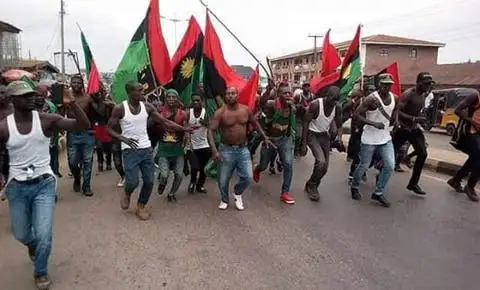
State Security Service, SSS, witness on Wednesday, told the Federal High Court in Abuja that between 170 and 200 security agents have died due to the activities of the proscribed Indigenous People of Biafra, IPOB, in the South Eastern Nigeria.
The witness, simply identified as DDD for security reasons, disclosed this before Justice James Omotosho in continuation of his testimony in the ongoing terrorism trial of Nnamdi Kanu, leader of the IPOB.
The DDD was led in evidence by the Federal Government’s lawyer, Chief Adegboyega Awomolo, SAN.
DDD, who is the 4th prosecution witness (PW-4), said the activities of IPOB and its armed wing, the Eastern Security Network, ESN, had led to the death of many security personnel in the region.
He restated that the National Broadcasting Commission, NBC, did not issue license to Kanu to import the radio transmitter he allegedly smuggled into the country to operate Radio Biafra.
He said shortly after he and members of his team recovered the transmitter from a premises in Ubuluisiuzor, Anambra, and brought it to Abuja, the SSS wrote the NBC to inspect it.
The witness told the court that on Nov. 9, 2015, the NBC sent an engineer, who inspected the transmitter and wrote a report.

Mr Awomolo then tendered a certified true copy of the provisional assessment of radio transmitter report submitted by the NBC.
DDD was asked to read a portion of the report, which he did.
He said the report indicated that the transmitter was a German made and that it was indeed a radio transmitter made for use on FM frequency.
The witness said the report also stated that such transmitter could only be procured and installed after being issued a licence and that the NBC had not licensed Radio Biafra to broadcast in Nigeria.
The PW-4 added that investigation by his team revealed that for one to operate a radio station in the country, one must apply to a regulator, who would issue a licence after due clearance by relevant security agencies.
“In this case, there was no application from the defendant. He brought in the transmitter illegally without approval,” he said.
He also said investigation was confirmed that the defendant was the owner of the transmitter, which he kept in the premises of one Benjamin Madubugu.
The witness said Kanu later came into the country and inspected the transmitter and made a video to satisfy members of the IPOB, who contributed money for the purchase of the transmitter.
He also read from some publications of the Vanguard newspaper, where it was reported that an arrested commander of ESN confessed to the activities of his group.
The witness said the ESN member, who he identified as Uzuoma Benjamin, aka Onye Army, spoke about how he was recruited and how they allegedly received directives from the defendant.
He allege that the defendant directed them to kill security agents and ensure that a deceased member of the group, Ikonso, was buried with 2000 human heads.
The witness also read where the said Onye Army claimed that he and other members of his group used the heads of 10 girls to prepare charms for their protection.
He said investigation revealed that the invasion of Owerri prison by IPOB members was directed by Kanu in one of his broadcast for his followers to attack and kill security operatives of the Federal Government of Nigeria.
DDD said further investigation revealed that the defendant, in his broadcast directed that Ikonso should be buried with 2000 heads, but that only 30 were gotten.
He said when the SSS requested from the police to access Onye Army, the police claimed he had escaped from custody.
He said during one of SSS’ agents’ raid of ESN members’ hideout, “we saw some ESN members, about seven, with human heads and some eating human flesh, which they said was for spiritual fortification.
“We could not find Onye Army. The police said he had escaped from custody.”
He said there were records about the number of security agents allegedly killed in the South East and that the number stood between 170 and 200.
The witness who said two SSS officials, including his driver, were among the victims, said it cut across all security agencies.
On how the ESN members operate, the witness said they are combatants, who carry arms and attacked homes of prominent individuals and traditional rulers in the region.
He said because they lacked sufficient operational tools, they sometimes set up roadblocks during which they hijack vehicles for their operation.
The witness identified some public property which he said IPOB and ESN members attacked and destroyed in the South East, including police stations.
He also gave details of how the late Ahmed Gulak, the former aide to ex-President Goodluck Jonathan, was killed on May 30, 2021 in Owerri, Imo.
On how Gulak died, the witness said he was among the first responders to the scene where the late chieftain of the Peoples Democratic Party, PDP, was killed and his corpse recovered.
He said on May 30, 2021, there was a total breakdown of law and order, as a result of the stay-at-home order declared by the defendant, through one of his broadcasts.
The witness said later that day, one of his officers informed him that a prominent politician was killed around Obiagwu and that when they got to the spot, they saw what happened.
He said the Divisional Police Officer, DPO, in the area told him that Gulak was in a hired cab when he was killed by IPOB some members.
The PW-4 said the driver told him that they were heading to the airport from Owerri town, when they saw a check point mounted by men of the Nigerian Air Force who were preventing people from accessing the airport, but decided to take another route where they ran into a check point by IPOB members.
He added that the driver further said the IPOB members ordered the three of them in the car to disembark, and demanded to know their tribes.
He said the driver told him he introduced himself as an Igbo person and that Gulak also said he was an Igbo man.
But that while he (the driver) could speak the Igbo language when they were asked to speak in Igbo, Gulak could not, following which they asked him to remove his cap and saw a Muslim prayer marked on his forehead.
The witness said the driver added that upon seeing the prayer marked, one of the IPOB members said “he is one of them,” following which they shot and killed him.
The SSS official, who said he served In Imo between 2019 and 2023, told the court that the deceased’s corpse was evacuated from the spot where he was killed in the witness’ car.
When he was being cross examined by defence lawyer, Onyechi Ikpeazu, SAN, the witness said there was no record of the importation of the transmitter said to have been smuggled in to the country by Kanu.
He said he could not say when the transmitter was brought into the country, but that he was among those who located where it was kept in Anambra and brought it to the DSS headquarters in Abuja.
On how they were able to locate the transmitter, the witness said his team used some equipment to analyse a video (showing Kanu inspecting the transmitter) to ascertain the location of the transmitter in Anambra.
He said he did not come across the names Benka Clearing and Forwarding and Chief Isaac Maduka in the course of investigation.
He also said he was not aware that Benka cleared the transmitter, as claimed by Ikpeazu.
When asked if he was aware that Radio Biafra was registered in London and broadcast from there, the witness said when Kanu was arrested in Lagos in 2016, he was arrested with his broadcast equipments.
He said he was not present when the defendant was arrested in Lagos and that all he said about his arrest in Lagos was what were relayed to him.
The witness said the two guns found were not recovered in the container in which the transmitter was kept, but under the mattress of Benjamin Madubugu, who lived in the premises.
The PW-4 said that Madubugu was later charged with unlawful possession of firearms.
The witness said the container was brought into the country by one Igwe Anyiba, who was later found to be living outside the country.
He said he was not aware that the Imo Government issued a statement to the effect that Gulak’s killing was political.
After DDD concluded his evidence, Justice Omotosho discharged him from the witness box and adjourned until June 19 for continuation of trial.
Dailynigeria.com


Nigerian federal workers are awaiting their salary payments following a social media post claiming that state government workers have received their salaries, with federal workers expected to be paid from Monday.
The update was shared by Naija Updates in the IPPIS Salary Discussion Group on Facebook, where the post announced that state workers had been paid and urged federal workers to anticipate their own payments.
The post generated engagement among Facebook users, attracting reactions and comments from members of the group interested in salary updates and workers’ welfare.
However, the claim that state workers have been paid and that federal salary payments will begin on Monday has not been independently confirmed. The post did not identify the specific states whose workers had received their salaries or provide an official statement from the Federal Government.
Federal workers are therefore advised to rely on official communications from their respective ministries, departments and agencies, as well as relevant government payroll authorities, for accurate information regarding salary disbursements.
The development comes amid continued public interest in salary payment schedules and the welfare of Nigerian workers.
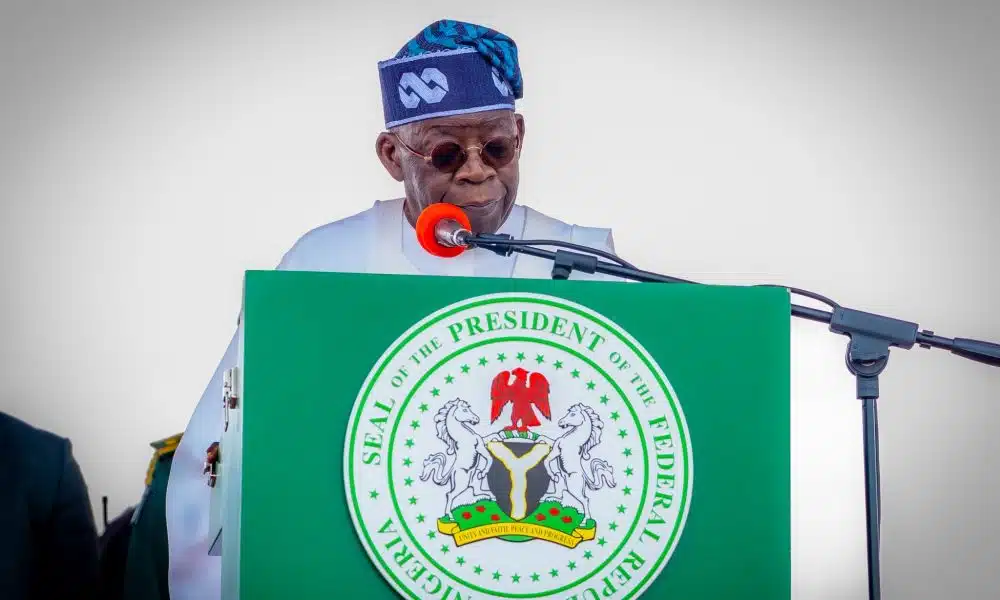
President Bola Tinubu has approved the appointment of the immediate past Director-General of the Department of State Services (DSS), Yusuf Bichi, as the Chairman of the Governing Board of the National Institute for Security Studies (NISS), Lower Usuma Dam, Abuja.
Bichi’s appointment was approved by President Tinubu based on the recommendation of the current Director-General of the DSS, Oluwatosin Adeola Ajayi.
Daily Voice reports that his appointment, according to a statement on Thursday by the Director of Coordination and Liaison of the NISS, Lilian Omo-Odigwe, is for an initial four-year term, effective 22nd October, 2026.
The statement noted that Bichi’s appointment is in accordance with Section 4 of the National Institute for Security Studies (Establishment) Act, 2019.
Bichi, who will succeed A.A. Gadzama, on the Governing Board, handed over leadership of the DSS to the incumbent Director-General in August 2024.
The former DG began his career in the Security Division of the Kano State Cabinet Office before his transfer of service in 1984.
“Bichi’s appointment to Chair the NISS Board brings an extensive experience in intelligence, security administration, operational leadership and institutional training to the governance of the National Institute,” the statement added.
Meanwhile, Nollywood actress Eniola Badmus has defended her continued support for President Bola Ahmed Tinubu, saying her political stance is the reason some people criticize her.
Naija News reports that the actress made this known during an interview with Nigerian comedian and content creator Isbae U on his podcast, Curiosity Made Me Ask.
Badmus explained that the criticism she receives is largely connected to her decision to support Tinubu, adding that she remains committed to the president despite the negative reactions from some Nigerians.
The actress maintained that she would continue to stand by her political choice, regardless of public opinion.
She also noted that democracy allows people to support political candidates and parties of their choice without being attacked for their decisions.
According to Badmus, she does not condemn people for supporting politicians different from the ones she believes in, stressing that everyone should be free to make their own political decisions.


Salary: Fresh Update Emerges On Payment To Nigerian Workers

Obasanjo’s Son Picks Side In 2027 Race