
Politics
Judgement: Jonathan Can Run For 2027 Presidential Election

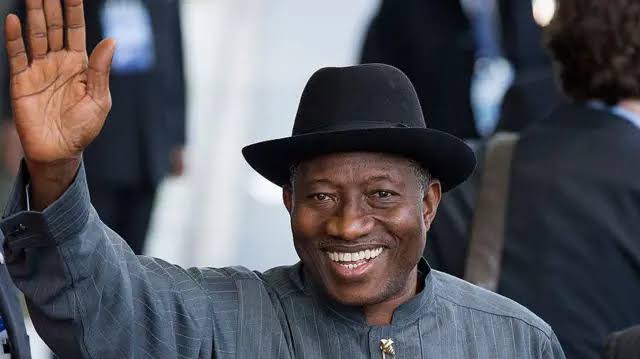
As the possibility of former President Goodluck Jonathan contesting the 2027 presidential election continues to heat up political discussions, a previously unpublished judgment delivered by a Federal High Court in Yenagoa, Bayelsa State, affirmed that Jonathan was well qualified to contest presidential election.
Two members of the APC in Bayelsa had gone to court in 2022 to determine Jonathan’s position, given the high stakes northern lobby to mobilise Jonathan to replace late President Muhammadu Buhari before the now President Tinubu eventually clinched the APC ticket.
Aides to the former President said he is still consulting on whether to throw his hat in the ring for 2027. Sources close to the former President told THISDAY last night, that he has been approached by three political parties – each wanting him to contest the presidency on their platforms. The Peoples Democratic Party, PDP, the New Nigeria Peoples Party, NNPP and the recently formed coalition, the African Democratic Congress, ADC – all jostling for the former President who many see as one of the most viable candidates that can give the incumbent President Bola Ahmed Tinubu a good run for his money.
This calculation is based on the fact that Jonathan can only legally seek one more term and could assuage the feelings of northern voters who accuse President Tinubu of marginalisation.
A claim that the presidency has vigorously denied.
The judgment delivered by Justice Isah Dashem of the Federal High Court, Yenagoa, on May 27, 2022 but obtained by THISDAY yesterday, put to rest the contentious constitutional amendment of Section 137(1)(b) and 3, as it affects Jonathan.
Various analysts led by the Minister of Aviation and Aerospace Development and Learned Silk, Festus Keyamo, had claimed that the PDP may put its presidential chances in 2027 at “risk” should they field Jonathan going by the provisions of the above section from the amended Constitution in 2018. However, Keyamo did not disclose or was unaware of the judgement of Justice Dashem.
The judgment, which has not been appealed or set aside remains subsisting. And it is now out of time for any appeal after 3 years since it was delivered
In the 2022 suit with number: FHC/YNG/CS/86/2022, the two APC members sued Jonathan, APC and the Independent National Electoral Commission (INEC), over rumour that the APC had planned to field the former president as its presidential candidate in the 2023 general elections.
Their grouse was that Jonathan’s participation would ruin the chances of the APC having taking oath of office twice as president.
The sole issue raised for determination was “Whether, in view of the provisions of | Section 137(1)(b) and (3) of the Constitution of the Federal Republic of Nigeria 1999 (as altered) and the fact that Jonathan had earlier been sworn-in as the President of the Federal Republic of Nigeria in 2010 and 2011 respectively, whether he is qualified to contest for the office of the President of the Federal Republic of Nigeria in the 2023 General Elections to be organized by the 3rd Defendant.”
The plaintiffs, Andy Solomon and Idibiye Abraham, through their lawyer, Seigha Egbuwabe, further urged that if the answer to (1) above was in the negative, then the court should determine “Whether the no 2” Defendant was entitled to field the 1st Defendant as its Presidential Candidate in the 2023 General Elections”.
The court was also to determine, “Whether the 3rd Defendant is entitled to disqualify the 1st Defendant from contesting and/or from being presented as the 2nd Defendant Presidential Candidate in the 2023 General Elections.”
Dashem, after taking arguments from plaintiffs’ lawyer and Jonathan, who was represented by Eric Omare, held that Jonathan was eminently qualified to contest in 2023.
Before arriving at the conclusion, Dashem observed that Jonathan was elected first as president in 2011.
“The office into which the ‘election’ stated in Section 137(1)(b) of the Constitution applies to the Office of the President of the Federal Republic of Nigeria and not into the Office of the Vice President. I have perused the entirety of the Plaintiffs supporting affidavit and Written Address and I am unable to find where the Plaintiffs referred this Court contested apart from the elections conducted in year 2011.
“I, therefore, find the Plaintiffs’ contention that the 1st Defendant has been elected to the Office of President on Two (2) previous occasions spurious, baseless and unsubstantiated.
“And I so hold.”
He clarified that although elections into the offices of President and Vice President were conducted simultaneously and upon a joint ticket submitted by a political party, such as the 2nd Defendant, to the 3rd Defendant, the positions of President and Vice President were two different offices.
According to the judge, election of a person, such as the 1st Defendant, into the Office of the Vice President is not the same as his election into the Office of the President and vice-versa.
The judge stated, “A person who is elected into the Office of Vice President cannot by virtue of such election simpliciter, occupy the position of the President of the Federal Republic of Nigeria. I so hold.
“As I have noted above, the Plaintiff did not file a Reply Affidavit to dispute the facts contained in paragraphs 4(i) — (y) of the 1st Defendant’s Counter Affidavit. The legal implication of this failure is that the contentions of the 1st Defendant are deemed to be true.
“In the final analysis, I find that, the evidence before this Court points to the conclusion that the 1st Defendant has only been elected into the Office of the President of the Federal Republic of Nigeria on one (1) previous occasion, which said occasion was in the General Elections conducted in year 2011. And I so hold.
On the provisions of Section 137(3) of the Constitution, Dashem stated that Jonathan was sworn in as president in 2010, to complete the tenure of late President Umaru Yar’Adua and again in 2011, after he won the 2011 presidential election.
He agreed with Jonathan’s submissions that the said provisions, which sought to bar persons who completed another’s tenure from contesting twice, did not apply to him because the law was passed in 2018, when he already had the right to contest and contested in the 2015, general elections.
Dashem said, “As I have held above, the provisions of sub-Section (3) of Section 137 of the Constitution was not part of our Constitution prior to June 7, 2018, when same took effect. It, therefore, follows that the provisions of sub-section (3) was not the position of our law at all material times before June 7, 2018. It also follows that, prior to June 7, 2018, no restriction was placed on the number of times a person who was sworn-in to complete the term of office of a President of the Federal Republic of Nigeria can be re-elected into that Office.
“The 1st Defendant has argued that, since he acquired his right to contest and, if successful, be sworn-in as President after he lost his re-election bid, in 2025, to the current President – President Muhammadu Buhari – it would be unethical to the spirit and intendment of the legislature to take away the right he acquired in year 2015 on the basis of a law that came into effect in 2018.
“Now, the position of the law on retroactive or retrospective application of laws is quite settled. Retroactive laws are which relate or cover matters or acts which occurred before its commencement date.”
The judge added, “Despite my best efforts, I fail to see where the legislature expressed their intention, by express and unequivocal words, that the provisions of subsection (3) of Section 137 of the Constitution should be accorded retrospective application.
“In the absence of such express words, I am constrained to hold that the provisions of Section 137(3) do not enjoy retrospective application. The application and enforceability of the said subsection can only be construed to apply with effect from June 7, 2018. And I so hold.
“In my opinion, the position being propounded by the 1st Defendant is not only tenable but accords with the position of the law. It is the duty of the Plaintiffs to point or direct this Court to where the legislature stated that the provisions of Section 137(3) of the Constitution apply to events and/or rights which have been acquired and/or have been vested in parties prior to June 7, 2018.
“The law is that, he who asserts must prove. See: Section 131(1) of the Evidence Act, 2011. It therefore, behoved the Plaintiffs to provide this Court with facts to support their case. In the absence of such proof, I find that the Plaintiffs have not discharged the burden of proof placed on them by law.
“I, therefore, find merit in the argument of the 1st Defendant that the introduction of sub-section (3) of Section 137 of the Constitution does not affect his right to contest for the Office of the President of the Federal Republic of Nigeria in the 2023 General Elections and be sworn-in as such, should he be victorious at the polls.
“As I have noted above, before, in year 2015 when the 1st Defendant lost his re-election bid into the Office of the President, the restriction imposed by subsection (3) to Section 137 was not in existence. This is why the 1st Defendant despite having been sworn-in as President on May 6, 2010 and May 29, 2011, was able to contest for the Office of the President in the 2015 General Elections.
“Had the 1st Defendant been victorious at the 2015 polls, he would have been sworn-in for a third time without any legal impediment. Therefore, the 1st Defendant acquired his right to contest for the Office of the President immediately his term as President ended on May 29, 2015. Clearly, it is incontrovertible that the Ist Defendant’s right to contest and be sworn-in as President accrued to and was vested in him on May 29, 2015. And I so hold.
“In the final analysis, I answer Question 1 formulated by the Plaintiffs in their Originating Summons in the affirmative.
“I declare that, the provisions of Section 137(3) of the Constitution acquired the force of law with effect from June 7, 2018 and same does not have retrospective application.
“I also declare that, the 1st Defendant is not disqualified by the provisions of Section 137(1)(b) and (3) of the Constitution from contesting for election into the Office of the President of the Federal Republic of Nigeria in the 2023 General Elections.
“Having answered Question 1 in the affirmative, the necessity to answer Questions 2 and 3 have been obviated. However, for the avoidance of doubt, I answer Question 2 in the affirmative also whilst I answer Question 3 in the negative.
“In the final analysis, I answer questions 1 and 2 posed in the Originating Summons in favour of the 1st Defendant and question 3 in the negative and therefore against the 3rd Defendant.
“Consequently, I enter Judgement for the I Defendant and all the reliefs sought by the Plaintiffs in their Originating Summons dated May 16, 2022 (but filed on May 17, 2022) fail and are all hereby dismissed.”
-THISDAY

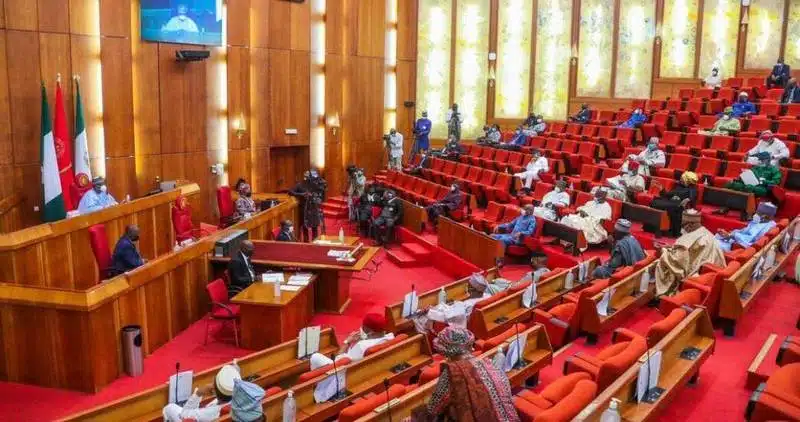
The Senate has asked President Bola Tinubu to immediately remove the Registrar General of the Corporate Affairs Commission (CAC), Hussaini Ishaq Magaji (SAN), from his office.
As reported by Nigerian Tribune, the Senate committee on finance, while passing a resolution in Abuja on Thursday, February 26, accused Magaji of failing to honour the upper legislative chamber’s invitations to account for the finances of his agency.
Senator Sani Musa, the chairman of the committee, said:
“He (Magaji) refused on so many occasions to honour our invitation to appear before this committee.
“We have issues with the reconciliation of the revenue of CAC.
“Each time we invite him, he gives us excuses.
” Magaji was appointed to this position by President Tinubu on October 13, 2023.
As the registrar-general of the CAC, Magaji is expected to work for the development and regulation of corporate affairs in Nigeria.
Meanwhile, President Tinubu on Wednesday night, February 25, formally urged the Senate to begin the process of amending the 1999 constitution to provide for the establishment of state police, declaring that Nigeria must urgently restructure its security architecture to confront terrorism, banditry and insurgency.
Speaking at an interfaith breaking of fast with the leadership and members of the Senate at the State House, Abuja, the president stated that the time had come for lawmakers to “start thinking” about embedding state policing in the constitution to enable governments at subnational levels better secure their territories.
The Nation quoted President Tinubu as saying:
“Nigeria is extremely challenged, we are facing terrorism, banditry, insurgency, but you never failed to make a right response to these calls.
“What I will ask for tonight is for you to start thinking how best to amend the Constitution to incorporate the state police for us to secure our country, take over our forests from marauders, free our children from fear.”
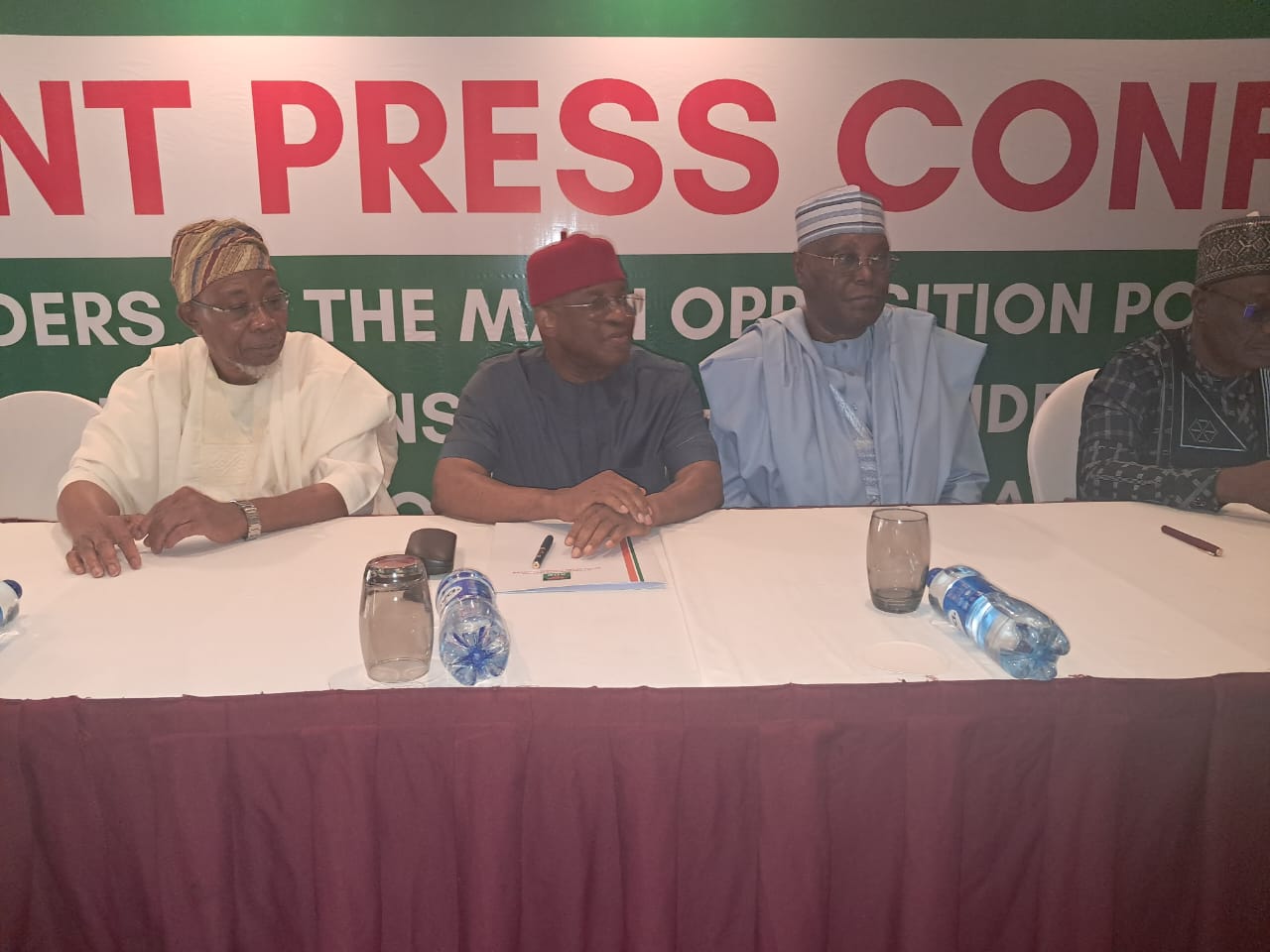
Leaders of the African Democratic Congress and the New Nigeria Peoples Party have called on the National Assembly to commence a fresh process to amend the Electoral Act.
Speaking on behalf of the opposition at a press conference in Abuja on Thursday, NNPP National Chairman, Ajuji Ahmed, urged federal lawmakers to expunge all objectionable provisions contained in the Act.
Prominent opposition figures at the meeting included former Senate President David Mark; NNPP chieftain Buba Galadima; former Vice-President Atiku Abubakar; and the 2023 presidential candidate of the Labour Party, Peter Obi.
Also in attendance at the Lagos/Osun Hall of Transcorp Hilton, Abuja, were the ADC National Secretary, Rauf Aregbesola; former Rivers State Governor Rotimi Amaechi; and the party’s National Publicity Secretary, Bolaji Abdullahi, alongside other stakeholders.
Others present included Senator Dino Melaye, former ADC National Chairman Ralph Nwosu, and former Cross River State Governor Liyel Imoke, among several dignitaries.
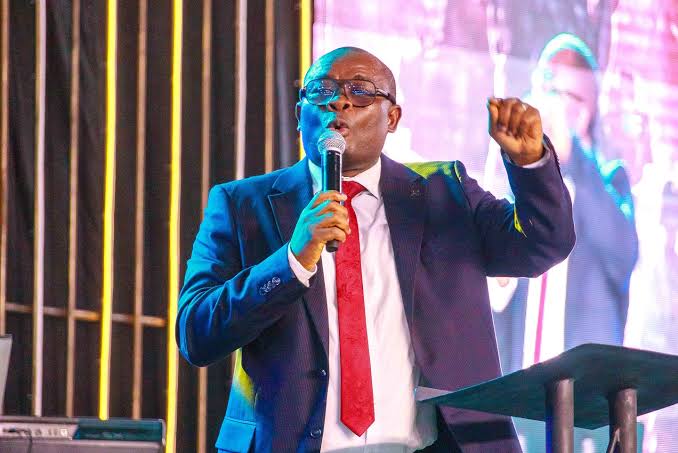
The Bayelsa state house of assembly has approved the appointment of Peter Akpe as the deputy governor of the state.
Akpe, a pastor, served as chief of staff to Douye Diri, governor of Bayelsa, prior to his nomination.
Ordained clergy by the Redeemed Christian Church of God (RCCG), Akpe has had a career spanning the civil service and politics.
He served in the Rivers and Bayelsa state civil services before transitioning fully into politics.
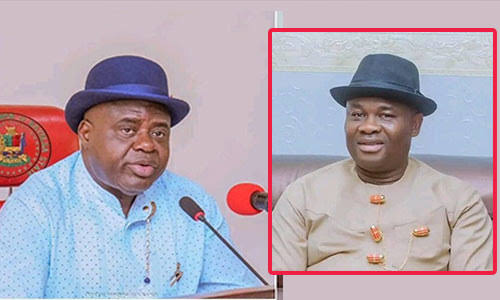
Akpe was a two-term member of the Bayelsa state house of assembly from 2011 to 2019, serving as majority leader throughout his stint in the legislature.
He also served as commissioner between 2008 and 2011 under the Seriake Dickson administration.
The approval clears the way for his swearing-in as deputy governor.
Akpe’s appointment follows the death of Lawrence Ewhrudjakpo, the former deputy governor, who passed on last December.


BREAKING: “Serial Disrespect” Sparks Drama As Senate Order Arrest Of Tinubu’s Appointee

Edo State To Spend N1billion On Armoured Car For Speaker, N4.6billion On Vehicles For Lawmakers

Opposition Leaders Urge N’Assembly To Begin Fresh Electoral Act Amendment

Former Super Eagles Star Loses Life Savings, Duped By A Pastor of ₦1.2 Billion

These ’90s fashion trends are making a comeback in 2017

I’m A Married Man, I Can Never Get Myself Involved With Such A Thing, Delta Gov Aide Reveals Why He Offered Comfort ₦500,000 Job
-

 Business2 days ago
JUST IN: 13 Banks May Shut Down In March As CBN Confirms 20 Safe For Recapitalisation Deadline
-
 Politics16 hours ago
BREAKING: “Serial Disrespect” Sparks Drama As Senate Order Arrest Of Tinubu’s Appointee
-
 Opinion16 hours ago
Edo State To Spend N1billion On Armoured Car For Speaker, N4.6billion On Vehicles For Lawmakers
-
 Politics16 hours ago
Opposition Leaders Urge N’Assembly To Begin Fresh Electoral Act Amendment