
Politics
Gowon Reflects On Aburi, Blames Ojukwu Misinterpretation

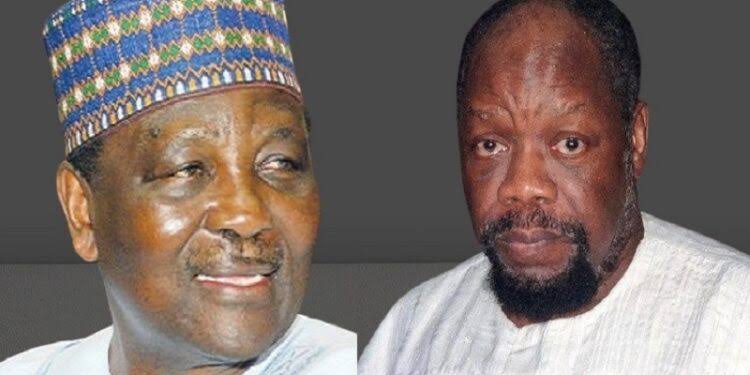
Former Nigerian Head of State General Yakubu Gowon has shed new light on the collapse of the historic Aburi Accord, claiming that his eastern counterpart, Chukwuemeka Odumegwu Ojukwu, misrepresented the terms of the agreement in a manner that derailed hopes of national unity and contributed to the outbreak of the Nigerian Civil War.
Speaking during an interview on Arise Television on Wednesday, Gowon recounted the tense atmosphere that followed the January 1967 peace talks held in Aburi, Ghana. The talks were convened to ease the political crisis threatening to splinter Nigeria in the aftermath of two coups and growing regional mistrust.
Gowon (the head of state) and Ojukwu (then military governor of the Eastern Region), were key players in the discussions.
Gowon said that while the intent of the Aburi meeting was to return home and finalize the resolutions together, Ojukwu immediately made public pronouncements that, according to him, were not aligned with what was actually agreed upon.
“We just went there, as far as we were concerned, to meet as officers and then agree to get back home and resolve the problem at home. That was my understanding,” Gowon said. “But that was not his (Ojukwu’s) understanding.”
The retired general, who led Nigeria from 1966 to 1975, said he fell seriously ill with fever shortly after returning from Aburi, which prevented him from immediately engaging in follow-up deliberations. During that time, he claimed Ojukwu moved quickly to present a version of the accord that surprised many of his fellow officers.
“I don’t know where he got his version from,” Gowon said, a note of bewilderment in his voice.
At the heart of the disagreement, according to Gowon, was the issue of military control. Ojukwu, he alleged, proposed that regional military zones be placed under the command of regional governors, a structure that would have effectively decentralized control of the armed forces.
“That was one of the major issues,” Gowon explained. “We said that the military would be zoned, but he wanted those zones to be commanded by the governor of each region. Of course, we did not agree with that one.”
Gowon also noted that a follow-up meeting was arranged in Benin City to clarify lingering ambiguities in the agreement. All regional leaders, including Ojukwu, were invited. But the Eastern Region governor declined, citing security concerns.
“We needed to review and agree collectively on the next steps. But he refused to come,” Gowon said.
The Aburi meeting, held from January 4–5, 1967, was one of the last-ditch efforts to preserve Nigeria’s unity in the face of mounting ethnic tensions, military mutinies, and regional secessionist sentiment. Both federal and eastern delegates agreed in principle that regions should have autonomy in managing their affairs, but the specifics, especially regarding the chain of command and national sovereignty, remained contentious.
The failure to implement the accord ultimately paved the way for the declaration of the Republic of Biafra on May 30, 1967, by Ojukwu and the onset of a brutal civil war six weeks later. The conflict, which lasted until January 15, 1970, claimed an estimated one to three million lives, many from starvation in the war-ravaged eastern region.
Though more than five decades have passed since the accord and the war, interpretations of Aburi remain divisive. To some, it symbolized a missed opportunity for a more decentralized, federal Nigeria. To others, it exposed the fault lines and distrust that no agreement, however well-intentioned, could mend.
Ojukwu, the man at the centre of that critical moment in Nigerian history, died in 2011 at the age of 78. His legacy, like that of Aburi, remains both revered and contested.
For Gowon, now in his 80s, the lessons of that era still resonate. “We wanted peace,” he said in the interview. “But peace must come with clarity and shared understanding. That, sadly, is where we fell short.”
Ripplesnigeria.com



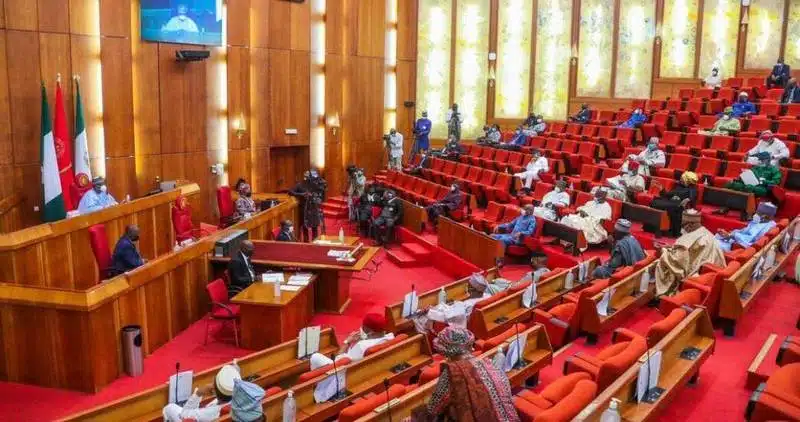
The Senate has asked President Bola Tinubu to immediately remove the Registrar General of the Corporate Affairs Commission (CAC), Hussaini Ishaq Magaji (SAN), from his office.
As reported by Nigerian Tribune, the Senate committee on finance, while passing a resolution in Abuja on Thursday, February 26, accused Magaji of failing to honour the upper legislative chamber’s invitations to account for the finances of his agency.
Senator Sani Musa, the chairman of the committee, said:
“He (Magaji) refused on so many occasions to honour our invitation to appear before this committee.
“We have issues with the reconciliation of the revenue of CAC.
“Each time we invite him, he gives us excuses.
” Magaji was appointed to this position by President Tinubu on October 13, 2023.
As the registrar-general of the CAC, Magaji is expected to work for the development and regulation of corporate affairs in Nigeria.
Meanwhile, President Tinubu on Wednesday night, February 25, formally urged the Senate to begin the process of amending the 1999 constitution to provide for the establishment of state police, declaring that Nigeria must urgently restructure its security architecture to confront terrorism, banditry and insurgency.
Speaking at an interfaith breaking of fast with the leadership and members of the Senate at the State House, Abuja, the president stated that the time had come for lawmakers to “start thinking” about embedding state policing in the constitution to enable governments at subnational levels better secure their territories.
The Nation quoted President Tinubu as saying:
“Nigeria is extremely challenged, we are facing terrorism, banditry, insurgency, but you never failed to make a right response to these calls.
“What I will ask for tonight is for you to start thinking how best to amend the Constitution to incorporate the state police for us to secure our country, take over our forests from marauders, free our children from fear.”
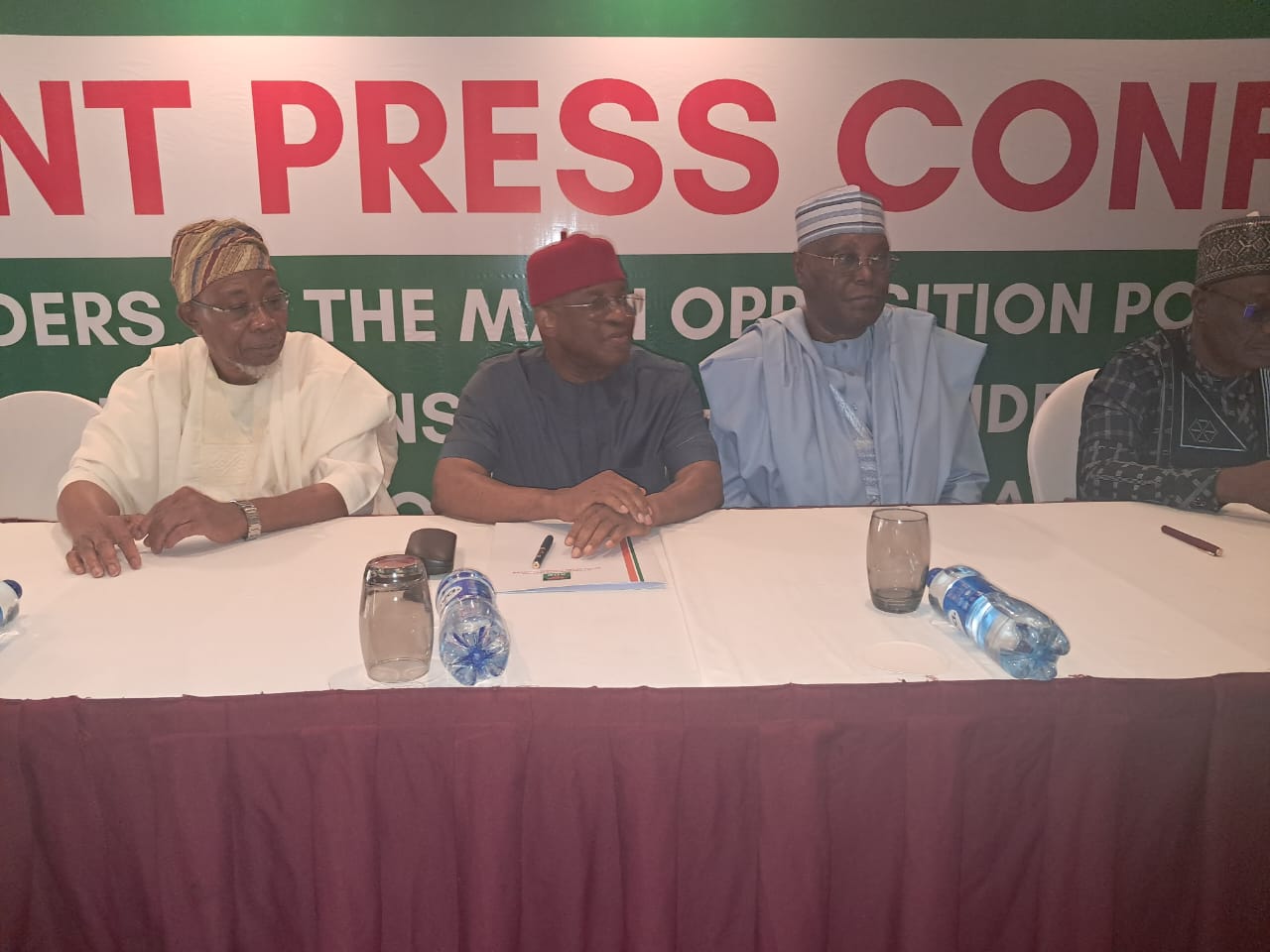
Leaders of the African Democratic Congress and the New Nigeria Peoples Party have called on the National Assembly to commence a fresh process to amend the Electoral Act.
Speaking on behalf of the opposition at a press conference in Abuja on Thursday, NNPP National Chairman, Ajuji Ahmed, urged federal lawmakers to expunge all objectionable provisions contained in the Act.
Prominent opposition figures at the meeting included former Senate President David Mark; NNPP chieftain Buba Galadima; former Vice-President Atiku Abubakar; and the 2023 presidential candidate of the Labour Party, Peter Obi.
Also in attendance at the Lagos/Osun Hall of Transcorp Hilton, Abuja, were the ADC National Secretary, Rauf Aregbesola; former Rivers State Governor Rotimi Amaechi; and the party’s National Publicity Secretary, Bolaji Abdullahi, alongside other stakeholders.
Others present included Senator Dino Melaye, former ADC National Chairman Ralph Nwosu, and former Cross River State Governor Liyel Imoke, among several dignitaries.
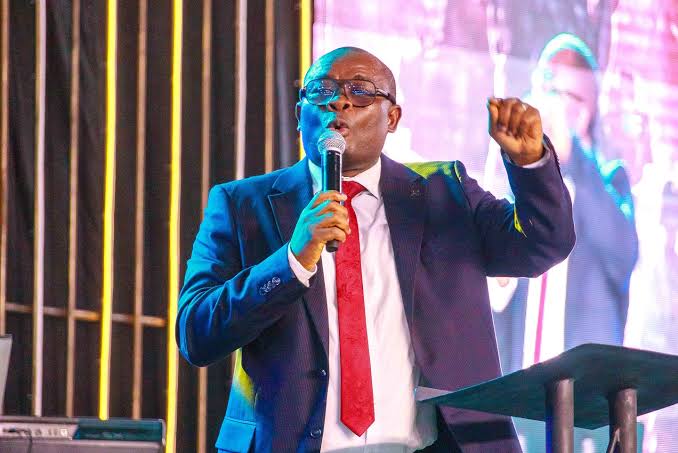
The Bayelsa state house of assembly has approved the appointment of Peter Akpe as the deputy governor of the state.
Akpe, a pastor, served as chief of staff to Douye Diri, governor of Bayelsa, prior to his nomination.
Ordained clergy by the Redeemed Christian Church of God (RCCG), Akpe has had a career spanning the civil service and politics.
He served in the Rivers and Bayelsa state civil services before transitioning fully into politics.
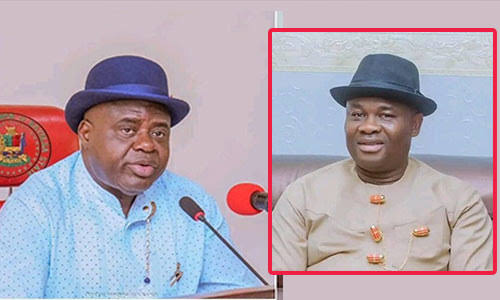
Akpe was a two-term member of the Bayelsa state house of assembly from 2011 to 2019, serving as majority leader throughout his stint in the legislature.
He also served as commissioner between 2008 and 2011 under the Seriake Dickson administration.
The approval clears the way for his swearing-in as deputy governor.
Akpe’s appointment follows the death of Lawrence Ewhrudjakpo, the former deputy governor, who passed on last December.


BREAKING: “Serial Disrespect” Sparks Drama As Senate Order Arrest Of Tinubu’s Appointee

Edo State To Spend N1billion On Armoured Car For Speaker, N4.6billion On Vehicles For Lawmakers

Opposition Leaders Urge N’Assembly To Begin Fresh Electoral Act Amendment

Former Super Eagles Star Loses Life Savings, Duped By A Pastor of ₦1.2 Billion

These ’90s fashion trends are making a comeback in 2017

I’m A Married Man, I Can Never Get Myself Involved With Such A Thing, Delta Gov Aide Reveals Why He Offered Comfort ₦500,000 Job
-
 Politics2 days ago
Assembly Confirms Popular Redeemed Pastor As Deputy Governor
-

 Foreign2 days ago
Cabinet Reshuffle: President Sacks Finance Minister
-

 Business2 days ago
JUST IN: 13 Banks May Shut Down In March As CBN Confirms 20 Safe For Recapitalisation Deadline
-
 Politics12 hours ago
BREAKING: “Serial Disrespect” Sparks Drama As Senate Order Arrest Of Tinubu’s Appointee
-
 Politics12 hours ago
Opposition Leaders Urge N’Assembly To Begin Fresh Electoral Act Amendment
-
 Opinion12 hours ago
Edo State To Spend N1billion On Armoured Car For Speaker, N4.6billion On Vehicles For Lawmakers